
THE EXTRA CHAIR
Grief is easier to survive when everyone agrees not to name what’s sitting at the table.

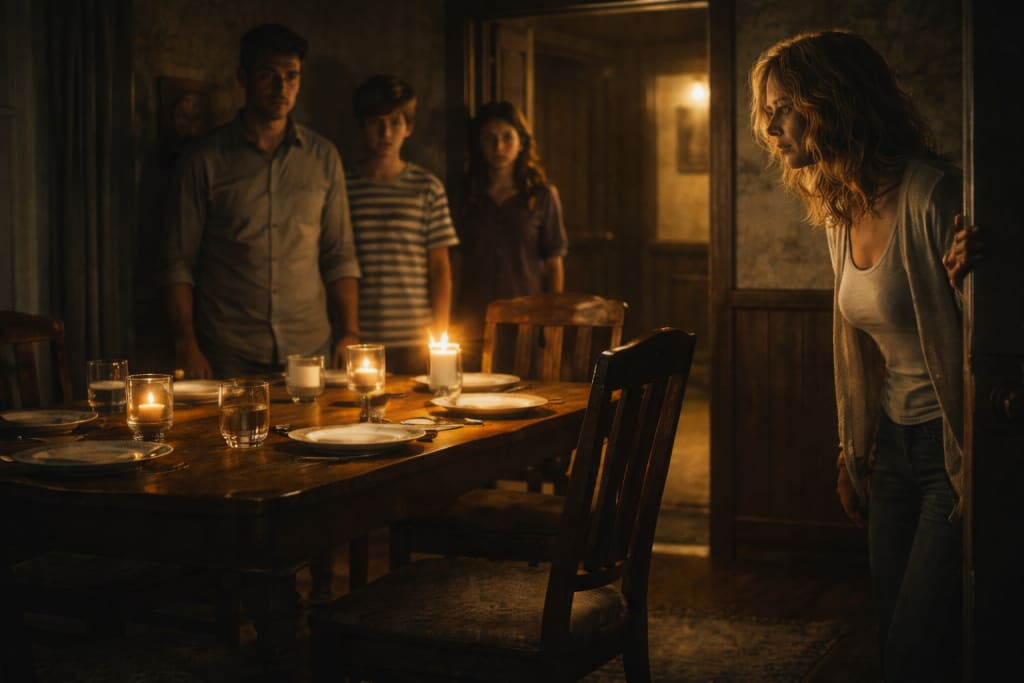
The first time the chair appeared, it was already set for dinner.
Marianne noticed it when she brought the pot roast to the table. There were five place settings instead of four. Five forks aligned like silver ribs. Five water glasses catching the yellow light.
She stopped walking.
“David,” she said carefully, “why is there an extra chair?”
David didn’t look up from carving. “Is there?”
“Yes.”
He glanced briefly at the table, then back at the meat. “Oh. That.”
“That,” she repeated.
“Better to have it than not,” he said. “You never know.”
Lily was spooning peas onto her plate with meticulous concentration. Thomas kicked his sister under the table and grinned.
“Can we eat?” Thomas asked.
The chair sat between Lily and the wall. It was one of the dining chairs; oak, slightly uneven but Marianne was certain it hadn’t been there the night before.
She would have remembered.
She set the pot roast down.
“Who is it for?” she asked.
No one answered.
David began serving slices onto plates.
Four plates.
The fifth remained empty.
The chair stayed.
***
The next morning, it was still at the table, angled slightly outward as if someone had risen in the night and forgotten to push it back in.
Marianne stood in the kitchen in her robe, staring at it while the coffee dripped.
“David,” she called.
He entered, knotting his tie. “Morning.”
“The chair.”
“Yes?”
“It’s still here.”
He poured himself coffee. “Of course it is.”
“Why?”
He took a sip. “We agreed.”
Her stomach tightened. “Agreed to what?”
David met her eyes with mild concern, as if she’d forgotten an appointment. “Not to make a fuss.”
Lily came in, backpack already on. “Mom, where’s my math folder?”
“On the counter,” Marianne said automatically.
Thomas shuffled in behind her, hair wild. He stopped when he saw the table.
“Is it here yet?” he asked.
“Eat your cereal,” David said.
Marianne’s hands went cold.
“Is what here?” she asked.
Thomas blinked at her, confused. “You know.”
“No,” she said. “I don’t.”
He hesitated, then shrugged and poured his cereal.
The fifth chair remained empty.
***
On Wednesday, Marianne set the table herself.
Four plates. Four forks. Four glasses.
She pushed the extra chair into the corner of the dining room, its legs scraping across hardwood in a thin, protesting shriek.
She felt a small, fierce relief.
When David came home, he paused in the doorway.
“Why is the table incomplete?” he asked.
“It isn’t.”
He stepped inside. His gaze moved from plate to plate, counting silently.
“You moved it,” he said.
“Yes.”
The air thickened.
“We talked about this,” he said quietly.
“We did not,” Marianne snapped. “You keep saying that. We did not talk about this.”
Lily and Thomas stood frozen in the hallway, watching.
David walked to the corner and lifted the chair. He carried it back to the table and slid it into place with deliberate care.
“There,” he said. “That’s better.”
“For who?” Marianne demanded.
David’s jaw tightened. “Lower your voice.”
“For who?” she repeated.
Thomas began to cry softly at first, then harder, as if Marianne’s question had pressed a bruise.
“Stop it,” David said sharply. “You’re upsetting them.”
“I’m upsetting them?” Marianne’s laugh came out thin and brittle. “There’s a chair for someone who doesn’t exist.”
Lily’s face went pale. “Don’t say that.”
The words seemed to strike the room itself. The lights flickered.
No one moved.
The fifth chair creaked.
Not from being touched.
From being leaned on.
Marianne saw it clearly; the subtle dip in the seat, the shift of weight. The faint compression of wood beneath something invisible.
Her breath caught.
David stepped forward, blocking her view.
“Enough,” he said. “We are not doing this again.”
“Doing what?”
“Pretending.”
The word hung in the air like smoke.
***
By Friday, Marianne stopped sleeping.
Every night, she lay awake listening to the house.
Around 2:13 a.m., the sounds would begin.
A soft tread on the stairs.
The careful slide of a chair across wood.
The muted clink of silverware being adjusted.
Not used.
Adjusted.
David slept beside her, steady and undisturbed.
On the fourth night, she slipped out of bed.
She moved down the hallway, each step cautious.
The dining room was dim, lit only by streetlight filtering through sheer curtains.
The table was set.
Five plates.
Five forks.
Five glasses.
She hadn’t done that.
Her heart thudded in her throat.
The fifth glass was half full.
Marianne took one step closer.
The chair was pulled back slightly, as if someone had just risen.
“Hello?” she whispered.
The house answered with silence.
Then..
A faint indentation appeared in the cushion of the chair.
Slowly.
As if someone were sitting down.
Marianne staggered backward.
“I don’t agree,” she said to the empty room. “I never agreed.”
From upstairs, Thomas’s voice drifted down, small and sleepy.
“Mom?”
She turned.
He stood on the staircase, clutching the banister.
“Don’t make it go,” he said.
Her mouth went dry. “Make what go?”
Thomas looked toward the table.
Marianne followed his gaze.
The fifth plate now held a smear of gravy.
Thomas’s eyes filled with tears. “It gets lonely.”
“For who?” she asked, barely audible.
Thomas shook his head violently. “Don’t.”
The chair creaked again, sharper this time.
A fork slid an inch across porcelain.
Upstairs, Lily began to sob.
David’s voice called from the bedroom, calm and steady. “Marianne. Come back to bed.”
She didn’t move.
“You’re scaring them,” he added.
The fifth glass tipped slightly, then righted itself.
Marianne’s pulse roared in her ears.
“This isn’t normal,” she whispered.
From the darkness behind the chair, something shifted - just enough to disturb the air.
David appeared at the top of the stairs, silhouette framed in hallway light.
“It is normal,” he said firmly. “We decided it is.”
“We decided?” she choked.
“Yes.”
His tone was gentle now. Persuasive. “Families adapt. That’s what we do.”
Thomas descended one step at a time, eyes fixed on the table.
“Please,” he begged her. “Don’t leave it empty.”
Marianne looked at her son. At her daughter’s shadow trembling on the wall. At her husband’s composed face.
At the fifth chair.
The indentation deepened, patient and waiting.
A fork lifted, just barely and then settled back down.
Her mind screamed for logic, for explanation, for something to anchor herself to.
Instead, she heard her own voice say, thin and distant, “I’m not pretending.”
David’s expression softened into something like pity.
“You’re the only one who is,” he said.
The house seemed to exhale.
The chair scraped forward an inch.
An invitation.
Thomas wiped his nose. Lily’s sobbing quieted.
“Mom,” Lily called weakly, “just sit down.”
Marianne stood alone at the edge of the room, staring at the space no one would name.
The fifth plate waited.
The house waited.
Her family watched her with fragile hope.
Slowly, mechanically, Marianne reached for the empty place setting.
Her hand hovered over the fork.
Behind it, the air felt occupied. Dense. Expectant.
She pulled the chair back.
It resisted, just slightly.
As if someone else was holding it in place.
********************************************************************************************************************************************
(Image was created using Gemini)
About the Creator
Lori A. A.
Psychological analysis | Identity & human behavior | Reflection over sensationalism
Keep reading
More stories from Lori A. A. and writers in Fiction and other communities.
THE QUIET RULE
(A family keeps one simple rule: never go into the basement after 9 p.m. But when something begins knocking from below - patient, deliberate, and alive - the real horror isn’t what’s waiting in the dark… it’s that everyone else has already accepted it.)
By Lori A. A.about 18 hours ago in Fiction
Veil of Subconscious Awakening
Images slide behind my eyelids like film cadres, bursting with meanings. In one moment, I’m speeding down the highway, making the speedometer swing wildly like a frantic pendulum. The next moment, I’m plunging from a falling plane, slowly crashing earthward. At home, I meet black cat’s green, googly eyes staring at me from the cavernous hollowness of the kitchen. When I turn for a moment, it disappears, and all I can see is a pair of blue suede shoes set up against the wall. I pick them up and put them on. When I glimpse at them again, they’ve become black as night, making me blink and flinch.
By Moon Desert6 days ago in Fiction
The Men in Black
The Men in Black The first time I saw them I thought it was a joke. Two men in black suits perfectly pressed standing in the shadows of the streetlamp outside my apartment. I had never seen them before. No one had. And yet there they were waiting. Their eyes were flat too calm like they had seen everything and nothing at once.
By Marie381Uk 2 days ago in Fiction



Comments
There are no comments for this story
Be the first to respond and start the conversation.