
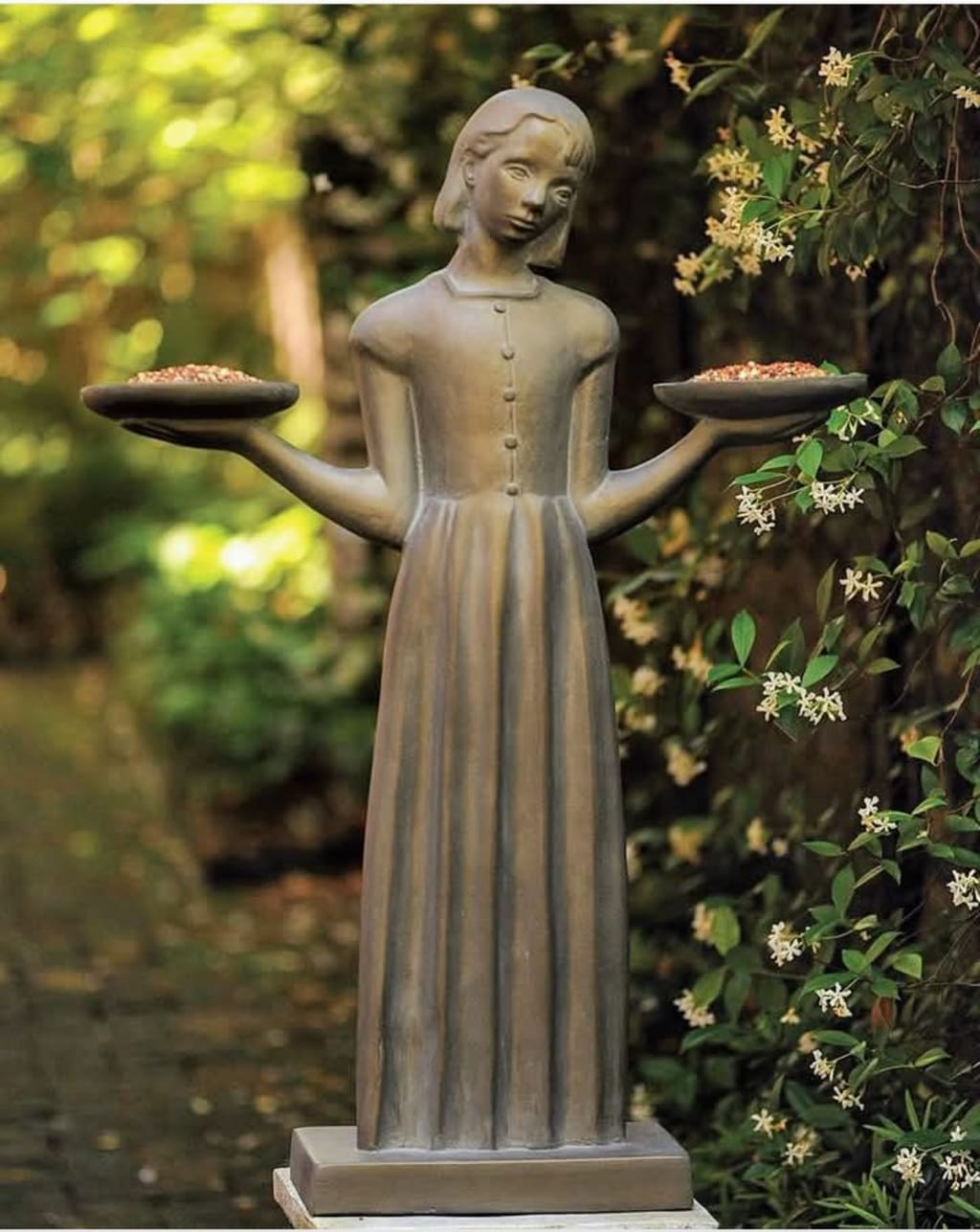
In the center of the bustling city square stood a statue of a young girl. Her marble face was tilted upward as if gazing at the endless sky, her arms extended slightly as though reaching for something just beyond touch. She had been there for decades, weathered by time, rain, and sunshine, yet admired by thousands who passed her every day. To most people, she was nothing more than a work of art—a symbol of innocence carved in stone. But to those who stopped long enough, the “Statue Girl” carried an aura of mystery, as if she held a secret no one else could understand.
Children often played around her base, their laughter echoing through the streets. Couples leaned against her pedestal, whispering their promises of forever. Street performers made her their silent audience, bowing theatrically in her direction. The world moved, but the girl of stone remained unchanged, a silent witness to every fleeting moment.
But there was something unusual about this statue. At night, when the city grew quiet and the streetlights cast long shadows, she seemed to breathe. Her eyes, once lifeless and pale, shimmered with a faint glow. No one saw it—except a lonely boy named Arman.
Arman was the kind of boy who felt invisible in the world. He lived in a cramped apartment with parents who were too busy working to notice him. He had few friends at school, and most days he wandered aimlessly after class, searching for something to make him feel alive. One evening, when the moon was full and silver light spread across the square, Arman stopped by the statue and sighed.
“I wish I could be like you,” he whispered to the stone girl. “You don’t have to feel lonely. You just… exist. And people love you anyway.”
To his shock, the statue’s lips trembled. Her stone fingers twitched, and her eyes glistened as though a tear was about to fall. Arman rubbed his eyes, thinking he was dreaming. But then she spoke, her voice soft and melodic like the ringing of distant bells.
“Lonely?” she asked. “Do you believe I am not lonely, standing here for eternity?”
Arman stumbled back. His heart raced, but curiosity rooted him in place. “You… you can talk?”
The statue girl’s smile was both sad and radiant. “Only to those who listen.”
From that night forward, Arman visited her every evening. He told her about his school struggles, his parents’ absence, and how he felt invisible to the world. In return, she told him about the years she had stood in silence, watching lives unfold, wishing she could move, laugh, and cry like everyone else.
“They see beauty in me,” she whispered once, “but none see the longing in my stillness. I would trade eternity in stone for one fleeting moment of real life.”
Arman’s heart ached for her. Each day, he grew more determined to help her. He researched myths and legends, searching for ways to free a trapped soul. One evening, under the soft drizzle of rain, he asked her, “If you could live, even just for a short while, what would you do first?”
The girl’s eyes lit with a spark. “I would run. I’ve watched children run all my life. To feel the wind pushing against me, to stumble and rise again—that is my dream.”
Days turned into weeks. Arman never stopped visiting, never stopped believing that her spirit deserved freedom. One night, as the clock struck midnight, he pressed his hand against her cold marble fingers and whispered, “If I could give you my breath, I would.”
A strange warmth spread between them. The marble softened beneath his touch, like skin awakening from a deep slumber. Slowly, the statue’s rigid form began to move. Stone cracked and fell away like fragile shells, revealing flesh, warmth, and life beneath.
The Statue Girl gasped, her first breath shaking the silent night. She looked down at her hands, alive and trembling, then at Arman. Tears streamed down her cheeks as she whispered, “You gave me what no one else could—hope.”
Arman laughed through his own tears. “Run,” he said. “Go feel the world.”
She did. She ran barefoot through the square, her laughter echoing like music. She spun beneath the rain, touched the wet leaves, and felt the cobblestones under her feet. For the first time, she wasn’t a symbol or a decoration—she was alive.
But as the first light of dawn broke over the horizon, her steps slowed. She turned to Arman, sorrow softening her radiant smile. “The magic was borrowed. My time is short.”
Arman’s chest tightened. “No… there has to be a way.”
The girl touched his cheek, her warmth fading. “Do not grieve. You gave me a night of life, of freedom, of joy. That is more than eternity in stone.”
And with the sunrise, she froze once more. Her marble form returned, yet something was different. Her lips curved into a permanent, joyful smile—one she never had before.
Arman visited her often after that. Though she could no longer speak, he knew she had lived, even if only for a night. And whenever others admired the statue’s radiant smile, only Arman knew the truth: the Statue Girl had run, laughed, and lived, if only for a fleeting moment.
She was no longer just stone. She was a memory, a miracle, and a reminder that even the stillest things can hold the deepest dreams.
About the Creator
Hasbanullah
I write to awaken hearts, honor untold stories, and give voice to silence. From truth to fiction, every word I share is a step toward deeper connection. Welcome to my world of meaningful storytelling.
Keep reading
More stories from Hasbanullah and writers in Fiction and other communities.
Seconds of Sorrow, Hours of Bliss"
Have you ever noticed how time seems to shift depending on how you're feeling? A joyful day with friends vanishes in what feels like moments. But a night filled with pain or waiting can stretch endlessly, each second a lifetime. Time, the most consistent thing in the universe, somehow becomes subjective the moment we live through it emotionally. Why does happiness seem to fly, while suffering drags its feet?
By Hasbanullah8 months ago in Fiction
Tatt~Master
— Assembly Line Tatt Machine ~ Impressions to Impress — As I begin to understand more about the Tattoo Phenomenon. I've written silly, yet verbatim, dating site anecdotes in 'Frazzled.' So let me ask you: Would you be More attracted to someone slathered with tattoos, or Less?
By Jay Kantora day ago in Humor



Comments
There are no comments for this story
Be the first to respond and start the conversation.