
The Slave Who Knew the Stars
Where crowns fade and chains speak louder than blood.

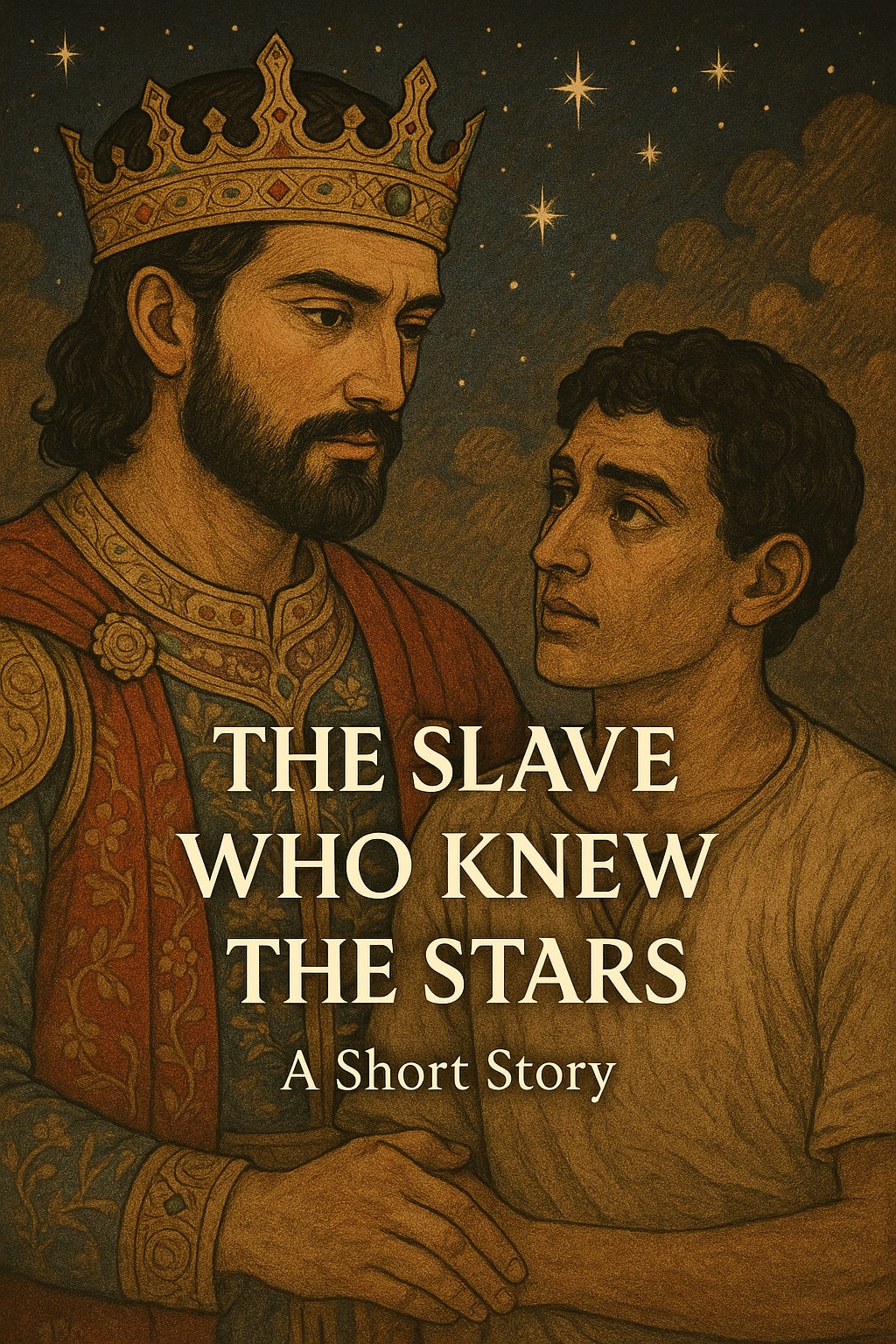
Once upon a time, in the ancient kingdom of Zaheerabad, nestled between black mountains and golden deserts, lived a Prince named Kamraan, son of the mighty King Ubaid. The Prince was fair in face and feared in sword, taught in the philosophies of men but untouched by the lives of those beneath him. The palace was carved from marble, adorned with silk and mirrors, but behind its glistening curtains brewed storms invisible to the blind.
In the shadow of this grandeur lived a slave boy named Ilyas. He was the son of a servant woman, born not with a sword in his hand but a broom. His hair was coarse, his tunic torn, but his mind—ah, his mind was luminous as the moon over a desert night. He read the stars when others slept. He listened when others laughed. And he remembered—everything.
One evening, during the festival of flames when the kingdom lit a thousand lanterns and floated them into the sky, fate played its first card.
Prince Kamraan was riding his steed through the outer gardens, accompanied by nobles and laughter, when his horse slipped on wet stone. Before the royal guards could reach, the Prince tumbled, his head inches from a sharp stone.
It was Ilyas—walking quietly with a bundle of dirty clothes—who darted forward and caught the Prince’s head before it cracked against death.
The guards shoved him aside. “How dare a slave touch the royal skin?”
But Kamraan, rising from the ground, stared at the boy.
“What is your name?” he asked.
“Ilyas, son of no one,” replied the boy.
From that day, the Prince demanded that Ilyas serve him directly. Many objected. “He is of no rank, my Prince!” But Kamraan insisted.
And so began a strange friendship.
Ilyas, silent and sharp-eyed, served the Prince in his chambers. He would pour wine, but never drink it. He would polish the Prince’s sword but never touch it. He would listen to the Prince's laughter but never laugh. Yet, in the silence between their roles, Kamraan discovered something he had never known before—truth.
“You do not flatter me like the others,” Kamraan once said.
“Because flattery is a mirror made of fog, my lord. It shows a thousand faces, but none are real.”
Kamraan laughed. “Where did you learn to speak like this?”
“I listen when others boast.”
As months passed, Kamraan brought Ilyas closer—not as a friend, nor quite a servant. Something stranger. A shadow of truth in a world of costumes.
One winter, a stranger came to the palace. A mystic from the East, cloaked in blue and silver, who called himself Malzahar.
He brought gifts of gems and prophecy.
He read the palms of nobles and whispered their futures like riddles. “You will die before your son,” he told the Queen. “You will lose what you cannot name,” he told the General.
When it was the Prince’s turn, Malzahar held his hand and smiled oddly.
“You will rise higher than kings, Kamraan. But only if you destroy the one thing that humbles you.”
Kamraan raised an eyebrow. “And what is that?”
“You already know.”
And then he vanished.
The Prince grew restless. He started pacing at night. He grew bitter with courtiers, harsh with servants. But it was only around Ilyas that he remained human.
One night, Kamraan asked, “Do you believe in destiny, Ilyas?”
The boy shrugged. “Destiny is like a hidden wound. You don't see it until it's too late.”
Kamraan laughed bitterly. “What if I told you I was destined to rule not just Zaheerabad, but the world?”
“Then I would say—beware of shoes too large. You may step into them, but you will trip.”
Kamraan fell silent.
Time passed. And one day, the King fell ill.
Whispers filled the court. Some said poison. Some said a curse. Some said age.
The palace brimmed with dread. Ministers plotted. Generals whispered. But Kamraan knew only one thing: the time of crowns was near.
But there was a problem. The King, in his final decree, had named a council to oversee the Prince's rule until he proved himself wise enough.
And chief among them? The High Priest, who loathed Kamraan.
“You are brave, yes. But wisdom is not in your blood,” he said.
Anger burned in the Prince. He drank in secret. He beat a servant once for spilling ink. He stopped laughing.
Only Ilyas remained beside him.
And then, the night of the fire.
A scream tore through the palace. The High Priest’s chamber was ablaze. When the fire was put out, only ashes remained—and a single dagger bearing the Prince’s crest.
Kamraan was arrested at dawn.
The ministers called it treason. “He wanted the throne early!”
The Queen wept. “He is my son. He would never…”
But evidence stacked. And then came Ilyas, standing before the court.
They asked, “Did you see the Prince leave his chamber that night?”
Ilyas looked at Kamraan. The Prince, with tired eyes, met his gaze.
And Ilyas bowed his head.
“Yes,” he said.
The court gasped.
That night, Kamraan was locked in the Black Tower—the prison beneath the palace where screams never left.
But as the guards dragged Ilyas away, Kamraan whispered, “Why?”
The boy replied, “Because you forgot what it means to be a man before a prince.”
—
Months passed.
Zaheerabad crowned a council. The Queen wept herself into sickness. The kingdom became quiet, like a beast that had forgotten how to roar.
But one stormy night, the gates of the palace blew open.
The guards were found asleep.
And Kamraan—was gone.
Only one saw him flee. A beggar woman near the river. She said he rode a black horse, eyes like fire, hair in the wind.
No one believed her.
Ten years passed.
The name Kamraan faded from lips. The Queen died. The throne remained empty—each council member either vanished or murdered by unknown hands.
And in the southern village of Nahraban, people spoke of a man who read the stars, healed the sick, and whispered secrets to birds.
He had no name. But he was said to weep every night before dawn.
One day, a rider came to Nahraban. A boy of eighteen, proud and brash, calling himself Malik. He had heard of the wise man in the hills and wanted to test him.
He met the old man near a cave, staring at the sky.
“Tell me,” said Malik, “what makes a king?”
The old man replied, “The ability to kneel.”
Malik laughed. “Kings do not kneel.”
“Then they are not kings.”
Malik scoffed. “Who are you?”
The man smiled. “A prince who became a prisoner. A prisoner who became a ghost. A ghost who found his soul.”
The boy frowned. “Kamraan?”
The man nodded.
“But… you were betrayed.”
“Yes.”
“By a slave!”
Kamraan looked away.
“He was the only one who told me the truth. I mistook his wisdom for insolence. His honesty for poison. I loved his presence but hated my dependence.”
The boy asked, “Did you kill the High Priest?”
“No.”
“Then who?”
Kamraan looked up. “The same man who said I would rule the world if I destroyed what humbled me.”
“Malzahar?”
Kamraan nodded. “He fed me the poison of pride. And I drank it like wine.”
The boy whispered, “So what happened to the slave?”
Kamraan’s eyes grew wet. “He freed me—from myself. But I destroyed him. He was hanged the day after my escape.”
—
Years later, a traveler from the East visited Zaheerabad, now a city of ruins. He found an old stone near a dry river. It read:
“Here lies Ilyas, son of silence, mirror of truth. He wore no crown, but ruled a prince.”
And beneath it, carved by an unknown hand:
“One who deceives with truth does not lie, but teaches. One who forgets truth for love, is not betrayed—but warned.”
Moral Lessons:
- A crown on the head cannot silence a wound in the soul.
- He who fears truth will be slain by illusion.
- To rule others, one must first rule one’s self.
- The wisest words often come from mouths covered in dust.
- What humbles you saves you. What flatters you, kills you.
- Justice delayed is not always justice denied—it is often revelation in disguise.
About the Creator
Muhammad Abdullah
Crafting stories that ignite minds, stir souls, and challenge the ordinary. From timeless morals to chilling horror—every word has a purpose. Follow for tales that stay with you long after the last line.
Keep reading
More stories from Muhammad Abdullah and writers in Fiction and other communities.
The Garden of Mirrors: A Tale of Two Thrones
Part I: The Echoes of the Orchard In an ancient land where rivers whispered secrets and mountains bore silent witness to time, there existed two mighty kingdoms, separated by a sea of sand and centuries of silence. One was Zahran, a land veiled in mist, where the people believed that dreams were fragments of lost truths. The other was Elburz, whose people trusted only what the eye could see and the hand could hold.
By Muhammad Abdullah7 months ago in Fiction
Affection and Healing for Yourself
During the night of the last quarter moon, I gathered my ritual supplies. I carefully handled the chunk of black tourmaline that would protect me from your overall negative and narcissistic energy. I carefully walked the house with my stick of selenite in hand, asking the universe to cleanse our working space.
By Alisha Wilkins ✒️🦋🖋️4 days ago in Fiction


Comments
There are no comments for this story
Be the first to respond and start the conversation.