
The Silent Symphony of Space: A Journey Beyond Earth
The Silent Symphony of Space
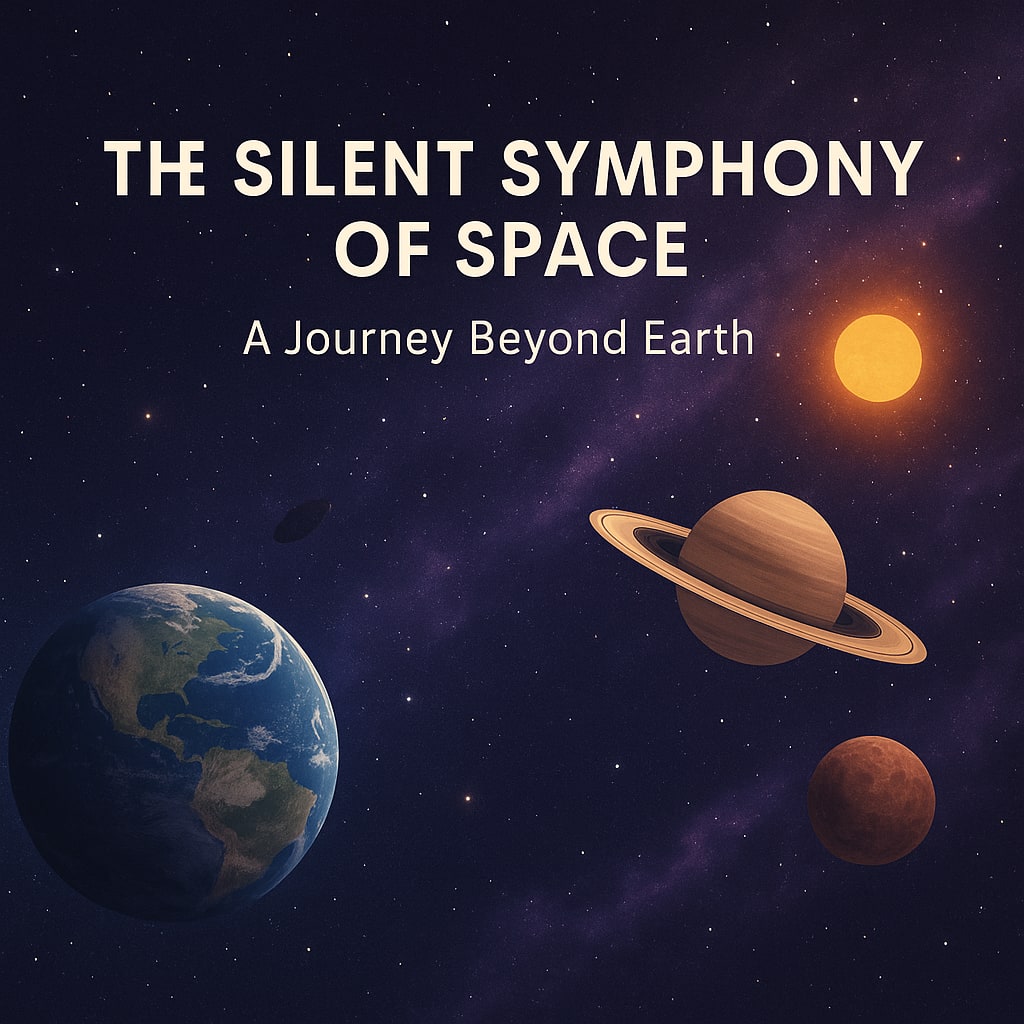
When we gaze up at the night sky, we are looking into a vast, silent arena of cosmic activity. Space, though often perceived as a dark and empty void, is teeming with mysteries, wonders, and phenomena that defy our everyday experiences on Earth.
A Universe in Constant Motion
Despite its stillness to the naked eye, space is incredibly dynamic. Stars are born in massive clouds of gas and dust called nebulae, where gravity pulls matter together until nuclear fusion ignites a new star. At the other end of a star's life, it may explode in a brilliant supernova, scattering elements essential for life into the cosmos.
Planets, comets, and asteroids follow complex orbits influenced by gravity, sometimes colliding or being flung into new paths. Even entire galaxies drift through the universe, occasionally merging in colossal cosmic dances that take billions of years.
The Vacuum That Isn’t Empty
Contrary to popular belief, space is not completely empty. It contains trace amounts of gas, dust, and even tiny particles known as cosmic rays. These particles travel at nearly the speed of light and can originate from distant supernovae or active galactic nuclei.
Additionally, scientists now know that invisible forces like dark matter and dark energy play a significant role in the structure and expansion of the universe. These mysterious components make up about 95% of the universe's total mass-energy content, yet they remain largely unexplained.
Time, Gravity, and Relativity
Space also alters our understanding of time. Thanks to Einstein’s theory of relativity, we know that time passes differently depending on your speed and the strength of the gravitational field you're in. This means astronauts aboard the International Space Station actually age slightly slower than people on Earth—a phenomenon known as time dilation.
A Future Among the Stars
As technology advances, humanity is stepping further into the cosmos. From robotic explorers on Mars to telescopes peering into the edge of the observable universe, our reach continues to expand. Plans for lunar bases and crewed missions to Mars suggest a future where space exploration becomes an integral part of human life.
Conclusion
Space is more than just a backdrop to our lives—it is a vast and ever-changing frontier that challenges our understanding and inspires our imagination. As we continue to explore, each discovery brings us closer to answering the biggest question of all: Are we alone in the universe?
About the Creator
Keep reading
More stories from Sharmin Akter and writers in Fiction and other communities.
"The Man in the Window: A True Urban Nightmare"
In 2002, a woman named Annie Andrews moved into a modest house in Rockland, Massachusetts with her two daughters. After losing her husband in a car accident, Annie hoped for a fresh start. But what followed was the kind of horror no one could have imagined—one that still chills the town to this day.
By Sharmin Akter9 months ago in Horror
A Strong Friendship
A Strong Friendship Kami Mian had a deep love for animals. He had a pet cat who was very dear to him. She was a beautiful white cat with soft, silky fur, and Kami Mian adored her endlessly. He pampered her so much that she slowly became proud of herself. Feeling special and favored, the cat began to believe she was superior to everyone else.
By Sudais Zakwan7 days ago in Fiction




Comments
There are no comments for this story
Be the first to respond and start the conversation.