
The Silent Bench
Some pain doesn't scream—it just sits quietly, waiting to be seen.

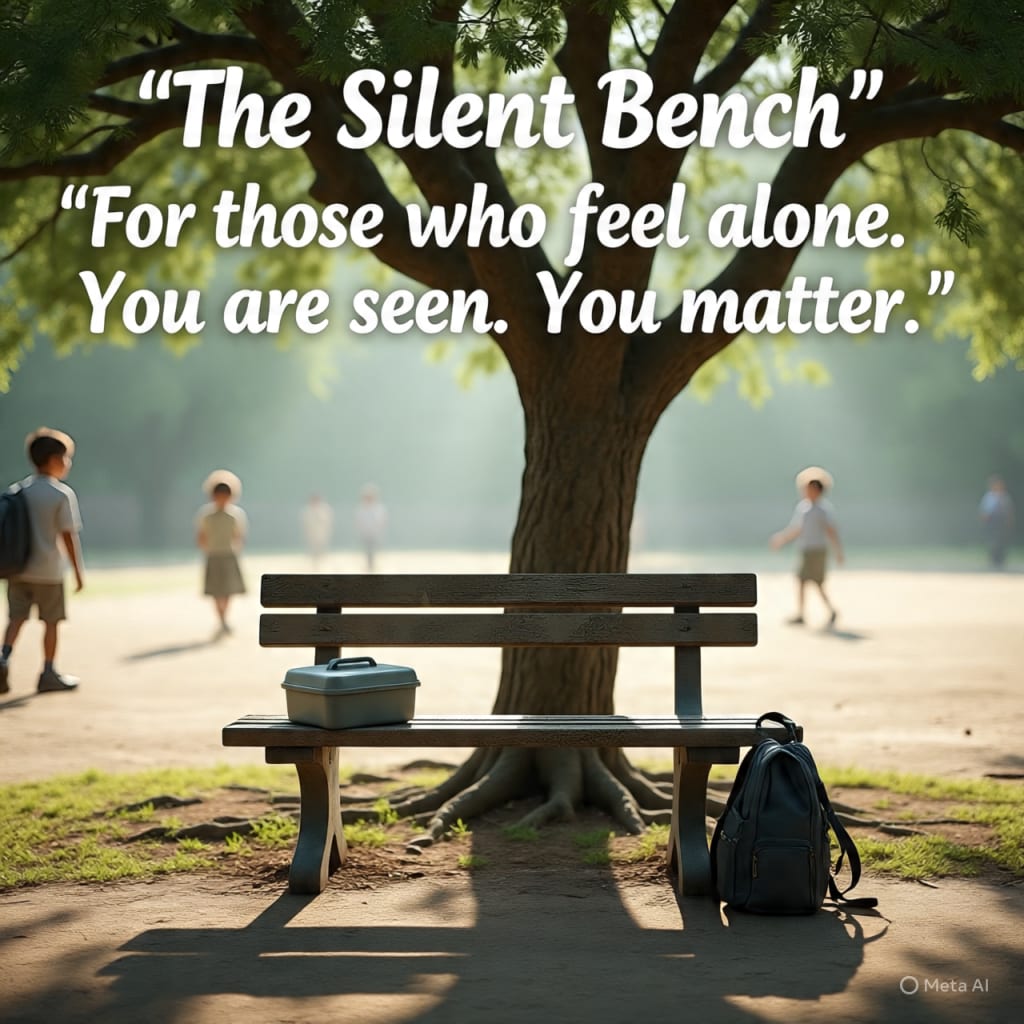
Every school has that one corner no one notices.
In our school, it was the broken wooden bench near the back gate, shaded by an old peepal tree.
And on that bench, every lunch break, sat Raghav.
Always alone. Always on time. Always silent.
He wasn’t new. He wasn’t invisible. He was just... unnoticed.
Raghav never caused trouble. He didn’t raise his hand in class. He scored average marks, wore a faded uniform, and carried a second-hand bag. His shoes had a stitched-up sole, and his lunch box often stayed closed.
No one ever asked him why.
The Joke That Wasn’t Funny
One day, a group of boys passed by the bench.
“Raghav bhai, kis se break-up ho gaya?” they laughed.
He looked up and gave a half-smile. “Kisi ne kabhi mila hi nahi, toh break-up kaisa?”
They laughed harder. But that was the first time anyone had heard him speak more than two words.
I was one of them.
We thought it was funny.
It wasn’t.
The Day He Didn't Show Up
A Monday. Nothing special.
Except the bench was empty.
For the first time in two years.
“No Raghav today?” someone muttered while unwrapping their sandwich.
The group shrugged. “Maybe bunks. Who cares?”
But he didn’t come on Tuesday either. Or Wednesday.
By Friday, the bench had leaves all over it.
Unclaimed. Quiet. Just like him.
The News
The following Monday, the principal entered our class with red eyes.
“We lost one of our students this weekend.”
A silence fell.
“Raghav.”
I felt something drop inside me. A strange hollowness.
“He had been battling depression. His mother passed away last year. His father works out of town. There was no one at home most days. We didn’t know. We’re sorry.”
No one moved. No one blinked.
The bench had been a cry for help. And we missed it.
The Things We Never Knew
Later, the counselor told us more.
Raghav had been coming to school hungry most days. His lunch box was often empty—not because he didn’t want to eat, but because there was nothing at home.
He loved poetry. He used to write it on the last pages of his notebook.
In one of them, they found these words:
> “I sit on a bench,
Not waiting for someone,
But hoping someone might see
That I exist.”
That line broke me.
I had passed by him. Laughed around him. But never seen him.
The Apology That Came Too Late
A few students, including me, started sitting on that bench during break.
We cleaned it. Painted it blue. And put a small board on it:
> “The Raghav Bench — For Anyone Who Feels Alone.”
Slowly, something changed.
The bench never stayed empty again.
Some sat silently. Some talked. Some even cried.
One boy came out as gay there for the first time. Another shared her anxiety issues. A shy junior read out her poem aloud for the first time.
The bench became a safe space—for voices that trembled, for eyes that had longed for understanding, for stories that were buried in silence.
Pay Attention Before Silence Turns Final
Raghav didn’t want attention.
He wanted connection.
Not sympathy—just someone to say, “You okay?”
A gentle smile. A shared lunch. A “want to sit with us?”
Little things that could’ve changed everything.
The Real Lesson
In every classroom, there’s a Raghav.
Someone who’s always alone but never complains.
Someone who smiles quietly, but is screaming inside.
We need to see them. Hear them.
Before it’s too late.
Not everyone who suffers says it out loud.
Some just sit on broken benches… waiting.
The Social Message
Pay attention to those who silently suffer.
Because silence doesn’t mean peace—it often means pain hidden too deep for words.
Your kindness might be the only thing standing between someone’s silence… and their goodbye.
About the Creator
Masih Ullah
I’m Masih Ullah—a bold voice in storytelling. I write to inspire, challenge, and spark thought. No filters, no fluff—just real stories with purpose. Follow me for powerful words that provoke emotion and leave a lasting impact.
Keep reading
More stories from Masih Ullah and writers in Fiction and other communities.
Bomb Scare
It was 2027, and the world never thought it would happen. A missle hit the United States, but it wasn't where they had anticipated. A little town in the northeast was hit by a missile strike, they didn't know why, and they didn't know exactly where it hit, but they did know it was a coastal community, somewhere between Maine and Delaware.
By Gregory Payton6 days ago in Fiction
Chosen Ones
*From the writings of Brother Pavel, whilst serving his sentence of Solitude. Clergy eyes only. "When the sky turns wrong, and the ground quakes and splits, and Fate and Fortune feel their strength slip, seven there shall be who step forward. A Noble, with hair of gold. A Priest, with mission sacred. A Bard, with singing strings. An Archer, green eyes so keen. A Soldier, with painful past. A Thief, his family lost. And a Farmhand, born on a moonless night."
By Malcolm Roach5 days ago in Fiction
The BAFTA Awards
By now, in a stunning departure from recent years, most of the world is aware of what happened at the BAFTA film awards. Social Media Headlines will tell you the bare bones: that John Davidson, a Tourette's Syndrome advocate, shouted a racial slur at two Actors of Colour, Michael B Jordan and Delroy Lindo.
By Natasja Rose7 days ago in Psyche


Comments
There are no comments for this story
Be the first to respond and start the conversation.