

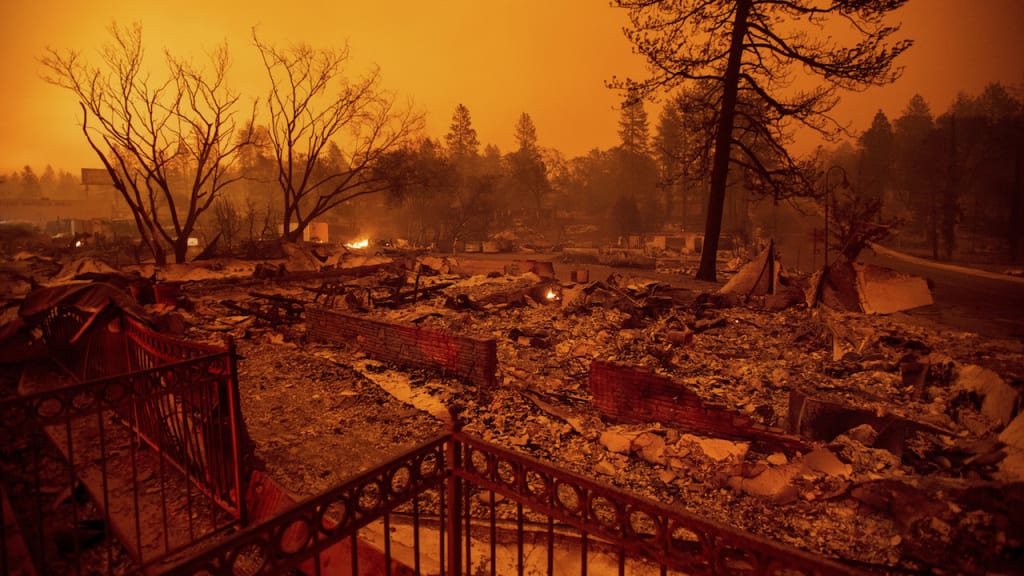
Fine-pointed charcoal sank into the earth once more and the satisfying grind of hardened wood on red dirt filled up the silence of morning. Too much clay, I thought for maybe the thousandth time. Or the ten thousandth. Besides, who bothered counting anything anymore? Rhythmic, the grinding rose again from the ruddy clay and I could almost make out the faint sound of flint corn falling into the fresh depression. What I wouldn’t give for a single bean and the ancient sight of its tendrils curling around the corn stock come late summer; but we buried the last of the seed the same season we buried her.
Reaching the end of the line, I turned to make another but the pouch was nearly empty. We had to hedge our bets these days and planting every seed meant gambling with the delicate balance of living and dying we had somehow achieved. Always save a quarter of what was left: that was the rule. The word brought me to a smirk as I remembered my hand heaving a brick through a bank window in the times before, when I was still young and hopeful. These days it was Death who made the rules and Death who ruled over what remained. We all carried six flakes of ruby in our hungry bellies.
My attention turned back to the ground, to the turning at the end of the row. It was poetry, bleak and impressionistic: a line wandering to the end of the little terrace. The Romans named a unit of poetry a verse after this very act, the turning at the end of a grain row. But the high arts were gone now, given over to half-recalled Leonard Cohen lyrics and hit-and-run limericks made in the field just to feel alive under the sweat and dust. Still, inside I was just then The Sower, the figure in that painting by… was it Van Gogh? Millet? That Old Disgust rose up in me just then. My stomach churned with resentment.
The world narrowed again and my mind was nothing but the crunch of loose gravel as I approached the longhouse. Emile looked up with an honest smile from the creaking handle of our antique pitcher pump. His name was one more nauseating relic but my love swelled over the edges of the growing knot in my gut. That smile of recognition could tame every ounce of hatred in me. I smiled back, earnestly.
“Is the water running clear, Little Bear?”
“It’s the same red as your face, Papa.”
His eyes asked me again why I bothered with the question. I tousled his hair and made my way into the longhouse. The shelves—a combination of half-rusted aluminum from some distant office and half-rotten planks of particle board—were mostly empty. Everything was empty. Even the things that were full carried the taste of emptiness. I pulled down a tiny clay pot, sealed along the top edge with beeswax. There was no hesitating any longer, no shaky choices; you had to be sure about everything. No doubt could find purchase in the hollow pains of choice. The smell of sickly sweet strawberries filled the air, mixed with a distant rumbling. But all I could find was the barren flavor of bitterness on my palate. They were coming.
Stepping outside, I grabbed Emile by the collar and thrust the little pot into his hands. He didn’t say a word when I stared darkly down at his little face and he made straight for the longhouse. Hearing the soft thud of the trapdoor against dirt, I steeled my attention toward the growing roar of predatory engines on the horizon. In my mind I touched the burnished blue iron of the Colt Python on my belt, checked to see if it was loaded, oiled, ready. Of course it was. One had to be sure these days. Doors slammed shut with a creak and the whine of the engines drawing down announced the encounter like the laughing of hyenas at the watering hole. My gaze didn’t move from them.
“Get us some water, I’m fuckin’ thirsty.” Skyler was a pale, lanky bastard whose skin always seemed freshly burned. You have to hate these men so I thought to myself that he looked like a diaper rash that had just been wiped clean. He threw an old army canteen to another man, a mousy halfwit named Chuck that I’d once worked with at Wal-Mart when I was a teenager. The greedy grimace on his face as he pumped out our well water bore through me like the digging stick in the red dirt.
“What do you want this time, Skyler?”
Skyler drawled back, “Come on now, is that how you talk to a poor, thirsty fella at your doorstep? What happened to that famed hospitality of yours, Jimmy?”
“That well’s run dry. Get to the point.” I glanced daggers at Chuck as he pumped.
“Fine,” he replied with a resigned shrug of feigned disappointment, “I suppose there’s no accounting for manners anymore. Don’t be coy, Jimmy, you know why I’m here. How much do you have for me?” His eyes grew hard and desperate. He carried the Old Disgust like it was a medal from the Great War.
“The corn’s all used up, Skyler. I planted the last of it this morning. You’ll get your share come harvest.”
“Yeah, that’s not gonna work for me, friend. You see, I’ve acquired some good dirt and some… volunteers to tend it. I want my share now and I thank you for it ahead of time,” he said, pausing for just a moment before sliding through a smirk with, “You know how gracious I am, after all.”
“I don’t have it. Like I said, you can come back at harvest. That’s the deal.”
My feet shifted ever so slightly and the tension of our posturing hung thick as smoke between us. Smoke had consumed the old world and it was consuming us still. We all still burned hot inside like the world had burned around us. Would today bring it to an end, one way or another? A small prayer grew inside me that it would. But I thought of Emile and I found the will to choke back my vulgar heroism and seek some middle ground.
“I’ll add an extra bushel come harvest,” I replied through a forced smile, “for your inconvenience. That should be plenty of seedcorn for next year.”
He cut me off with a nervous snicker, “Like I said, that’s not gonna work for me, James.”
We don’t really make decisions anymore. The entropy of things simply won’t allow that kind of languid thinking. No versification of our living and dying, no parlay with the way things are. I suppose we’ve been thrown back to our animal past and the words of Hobbes have become some kind of prophetic light in our dark corners. We’ve been forged into something other than human by the times. The Times are our God now. And the Times don’t abide hope or preponderance or even hindsight.
My Python had gone off twice already and the battered heel of my boot was coming fast at Chuck’s awestruck face. The thunder in my belly covered any kind of attention to what ensued and the lightning behind my eyes blinded me to the consequences. A tussle. Chad was squealing like a piglet from the pain but he fought back more like a cornered boar. Somehow I heard the crunch of his larynx under my knee and soon the sound of my own ragged breathing crept back into my consciousness. Too ragged.
The electricity faded from my vision and I saw his tusk half-buried in my side. For some reason I thought of that decrepit American god of hope on a crucifix in his final moments and I sat back laughing until I couldn’t bear the pain that came rushing through. Hope had no home in the world anymore. Was it an hour? Five minutes? Who bothered counting anything anymore.
Emile was by my side, crying. I held him until dusk came and his little lungs couldn’t bear the labor of it. Just then everything became so clear. I can’t account for what that meant, but it was true. I knew what mattered in all the emptiness, remembered why I persevered these long years in these fire-scarred hills. Hills that used to be full of broad oak canopies that sheltered birdsong and the placid wandering of black-tailed deer. Emile looked up at me through the crystal of that moment: he was all that was left of the birdsong and the black-tailed deer.
“Help me to the tree, would you, Little Bear?”
I almost blacked out getting to my knees and his little back—broadening like those canopies in his emerging adolescence—bore me to the last old oak tree, where she and I had so long ago decided to make our stand. I missed her just then. He sat in my lap, almost too big at this point yet in that second still so small against the background of this broken landscape.
And as we sat there we remembered, the both of us. We remembered the bright smile she used to shine on us like a great crescent moon against the inky skies. How she could turn a bag of rancid cornmeal into a feast for us, her princes. We sang the songs she used to sing beneath the very same stars under which we now sang. Eventually, collapsing into the exhaustion of catastrophe, Emile fell into a deep sleep.
I sat leaning against our tree. I wondered if he understood what came next. He did. It had happened to her, too. So there was nothing left but despair and I began the silent sob of a man who could do no more for his son, who knew he was leaving forever to a church somewhere in the East. My hands gripped the red dirt in agony and defiance and I pressed their closed fists to my forehead, the earth in my hourglass slowly streaming from their fingers.
The sobs fell into heavy breathing as my pulse dropped to a dulling thump. I could feel something smooth in my hand. Pulling my fist away from my brow I saw a thin silver chain dangling out of my reddened palm. Knowing and not knowing, I opened it slowly: a robust silver locket shaped as a heart. Her locket. Trembling under my fading breath, I opened it.
A single golden bean.
A promise of what might yet be.
About the Creator
Eric Chisler
Farmer, poet-scholar, and activist living in Occupied Mechoopda territory writing from the edge of apocalypse. Testifying to the times we live in.
Keep reading
More stories from writers in Fiction and other communities.
Affection and Healing for Yourself
During the night of the last quarter moon, I gathered my ritual supplies. I carefully handled the chunk of black tourmaline that would protect me from your overall negative and narcissistic energy. I carefully walked the house with my stick of selenite in hand, asking the universe to cleanse our working space.
By Alisha Wilkins ✒️🦋🖋️6 days ago in Fiction
📢 Raise Your Voice Thread: 01/22/2026
Our “Raise Your Voice Threads” are hosted most alternating Thursdays at 12PM ET to offer creators more avenues to uncover exceptional stories on Vocal. As we are continuously searching for fresh creators and inspiring stories, this thread provides an opportunity to exchange and discuss the stories that have moved and motivated us on Vocal.
By Raise Your Voice by Vocal3 days ago in Resources



Comments
There are no comments for this story
Be the first to respond and start the conversation.