
The Rainy Season Story
A Corn Seller's Life in the Village

The Corn Seller's Journey
It was the beginning of the rainy season in a small, rural village tucked away between rolling hills and green fields. The air was thick with moisture, and the scent of wet earth filled the atmosphere. The once-dusty roads had transformed into muddy tracks, making it difficult for villagers to walk without getting their feet soaked. Yet, despite the discomfort brought by the rain, there was a certain peace in the air—an unspoken beauty in how nature seemed to cleanse everything.
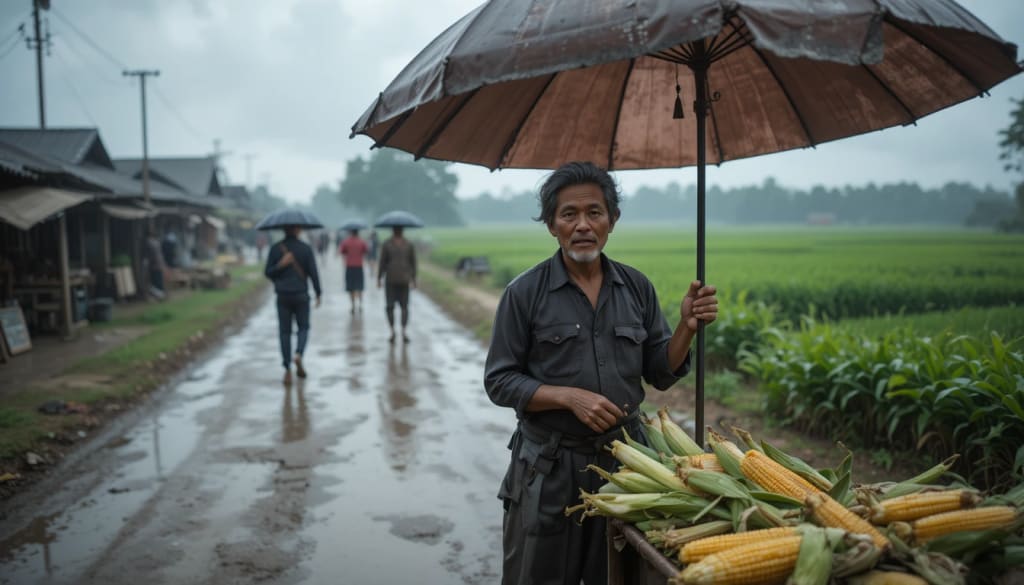
In the heart of this village, there was an old man named Ali who had spent most of his life selling corn. His small wooden stall was set up on the edge of the muddy village square, sheltered by a large, weather-beaten umbrella. He had inherited the art of selling corn from his father, and his father before him, each passing the trade down through generations. Corn was not just a product for him; it was a way of life—a connection to his roots and his community.
Ali's stall, although humble, was a fixture in the village. As the rains poured down from the dark clouds above, Ali continued to stand at his post, rain dripping from his weathered face. His clothes, once bright, had faded to earthy tones, much like the land he had lived on all his life. His hands, rough from years of hard work, carefully peeled the husks off the corn and prepared it for his customers.
The villagers had come to expect his presence, no matter the weather. Children, with their faces pressed against the windows of their homes, watched in fascination as the corn was cooked in large pots over open fires. The smell would spread throughout the village, drawing people out of their homes like moths to a flame. In a time where technology had not yet reached the remote corners of the world, Ali's corn was more than just food; it was a piece of tradition, a piece of comfort that people came to rely on.
Yet, selling corn wasn't as simple as it seemed. In a time of constant change, the younger generation was moving away from the village in search of better opportunities. The older villagers, like Ali, struggled to keep their traditions alive while adapting to new realities. The rains, which once brought prosperity to the harvests, now seemed to bring a sense of uncertainty. Crops were damaged, roads were washed away, and the supply of corn became increasingly unreliable. But still, Ali kept going. He was determined to keep the village's spirit alive, one cob of corn at a time.
The Struggle of Tradition and Change
Ali knew the importance of keeping the village's traditions alive. It wasn’t just about corn. It was about the community—the faces that came to his stall, the conversations that were shared in passing. Every transaction was more than a business deal; it was an exchange of stories, a part of the rich tapestry that made the village unique.
The younger generation often mocked the old ways. "Why waste time selling corn when you could be working in the city? Things are changing, Ali," they would say. "The rains aren’t as predictable as they used to be. People need to adapt."
But Ali didn’t see it that way. He believed that the village had its own magic, its own charm. The rain, the mud, the smell of the earth—these things were part of the village’s identity. They connected everyone, no matter their age or background, to something larger than themselves. The corn, the rain, the land—it all told a story, and Ali was the storyteller.
A Change in the Rain
One particular rainy day, as the clouds hung low and the village square emptied out, Ali noticed something unusual. A young woman, drenched from head to toe, approached his stall. She was not a regular customer, and Ali could tell she was new to the village.
"I’ve heard about your corn," she said with a smile, her voice warm despite the cold. "I’m not from around here, but I thought I’d try it."
Ali smiled back and handed her a fresh ear of corn. "It’s always better when it’s fresh from the fire," he said. "It’s the heart of our village, this corn. And the rain... well, it makes it taste even better."
The young woman took a bite, her eyes lighting up with satisfaction. "This is amazing," she said. "I’ve never tasted anything like it before."
Ali chuckled. "It’s not just the corn. It’s the rain, the soil, the people. Everything that comes together here makes it special."
As the rain continued to pour, the young woman sat down at the stall, and for the first time in a long while, Ali felt a glimmer of hope. Perhaps the traditions of the village could still survive, even in an age of change. The younger generation might leave, but there would always be those who remembered the old ways, who appreciated the small things—like a warm ear of corn on a rainy day.
The Legacy of Corn
As the years passed, the rains became more unpredictable, and the world continued to change. The younger generation gradually moved to the cities, seeking jobs in modern industries. But Ali's corn stall remained, a constant reminder of the village’s deep-rooted traditions. And though fewer villagers visited, the ones who did shared stories of their childhood, of the simpler days when the whole village gathered around to enjoy the harvest.
Even as the world around him evolved, Ali continued his work, not just as a seller of corn, but as a keeper of stories. He understood that the real value of his work wasn’t in the money he earned, but in the connections he made with others—the way his corn brought people together, even in the rain.
And so, on a rainy morning, with the world outside wet and wild, Ali stood at his stall, just as he always had. With a warm smile and a steady hand, he offered his corn to the villagers who still knew the taste of tradition. Because sometimes, in the midst of the storm, it’s the simple things—the familiar comforts—that remind us of who we are.
Conclusion
The rainy season, with all its challenges, had a way of reminding the people of the village about the things that mattered most. And for Ali, the corn seller, it wasn’t about the weather or the changing times. It was about keeping the spirit of the village alive, one cob of corn at a time.
About the Creator
Keep reading
More stories from Bilal Mohammadi and writers in Fiction and other communities.
Ancient Minarets of Afghanistan
The desert wind carried a warm breath across the valley as the last shades of daylight slid behind the rugged mountains of central Afghanistan. In the heart of that vast silence stood the ancient minaret—tall, proud, and unbroken despite the centuries that had passed around it. Villagers called it **“The Silent Watcher.”** But for twelve-year-old **Samir**, it was much more than a monument. It was a mystery waiting to be solved.
By Bilal Mohammadi2 months ago in Fiction



Comments
There are no comments for this story
Be the first to respond and start the conversation.