
The Quixotic Paradox: A Hallucinatory Pilgrimage Through Cervantes' Labyrinth
Miguel de Cervantes

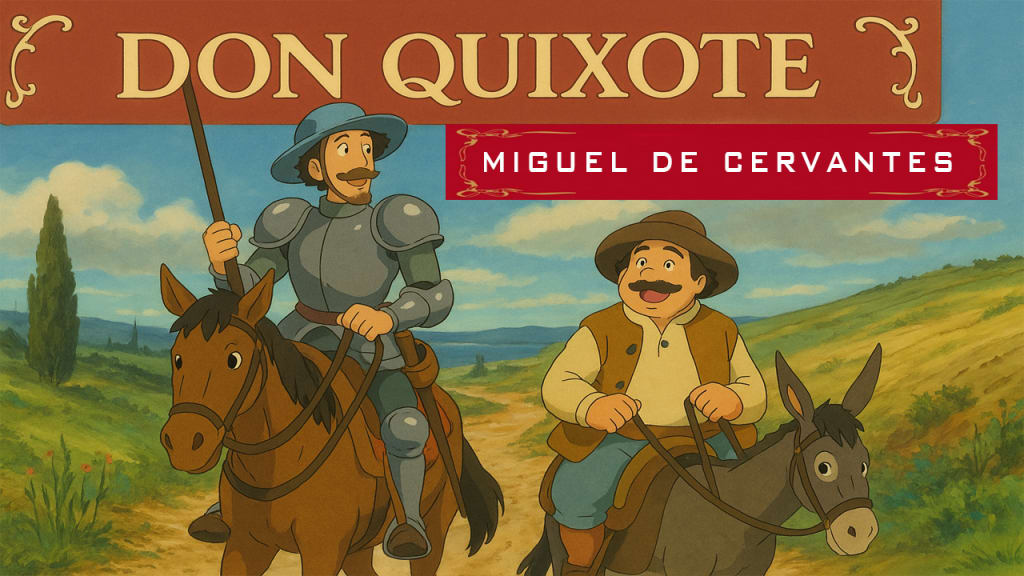
Prologue: The Birth of Literary Schizophrenia
Imagine, if you will, a world where reality is but a flimsy curtain—and one man, armed with nothing but delusions and a rusted lance, tears it asunder with manic glee. Enter Don Quixote: part lunatic, part prophet, wholly unforgettable. Cervantes didn't merely pen a story in 1605; he unleashed a literary atom bomb, one that detonated the very boundaries between sanity and madness, comedy and tragedy, fiction and... something far stranger.
This isn't just a tale about a madman attacking windmills. Oh no. It's a metaphysical funhouse, where every mirror distorts in ways that make you question which side you're really on. The genius of Don Quixote lies not in its humor (though God knows it's hilarious) but in how it claws at your subconscious, forcing you to ask, are we all just one bad day away from becoming Quixote?
The Narrative: A Fever Dream in Two Acts
Act I: The Descent Into Delirium (1605)
Alonso Quixano—a man whose library has rotted his brain like overripe fruit—decides the world needs saving. Not from plague, or war, or injustice, but from the most terrifying villain of all: banality. Thus begins his transformation into Don Quixote de la Mancha, self-appointed knight-errant of a kingdom that exists only in the flickering synapses of his crumbling mind.
- The Windmill Gambit: Literature's most iconic hallucination. Quixote sees hulking giants; we see creaking machinery. But here's the rub—who's really wrong? In a world devoid of magic, isn't his vision more beautiful?
- The Alchemy of Perception: Watch as a roadside inn becomes a castle, a prostitute becomes a lady (Dulcinea, "so pure she probably glows"), and a barber's basin morphs into the Golden Helmet of Mambrino (a delusion so specific it feels like divine comedy).
- Sancho Panza: The Anchor to Madness Our "squire" is the perfect foil—a man of dirt and hunger who follows Quixote not out of belief but because even lunacy beats starving in a field.
Act II: The Meta-Collapse (1615)
Here's where Cervantes pulls the rug out from under literature itself. Part Two isn't a sequel; it's a black hole where fiction consumes its own tail.
- The Characters Have Read Part One. They know Quixote's madness. The Duke and Duchess don't just mock him; they stage elaborate psychological torture, turning his delusions into courtly entertainment.
- Sancho's Island: A surreal interlude where the peasant becomes governor, dispensing wisdom through folk sayings that cut deeper than any philosopher's treatise.
- The Death of Dreams: The Knight of the White Moon doesn't just defeat Quixote—he murders his fantasy. The final pages, where Quixote renounces chivalry and dies in his bed, are some of the most devastating ever written. Not because he loses but because he stops believing he ever could have won.
Themes: Cervantes' Razor to the Soul
1. The Delusion/Genius Feedback Loop
Quixote isn't just mad. He's operating on a higher wavelength, one where the rules of reality are negotiable. His tragedy? The world refuses to play along.
- Is he insane—or the only sane man in an insane world?
- Does his madness reveal truths that "sane" people are too cowardly to see?
2. The Infinite Regression of Storytelling
Cervantes builds a narrative Möbius strip:
- A fictional narrator claims to transcribe an "Arabic manuscript."
- That manuscript includes other stories (like the baffling Tale of Foolish Curiosity).
- In Part Two, characters read Part One as a published book.
- The reader (you) is now trapped in a hall of mirrors, unsure which layer is "real."
This isn't just clever—it's a grenade tossed into the lap of literature itself.
3. The Violence of Idealism
Quixote's real enemy isn't windmills. It's a world that demands he grow up. His surrender to "reality" isn't redemption—it's a spiritual execution. When he dies, it's not just a man perishing, but the death of wonder.
Characters: The Holy Trinity of Literary Anarchy
Don Quixote: The Last Knight of the Apocalypse
- A walking contradiction: Ridiculous yet noble, pitiable yet transcendent.
- His madness is a language: One that reveals the absurdity of "normal" life.
- The original unreliable narrator—except he's not the narrator. Or is he?
Sancho Panza: The Fool Who Became a Sage
- Starts as comic relief: A peasant chasing promises of islands and gold.
- Ends as the novel's moral center, his proverbs ("Whether the stone hits the pitcher or the pitcher hits the stone, it's bad for the pitcher") carrying more weight than Quixote's rants.
- His governance of the "island" is a masterclass in satire: The common man ruling better than the nobility ever could.
Dulcinea del Toboso: The Ghost Who Haunts the Story
- She doesn't exist. Not really.
- And yet, she's the most powerful force in the novel—the idea of purity Quixote fights for, even as it crumbles in his hands.
Legacy: How a Madman Conquered the World
Literary Shockwaves
- Kafka's K. wanders Quixote's labyrinth.
- Borges' infinite libraries owe him debts.
- Modern antiheroes (Tyler Durden, Walter White) are his bastard children.
Cultural DNA
- "Quixotic": The ultimate backhanded compliment.
- "Tilting at windmills": The battle cry of doomed idealists.
Why It Still Gut-Punches Us
Because Cervantes understood: We're all Quixote.
- The student who thinks they'll change the world.
- The artist convinced them their work matters.
- Anyone who's ever fought for a love that didn't love them back.
The tragedy isn't that Quixote failed. It's that we stop trying.
Epilogue: The Mirror Crack'd
Don Quixote isn't a book. It's a living entity, shape-shifting across centuries.
- Read it as satire (it's hilarious).
- Read it as tragedy (it'll destroy you).
- Read it as a manifesto (it might just save you).
But beware: Stare too long into Quixote's eyes, and you'll see your own reflection—laughing, weeping, and maybe, just maybe, strapping on a cardboard helmet to charge your own windmills.
╰•★★ ᴍɪ ʙᴀᴀᴅꜱʜᴀ ★★•╯
About the Creator
MI BADSHA
Hello! Thank you for taking the time to look at my content creator profile. I'm MI BADSHA from Bangladesh. I enjoy writing articles and am arguably more versatile than most writers. I love writing articles on technology, lifestyle, etc.
Affection and Healing for Yourself
During the night of the last quarter moon, I gathered my ritual supplies. I carefully handled the chunk of black tourmaline that would protect me from your overall negative and narcissistic energy. I carefully walked the house with my stick of selenite in hand, asking the universe to cleanse our working space.
By Alisha Wilkins ✒️🦋🖋️a day ago in Fiction


Comments
There are no comments for this story
Be the first to respond and start the conversation.