
The Dark Entity That Haunts a Village in Semarang
The Curse of Sumala: A Village's Eternal Nightmare in Semarang

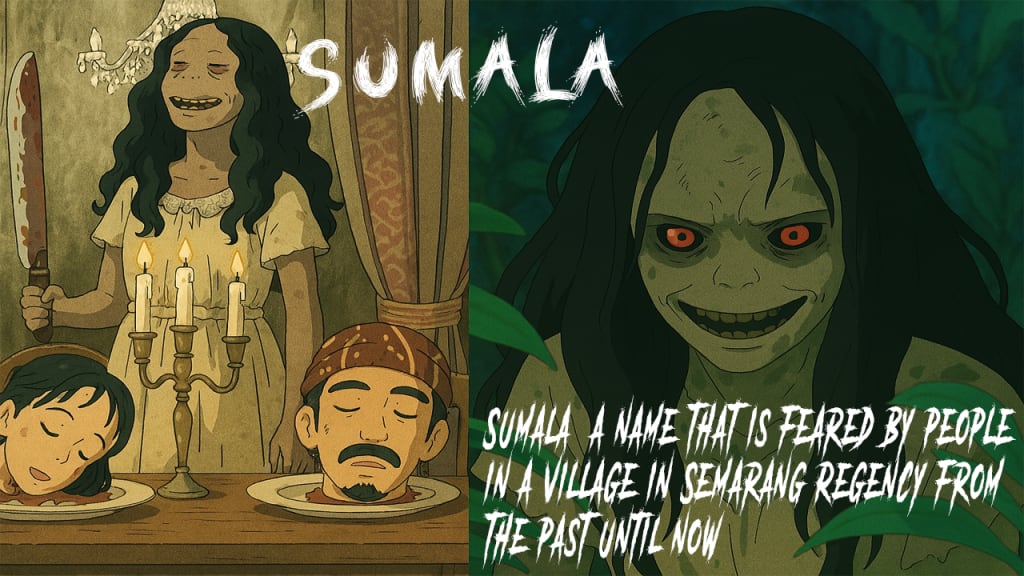
In the far interior region of Semarang Regency, Central Java, there is a village living in fear: a name hushed under the breath and echoing through generations—Sumala, a fright that haunts by night. The villagers live under an unchanging law: no one is to step outside at night. Those who dare test it know they will experience something more fearful than death.
The community has been plagued by Sumala, a terrible and malevolent creature, for centuries. Some folks think it's a demon, some think it's an angry ghost, and some just don't know what it is. Its sight and sound are not warmly received by those who see them, and those who hear them will never forget the sound.
The Origins of Sumala
The exact beginnings of Sumala are unknown, but local legend has some particularly violent possibilities:
- The Revengeful Spirit: Some state that Sumala was once human, a villager who was murdered by being horrifically and unjustly harmed, and their boundless wrath duration was too much for their spirit to find rest, and because of this, their spirit stayed in place to instigate revenge on those still living.
- The Ancient Demon: Some say that Sumala is older still than the settlement, a pre-Islamic monster who has been dwelling in Java's hills and forests for centuries. It is said to live on fear, increasing its strength with each frightened person it encounters.
- A Cursed Soul: A different ominous tale denotes that Sumala was a powerful shaman that engaged in dark black magic. Once his rituals became ineffective, he turned into a ghastly creature, forced to walk only at nighttime forever.
One thing is certain, regardless of the truth: those who have experienced Sumala's presence know it to be real.
Encounters with the Invisible Horror
Several villagers over the years have experienced horrible encounters with Sumala. While few have ever seen it clearly, its existence is beyond dispute:
The Pursuing Shadow: A tall and shadowy figure is what many sense on the edge of sight. It moves quietly, never quite seen, but its presence is known—a cold terror trickling down the spine.
The Whispering Voice: Others report they heard Sumala before they saw it—a faint, guttural whisper pronouncing their name. They who turn to look often regret it.
The Disappearances: Their scariest accounts are of their going out to walk at nighttime and never reappearing again. Some of them were found days later, catatonic and uttering nonsense; others just vanished without a trace.
There is a famous case of a farmer who ignored the warnings and went to his cattle at night. He was found the next morning in a rice paddy, huddled and shivering, eyes wide with terror, hair turning gray. He did not survive for three days, too frightened to speak about what he saw.
The Village’s Nightly Curfew
Thanks to Sumala, the village has set strong traditions to protect itself:
- Nobody goes out of their home after dark. Even emergencies are postponed till dawn.
- Doors and windows are shut using protective charms—garlic, salt, and prayers written by hand, placed in doorframes.
- Children are cautioned early about Sumala, so they never get brave enough to try the legends.
Despite modernization, the fear remains. Even outsiders who come to the village are soon warned, "Jangan keluar malam—Sumala akan datang." ("Don't go out at night—Sumala will come.")
Is Sumara the real thing?
Skeptics argue that Sumara is nothing but a superstition - a story that keeps children obedient. However, the vast number of mysterious events makes rejection difficult.
- Livestock factors were mutilated without the natural predator responsible.
- There is a strange scar on the door, as if something was trying to hurt itself late at night, without a visible source.
Is Sumara a collective hallucination? Fear of deep seating with psychological symptoms? Or is it really unnatural and hidden in the dark?
Survived Zone
In Sumara for those who believe protection against Sumara is the physical and mental immune system.
- Prayer and Rituals: Many villagers either recite poems from the Quran or perform old Javanese rituals to drive away evil spirits.
- Protectionism: Amulets with sacred inscriptions or blessed objects can be worn or placed around the house.
- Avoid Provocation: The worst thing you can do is laugh or challenge Smara. People who often suffer from consequences.
Conclusion:
The fear that holds Smara is not just a ghost story. It is an active nightmare for the villagers of Semaran. Whether it is the spirit, the devil, or something else, its effects cannot be denied. The fear that it would begin shaped the way the village lived, ensuring that silence would increase after the autumn of the night.
Why not visit this village after darkness? Or block the door and pray for dawn?
There's one thing that's certain. Some legends remain... because some fears are so realistic.
About the Creator
MI BADSHA
Hello! Thank you for taking the time to look at my content creator profile. I'm MI BADSHA from Bangladesh. I enjoy writing articles and am arguably more versatile than most writers. I love writing articles on technology, lifestyle, etc.
One to See, One to Speak, One to Listen
Contains gore and horror some readers may find disturbing. Rated 14+ Author's Intro: This story is meant to revive the Gothic literature so famously crafted by one of my favourite writer's, Edgar Allen Poe, and as such, the language and style is deliberately antiquated. Thank you for reading my all time favourite work of horror - Les
By Call Me Les22 days ago in Horror
Stories Told At Twilight
A 300-word flash fiction regarding the above image: She never realized the pale blue of her eyes until now. Pressing the palm of her hands against the cold porcelain sink, she sank deeper into her own gaze. Her eyes were not only pale but striking.
By JB Ingland3 days ago in Horror



Comments (1)
I came looking for information on this because of the movie on Netflix called “Sumala”. I was mainly curious because it said based on a true story. I love the detail in this! I believe that if people locally are telling you something then you listen. It was nice to find out some reasoning behind this story. Thanks!