
The Photographer Who Couldn’t See Faces
When the eye forgets what the heart remembers

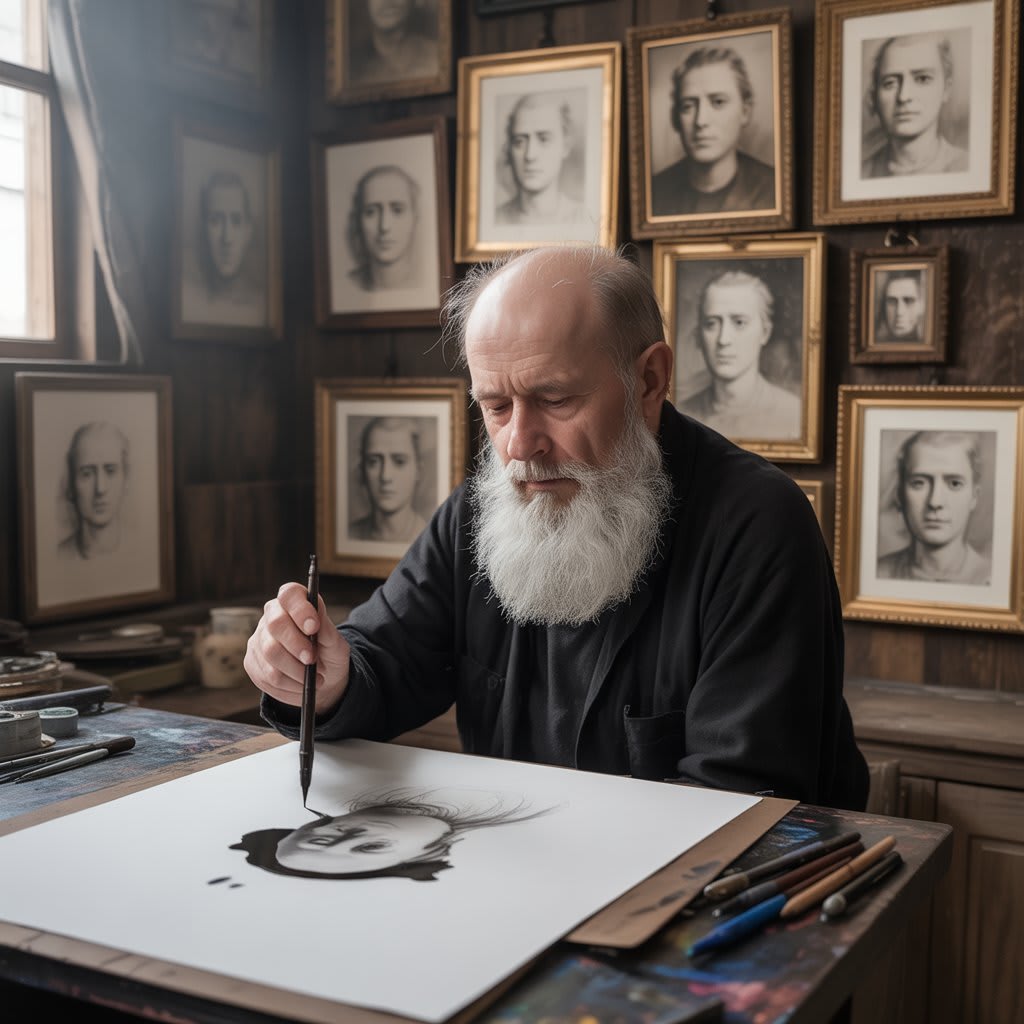
The old man’s hand trembled as he rested the pen above the pristine white page. The studio was silent except for the occasional scratch of graphite on paper, a sound that seemed louder in the stillness of the room. He leaned back in his chair and closed his eyes, letting a shiver pass through him. Memories of faces, faces he had captured for decades, now hovered just beyond the reach of his vision, blurred and distorted, as if the world itself had grown shy.
“Why now?” he whispered to the empty room.
Decades of photographing strangers, friends, lovers, and family had always been his way of seeing the world and of remembering it. But that morning, the faces he once traced in light and shadow had vanished. Not metaphorically. Literally. Each person he looked at appeared in sharp detail except for the face. Blank. Smooth. Featureless.
He picked up a photograph of a smiling woman, someone he thought he would always remember. Her hair curled in the sunlight and her eyes sparkled in silver halftone, yet her face was an empty canvas. The ache in his chest sharpened.
“Am I losing my mind?” he muttered.
The old man, known to most as Elias Marr, had been a photographer of renown. His portraits hung in galleries, coffee shops, and private homes. People came to him hoping to capture not only their appearance but the essence of themselves. He had always been proud of that, proud of his ability to freeze the soul in a frame. And now, he could not see it at all.
He sighed and pushed a chair closer to the massive, blank page before him. Ink pooled at the tip of his trembling pen as though the pen itself shared in his despair. Slowly, almost hesitantly, he began to draw.
Lines, shapes, shadows, a curve here, a smear there. He did not know why he drew what he did, only that his hand moved as if guided by someone else. Minutes stretched into hours, but the page remained stubbornly alive with unfinished forms, vague silhouettes, faint outlines of noses, lips that almost formed smiles, and eyes that hovered like lost stars.
A knock on the door startled him.
“Elias? You still here?” It was Marianne, his assistant and the one person who knew him best. She stepped inside carrying a cup of tea. Her face was fully visible, of course, but to Elias it was just another smooth mask.
“Marianne,” he said, his voice rough. “Do you see it too?”
She frowned. “See what?”
“I cannot see faces, not today, not anyone.”
Marianne set the tea down and touched his arm. “You are tired, that’s all. You have been working too hard. Come on, sit. Let me make you some soup.”
“I am not tired,” he snapped, though the sound surprised him. “I cannot see them, and it is not just you. Nobody, faces, gone.”
She paused, searching his eyes. “That is impossible.”
“Maybe,” Elias admitted, “but it is real.”
Alone again, he returned to the page. This time, the shapes seemed to move, as if the pen was pulling the missing pieces from memory, but memory itself was unreliable. He drew a man with broad shoulders, a woman with laughing eyes, a child skipping through a garden, and yet their faces remained absent, only the faint suggestion of eyes, a shadow where a smile should have been.
Hours became a day, and days blurred into one another. He slept little, ate less, and spent every moment attempting to recapture what his eyes could no longer perceive. Every person he met, every photograph he touched, was a puzzle missing its most essential piece.
Then, one evening, as the rain drummed lightly against the windows, a knock came at the door. A small parcel had been left outside with no sender and no note. Elias opened it carefully. Inside was a single old photograph, yellowed at the edges. His breath caught. It was a photo of a woman, standing on a pier with her arms open to the wind. The face was faint, barely visible, but for a second, just a flicker, he saw her smile clearly.
“Lena,” he whispered.
She had been someone he loved decades ago, someone who had vanished from his life without warning. And now, in the shadow of this blank-faced world, she had returned through the photograph. His heart raced as he traced her outline with a finger, feeling a strange warmth despite the emptiness around him.
Elias rushed to the page and began to draw again, guided by a sudden clarity. This time, shapes became more defined. Features began to emerge. It was Lena, yes, but also the many others he had photographed over the years. Slowly, slowly, the faces returned, not as perfect replicas, but as echoes of memory, imperfect yet real.
A noise behind him made him turn. Marianne stood in the doorway, her cup of tea long forgotten. “Elias, the studio…”
The studio was filled with the soft glow of completed portraits. Every face that had been erased now stared back at him, some smiling, some sorrowful, some curious. At the center, a faint shape in the newest sketch mirrored Lena’s photograph perfectly.
“You have remembered them,” Marianne whispered.
“No,” he said, tears sliding down his cheeks. “They never left. I just forgot how to see.”
He looked around the room at the scattered sketches and photographs, at the traces of ink and graphite on his fingers, and realized something profound. The faces had never truly disappeared. The eye may forget, but the heart never does. It is memory, emotion, and longing that allow us to perceive the world beyond sight.
A shadow moved near the window, and for a brief moment, Elias thought he saw Lena alive and smiling. He blinked, and she was gone. The room was empty, save for Marianne and the ghosts of his past subjects.
Elias sank into his chair, exhausted but strangely peaceful. He understood now that his gift, or curse, was not in capturing the physical image, but in remembering what people meant to him. The true art had always been in the heart, not the eye.
As the first light of dawn spilled across the white page, he held his pen and smiled faintly. The portraits were imperfect, fragmented, and alive with memory. Each face told a story, a life, a love, a moment, and in that imperfection, he found beauty.
He had been blind and now he could see again, not with his eyes, but with everything that had ever made him human.
The pen hovered above the page. Ink dripped slowly, deliberately, forming the outline of a face that was not quite finished. Elias did not need to finish it. He knew he never would. The memory, the feeling, the recognition was enough.
And for the first time in weeks, he laughed. It was soft, fragile, and full of wonder.
When the eye forgets what the heart remembers, perhaps the heart is the only true lens we needs.
About the Creator
Wahdat Rauf
I am an article writer who turns ideas into stories, poems, and different type of articles that inspire, inform, and leave a lasting impression.
Keep reading
More stories from Wahdat Rauf and writers in Fiction and other communities.
The Day I Stopped Editing My Life
I still don’t know whose blood was on the red pen. It was 3:17 a.m. when I found the Montblanc lying across my manuscript like a murder weapon. The cap was off, the nib bent, and a single crimson bead trembled at the tip. My apartment—usually a surgical white cube of right angles and labeled drawers—reeked of wet iron and turpentine. I hadn’t painted in seven years.
By Wahdat Rauf2 months ago in Fiction
So You Decided To Become a Nurse Practitioner:
So you decided to become an "Advanced Practice" nurse. Congratulations!... is what I would say if this was a good idea. Grad school? In this economy? What were you thinking? Likely it was something along the lines of either 1) “I've seen these other chucklefucks do it— Why can't I?” or even 2) “I've got a nice career, I should shake it up. I miss feeling like I have no clue what I'm doing.”
By Sandor Szabo2 days ago in Fiction
The Confrontation, Saturday, September 24th, 2011
“Toby’s dad is ‘it’,” called one of the neighborhood boys at the park. Anton was enjoying his weekly Saturday game of tag with Toby and the neighborhood kids at the local park. The park’s large, grassy area was rarely mowed and riddled with weeds. Random garbage and the occasional pile of dog feces dotted the landscape. In the center of the park was a circular area of old, red mulch with a rust, brown jungle gym in its center. On the side adjacent from each other were two equally deteriorated, brown swing sets. The children used one of the swing sets, while the other set only had one swing left. That individual swing was used by the local drug dealer as a one stop shop for a variety of illegal drugs. He monopolized that spot for a majority of each day.
By Anton Mathias Heft about 4 hours ago in Fiction



Comments
There are no comments for this story
Be the first to respond and start the conversation.