
The Day I Stopped Editing My Life
Embracing Imperfection: How Letting Go of Perfection Freed My Creativity

I still don’t know whose blood was on the red pen.
It was 3:17 a.m. when I found the Montblanc lying across my manuscript like a murder weapon. The cap was off, the nib bent, and a single crimson bead trembled at the tip. My apartment—usually a surgical white cube of right angles and labeled drawers—reeked of wet iron and turpentine. I hadn’t painted in seven years.
“Elise,” someone whispered from the hallway. My own voice, but younger.
I froze. The only light came from the city’s sodium haze bleeding through the blinds, striping the floor in prison bars. I lived on the twenty-third floor of the Meridian Lofts, a building so exclusive the doormen wore earpieces and called me “Ms. Vale” even when I was barefoot. No one had a key. No one.
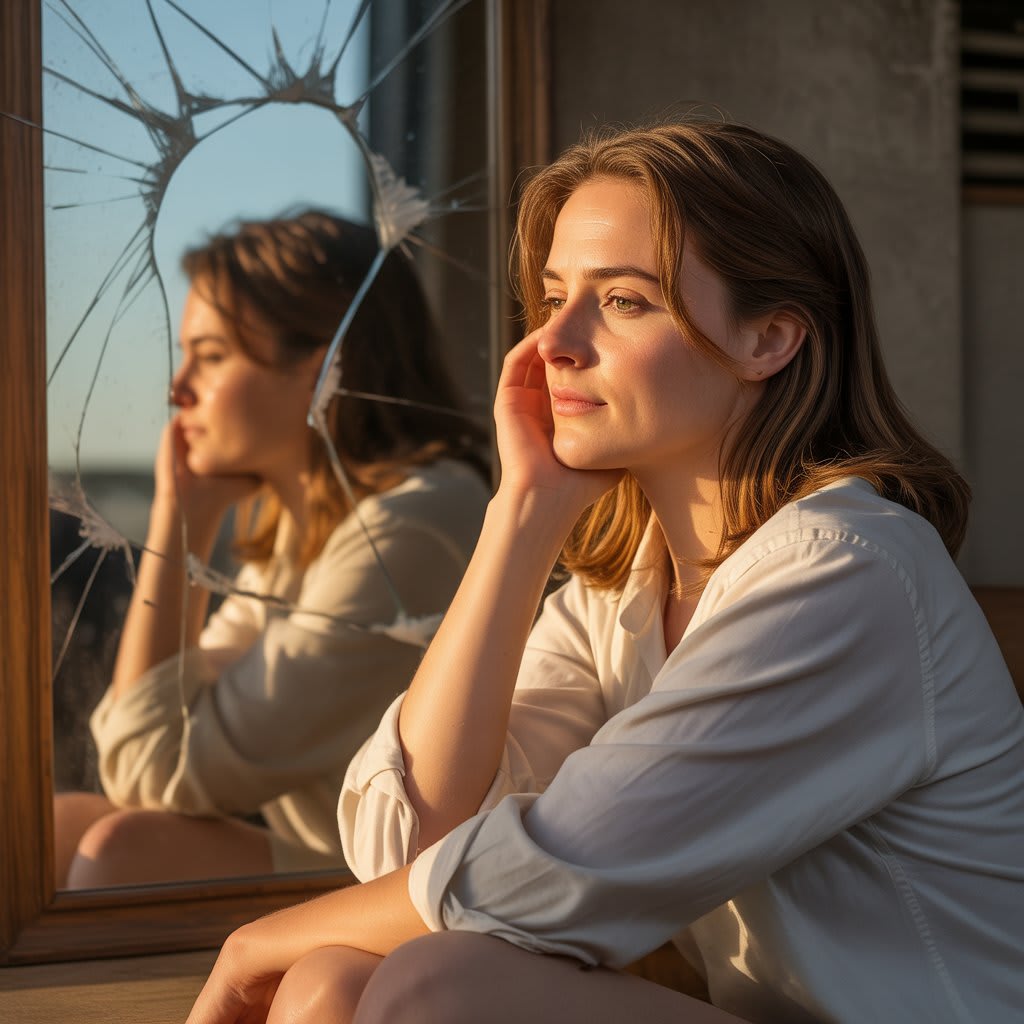
I crept toward the sound. The hallway mirror reflected me—thirty-four, black silk pajamas, hair twisted into the same low knot I’d worn since graduate school. But the reflection blinked a half-second after I did.
“Stop fixing everything,” the mirror-Elise said. Her pupils were blown wide, like she’d been crying ink.
I reached for the glass. My fingers passed through, cold as a gallery wall in winter. On the other side, the apartment was identical except for one detail: every surface crawled with color. Walls bled cadmium, the ceiling dripped cerulean, and my pristine white sofa had been slashed open to birth a garden of poppies.
The red pen vibrated in my pocket like a trapped wasp.
That was the first twist.
I’d spent a decade editing—first other people’s novels at Archway House, then my own life. I color-coded emotions, scheduled orgasms, and ghost-wrote apologies for billionaires. My own book, The Architecture of Longing, had been rejected forty-three times because every sentence was “too perfect to feel.” My agent, Marcus, said readers wanted scars. I gave them marble.
The second twist came at dawn.
I woke on the hardwood, cheek glued to a page. The manuscript I’d been revising for three years—Chapter 17: The Geometry of Grief—was gone. In its place lay a single sheet, handwritten in frantic loops:
If you want your life back, burn the red pen at the place you first learned to draw.
No signature. The ink smelled like my mother’s attic.
I hadn’t drawn since I was nine. The summer before she died, Mom converted the garage into a studio. Easels, turpentine, a cracked skylight that painted us in fractured rainbows. She let me ruin canvases. I ruined seventeen before she laughed and said, “Perfection is a thief, Elise. It steals the story.” Then the cancer stole her.
I kept one painting: a crooked sailboat on a purple sea. Dad called it garbage. I hid it behind the water heater.
Now the red pen pulsed against my thigh like a second heart.
I took the elevator down twenty-three floors, past the doorman who pretended not to notice my bare feet. Outside, October wind knifed through my pajamas. The city was still asleep, but the subway ran. I rode to Queens, to the house Dad sold after the funeral. The new owners had painted it beige.
The garage was unlocked.
Inside, moonlight speared through the same cracked skylight. The air tasted of mouse nests and linseed oil. My sailboat leaned against the wall, frame splintered, colors faded to bruises. Someone had taped a fresh canvas beside it—blank, waiting.
Footsteps behind me.
Marcus stepped from the shadows, trench coat collar up, eyes red-rimmed. “You weren’t supposed to come here.”
“You wrote the note?”
He held up a matching Montblanc. “I’ve been editing you for years, Elise. Your metaphors are airtight, your life is airtight, and you’re suffocating.”
I laughed, a sound like breaking glass. “You broke into my apartment?”
“I used the key you gave me after the Hamptons retreat. Remember? You said, ‘In case I lock myself out of my own happiness.’”
The red pen burned. I pulled it out. The blood was dry now, flaking like rust.
Marcus continued, softer. “Your mother’s last words to me—she made me promise to remind you when you forgot how to be messy.”
“Mom’s been dead twelve years.”
“Doesn’t mean she stopped talking.” He gestured to the blank canvas. “One stroke. No erasing.”
Conflict coiled in my chest—terror that the stroke would be ugly, hope that it might be true. I uncapped the pen. The nib was bent, but it bled.
I painted a single red line. Crooked. Thick. Alive.
The garage trembled. The skylight shattered inward, raining diamonds of glass. Where each shard landed, color erupted—vermilion poppies, cobalt waves, a yellow so bright it sang. The sailboat lifted off the floor, sails billowing though there was no wind.
Marcus smiled, the first real one I’d seen from him. “Now burn it.”
I touched the pen to the canvas. Flame raced the red line, devouring white space. The fire didn’t burn me; it warmed me, like Mom’s hand on my fevered forehead.
Twist three: the flames weren’t destroying the canvas—they were revealing it. Beneath the white gesso lay a mural I’d painted at nine, hidden under layers of primer when Dad said art was for people with trust funds. A storm-tossed sea, a girl in a yellow slicker waving from a lighthouse. Me.
The garage dissolved. I stood in my apartment, but it was different. The walls were raw brick, the floor scarred with paint. My manuscript sat on the desk—Chapter 17 rewritten in crayon, margins crowded with doodles.
Marcus was gone. The red pen was ash.
I opened my laptop. The cursor blinked. For the first time, I didn’t plan the sentence. I let it stumble.
She was never the lighthouse. She was the storm.
The words felt like breathing after years underwater.
Epilogue, six months later:
The book launched on a Tuesday. Not at a glossy bookstore but in the Queens garage, now a community studio. Kids finger-painted on the walls. Marcus read the dedication aloud:
For Mom, who taught me that mistakes are just stories in disguise. And for the girl who finally stopped editing her life.
Afterward, a woman approached—mid-forties, paint under her nails. “I used to be you,” she said. “Every email proofread twelve times. Then I read your chapter about the red pen. I quit my job. Started welding scrap metal into birds.” She showed me a photo: a phoenix made of rusted hubcaps, wings spread mid-flight.
I cried in front of strangers. It was messy. It was perfect.
That night, I found a new pen on my desk. Black ink, no cap, nib already scratched. A note in my own handwriting:
Keep going. The next mistake is waiting.
I smiled, uncapped it, and wrote until dawn.
The blood on the red pen? Turns out it was mine—pricked finger from a rose thorn the day Mom died. I’d kept the stain like a relic. Letting it burn was the hardest edit I ever made. And the easiest.
(The story is written and editted by author with minimal language support)
About the Creator
Wahdat Rauf
I am an article writer who turns ideas into stories, poems, and different type of articles that inspire, inform, and leave a lasting impression.
Keep reading
More stories from Wahdat Rauf and writers in Fiction and other communities.
The People Who Live in My Grocery Store
The fluorescent lights buzzed softly, like a whisper nobody cared to listen to. I’d been coming to this grocery store for months, maybe years, though I could never be sure anymore. Not the shopping, not the aisles, not the faint smell of polished floors and stale coffee. It was the people.
By Wahdat Rauf2 months ago in Fiction
Incident Preparedness Guidelines: Safety Procedures for Unplanned Incidents.
Dear New Staff Member, Herein are instructions that are provided as a courtesy to ensure safety across our green campus. Please follow them carefully. As you are aware from your recent onboarding course, your wellbeing and that of the children in your care is paramount to our institution. Consistency is key. In precarious situations, panic is somewhat inevitable. Naturally, we aim to minimise this as much as humanly possible. You will invariably, from your mandatory attendance of the above-named course, recall that children under undue pressure respond best to routines that are both familiar and rehearsed.
By River and Celia in Underland 5 days ago in Fiction



Comments
There are no comments for this story
Be the first to respond and start the conversation.