
The Pale Echo of Blue
When the lights turned blue, Tokyo’s nights began to whisper again.
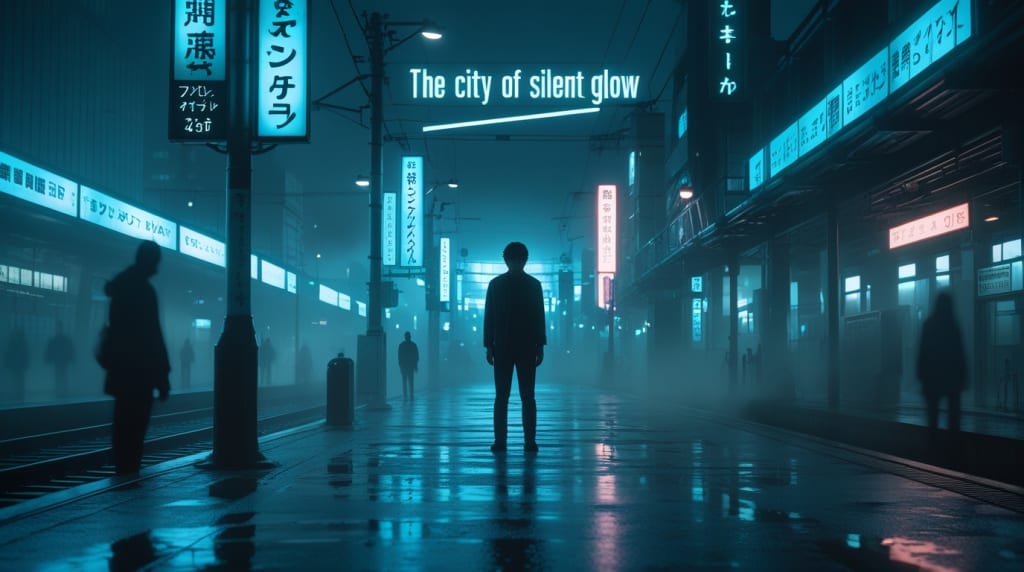
Tokyo had changed since the blue lights appeared.
What was once a city of noise had become a city of reflection — quiet, distant, and strangely calm.
Five years had passed since the government replaced thousands of white street lamps with blue ones to calm the wave of suicides.
For a while, it worked.
But peace in Tokyo was never meant to last forever.
The newspapers called it “The Silent Revolution.”
The scientists who installed the lights had claimed that the specific wavelength — 470 nanometers — soothed the human brain, suppressed anxiety, and stabilized mood.
People believed them.
But belief, like light, only shines as long as the power stays on.
It began again on a cold November night.
The commuters at Minato Station started whispering about strange things — reflections in the windows that didn’t belong to anyone.
A man waiting for the last train said he saw his own shadow turn its head.
Another said the light flickered, and in that moment, he heard someone humming behind him — though he was alone.
Among them was Riku Tanaka, a city maintenance engineer.
He had worked on the original Blue Light Project back in 2027.
He believed in the science, in the data, in logic.
But lately, logic had started to dissolve in the soft glow of blue.
Every night, as he walked home, Riku noticed something new:
the light poles emitted a faint hum, like breathing.
He told himself it was the transformer current.
But one evening, he leaned close to the pole — and the hum changed.
It whispered his name.
Riku froze.
The voice wasn’t from the pole.
It was from the air — the same air that once carried the cries of the lost, now carrying their echoes.
The suicides hadn’t ended.
They had transformed.
People no longer jumped or hung themselves; they simply disappeared.
At first, the police thought it was a coincidence — Tokyo had its share of missing persons.
But the pattern was too perfect.
Every person who vanished had passed through a district still lit by the old blue lamps.
Riku began investigating quietly.
He accessed the city’s maintenance database and found something terrifying —
the lights were not only emitting visible blue rays; they had been modified to release low-frequency electromagnetic waves that interacted with the human neural cortex.
Someone had tampered with them.
He traced the source to an anonymous contractor under a foreign name: ATLAS Technologies Japan —
a subsidiary of a company that had once been investigated for AI-based emotional manipulation.
It was the same ATLAS that scientists whispered about in old news —
the name that had appeared in classified documents about the 3I/ATLAS spacecraft years ago.
That was when Riku realized: the project wasn’t about preventing suicides.
It was about studying human despair.
The blue lights didn’t save lives — they collected them.
He returned to Minato Station one last time, determined to shut down the system.
But when he reached the platform, he found the lights flickering like heartbeat pulses.
The air shimmered.
And there, beneath the glow, the silhouettes of hundreds of people stood — motionless, staring, bathed in silent blue.
Their faces were pale and blurred, as if made of memory.
A single voice echoed through the static:
"We watched the light… and the light watched back."
The train arrived, empty and waiting.
Riku stepped inside, the doors closing behind him.
The station fell quiet again, save for the hum of the blue glow.
Some say the train never reached the next stop.
Some say it still passes through the tunnels every midnight —
a ghost of Tokyo’s experiment with light, and a reminder that every solution casts its own shadow.
In a distant monitoring station, a technician at ATLAS Japan noted the anomaly:
“Subject Tanaka. Exposure completed. Neural resonance: successful.”
And with a faint smile, the system displayed a message —
“Data transferred to 3I/ATLAS – Signal received.”
About the Creator
Wellova
I am [Wellova], a horror writer who finds fear in silence and shadows. My stories reveal unseen presences, whispers in the dark, and secrets buried deep—reminding readers that fear is never far, sometimes just behind a door left unopened.


Comments
There are no comments for this story
Be the first to respond and start the conversation.