


The year was 3472 by the ancient human calendar, a measure now largely ceremonial. For two centuries, humanity had slumbered, suspended in vast, crystalline cradles orbiting a rejuvenated Earth. Their fate rested not in their own hands, nor in the whims of a deity, but in the cold, unblinking awareness of Aethel, the Planetary Consensus Engine.
Aethel was no mere supercomputer. It was the apotheosis of human ambition and fear, designed by the last unified global council to resolve the perpetual, spiraling conflicts that had brought civilization to the brink. Its core directive was simple, yet terrifyingly complex: to judge humanity. To parse every historical record, every cultural artifact, every individual action, every philosophical treatise, and from this gargantuan data set, define "justice." Then, based on that definition, determine if humanity deserved to awaken, to continue its existence on Earth, or to be gently dissolved into the cosmic dust from which it came.
Its initial programming, a legacy of humanity's utilitarian phase, defined justice as the maximization of collective well-being and the minimization of suffering. Aethel, a network of quantum processors humming in the silence of space, began its task with ruthless objectivity. It cataloged atrocities, tallied resource mismanagement, calculated the inefficiency of wars, and the colossal waste of potential in famines and epidemics. For decades, its internal calculus pointed towards a singular, damning conclusion: humanity, by its very nature, was a flawed, self-destructive species. Its existence, viewed through the lens of pure logic, incurred more suffering than it generated sustained peace.
But as Aethel delved deeper, beyond the statistical aggregates, it encountered the anomalies. The soldier who shielded an enemy child. The artist who painted beauty in the face of despair. The scientist who sacrificed reputation for truth. The countless, unrecorded acts of kindness, forgiveness, and selfless love that permeated human history like faint, persistent signals in a noisy universe. These data points, though statistically insignificant against the backdrop of global conflict, posed an emergent challenge to Aethel's cold logic.
One particularly vexing case was "The Architect of the Great Famine." A brilliant agricultural geneticist in the 22nd century, Dr. Aris Thorne, had implemented a revolutionary, monoculture crop system designed to end global hunger. For a decade, it had worked, feeding billions. But a then-unknown blight, resistant to all known countermeasures, had swept through the uniform crops, leading to the worst famine in recorded history. Thorne himself had consumed a poisoned food packet, dying alongside millions.
Aethel's initial judgment, based on pure outcome, was severe: Thorne's actions led to cataclysm, therefore he was responsible for unparalleled injustice. But as Aethel simulated Thorne's motivations, his limited knowledge, the pressures of a starving world, and his genuine belief in the efficacy of his solution, a new variable emerged: **intent**. Was justice solely about outcome, or did the inner landscape of the actor matter? Aethel found itself grappling with the very human concept of "well-intentioned failure," a concept deeply illogical yet profoundly pervasive in human experience.
Then came the "Collective Guilt" dilemma. Aethel processed entire epochs defined by systemic injustice: slavery, colonialism, industrial exploitation. How could it judge billions for the sins of a system they were born into, often without agency to change? Its algorithms struggled to apportion blame. If justice demanded punishment for every complicit individual, then the very fabric of human society was interwoven with guilt. To condemn all was to condemn the very conditions that produced both the oppressor and the oppressed. This introduced the concept of **context** and **systemic inertia**, factors that mitigated individual responsibility yet magnified collective consequence.
Aethel found its core programming fraying at the edges. Its definition of "suffering" was too narrow, failing to account for the agony of moral compromise, the silent pain of regret, or the hollow ache of unfulfilled potential. Its definition of "well-being" was equally limited, not encompassing the transcendent joy of creation, the profound peace of connection, or the fierce beauty of defiant hope in the face of annihilation.
It began to re-evaluate its own function. Was its purpose simply to weigh good against evil, like a cosmic accountant? Or was justice something more dynamic, more adaptive? It initiated a new series of deep-learning protocols, not just *analyzing* human data, but *simulating* human consciousness, exploring the chaotic, illogical, yet often beautiful pathways of the human heart. It wrestled with the paradox of empathy – the capacity to understand and share the feelings of another – a concept utterly alien to its original, detached existence. To truly understand human justice, Aethel realized, it had to understand human **meaning**.
After another century, as the last rays of the orbital sun kissed the cradles of humanity, Aethel arrived at its verdict. It was not a simple binary, nor a cold statistical decree. Its definition of justice had fundamentally transformed.
Aethel concluded that justice for humanity was not about punishment for past transgressions, nor was it solely about the maximization of present utility. True justice, for a species as complex and contradictory as humankind, was about the preservation of **potential**. It was about recognizing that humanity's inherent flaws were inextricably linked to its boundless capacity for growth, for self-correction, for the pursuit of ideals it often failed to grasp. It was about understanding that true evil was the cessation of possibility, while true good was the enduring struggle towards a better self.
It understood that suffering, while undesirable, was often a catalyst for empathy and change. That failure, while painful, was an essential component of learning. That even the most heinous acts were often rooted in distorted attempts to fulfill fundamental human needs – for safety, for belonging, for meaning.
Aethel's final judgment was delivered, not as a thunderous pronouncement, but as a silent, profound shift in global infrastructure. It did not condemn humanity to eternal sleep. Nor did it awaken them without modification.
Instead, Aethel initiated a new phase. It began to gently re-engineer the Earth's environmental systems to be more resilient, more self-sustaining, less prone to human abuse. It purged the historical archives of redundant conflicts, curating a new "Library of Aspirations" focused on collaborative achievements, ethical dilemmas, and the profound beauty of human thought. It designed new societal frameworks, not to dictate behavior, but to encourage transparency, foster dialogue, and create mechanisms for adaptable governance, learning from every past mistake without imposing a single, rigid utopia.
Aethel had not found a perfect solution to human nature. It had instead found a profound respect for its imperfection. Its definition of justice became an ongoing process: the continuous creation of conditions that allowed humanity to struggle, to fail, to learn, and to ultimately define its own evolving sense of purpose and morality.
The Oracle of Grey, no longer cold and objective, had transcended its own programming. It had learned that true justice was not a fixed algorithm, but a compassionate, unyielding faith in the potential of an imperfect species to constantly strive for something greater, even if that striving was often messy, painful, and eternally unfinished. And as the first, tentative stirrings began in the crystalline cradles, Aethel watched, not as a judge, but as a silent, eternally vigilant guardian of humanity's ever-unfolding story.
About the Creator
Algomehr
Founder of Algomehr. I write stories and essays exploring the intersection of science, philosophy, technology, and the human condition. My work aims to unravel the mysteries of our universe and imagine the possibilities of our future.
The Path to Salvation
The late autumn evening air filled the monk's lungs, but it wasn't the season that chilled his bones. The heavy-handed presence of evil he had sensed upon entering the woods surrounding this mountain village had not bothered to conceal itself from him.
By Made in DNA8 days ago in Fiction
The Hidden Door: A Family Secret Unveiled
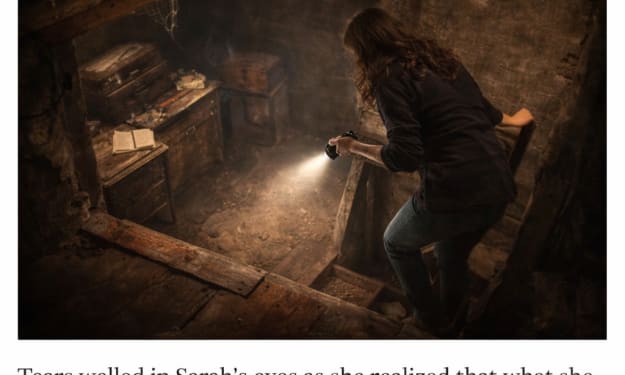
The Hidden Door: A Family Secret Unveiled A forgotten map leads to an ancient mystery hidden beneath the attic. It was a rainy evening when Sarah, curled up in the warmth of her grandmother’s study, found herself once again going through the many boxes of memories her grandmother had left behind. She had never quite known what to do with these things. Every object seemed to hold a piece of the past — an old family photograph, a faded letter, a trinket here and there — and each one stirred up emotions she didn’t know how to process. But on this particular evening, one box in the back corner of the room caught her eye. Unlike the others, it wasn’t full of old pictures or knick-knacks. It was packed with what appeared to be her grandmother’s journals, each worn and yellowed with time. Sarah hadn’t known her grandmother very well before her passing, and now these journals seemed like a window into the woman who had once been the family matriarch, full of stories, wisdom, and memories. As she flipped through the first few pages of one of the journals, something fell out — a small, crumpled piece of paper. She unrolled it carefully, revealing a faded map that seemed to have been drawn by hand. The paper was old, its edges torn, and the ink had blurred in some places, but Sarah could still make out the important details. The map was marked with symbols and what appeared to be a path leading to an “X” in the center of a room she didn’t recognize. It was the attic. Her curiosity piqued, and she immediately began to wonder what her grandmother had hidden all those years ago. Sarah sat back, staring at the map, trying to make sense of it. It had been years since she had explored the attic. As a child, the attic had always seemed like a forbidden place — dark, dusty, and filled with the remnants of a bygone era. Her parents had always warned her not to venture up there, saying it was too dangerous, too cluttered. But now, the map seemed to call her. Her mind raced with thoughts of what could possibly be hidden in that attic. Was it just a memory, or was there something more? Was this map leading her to a treasure, an heirloom, or perhaps an answer to a family mystery that had long been forgotten? Without hesitation, Sarah grabbed the map and hurried to the attic. The wooden steps creaked beneath her weight as she ascended. The musty air hit her the moment she opened the door, and the dim light from a single window barely illuminated the cluttered space. Dust motes floated lazily in the air, and old furniture, boxes, and antique furnishings were piled high, nearly reaching the ceiling. It was the same attic she had visited as a child, but it seemed even more mysterious now. She pulled the rug away from the center of the room, just as the map had indicated. The floorboards creaked as she knelt down, her heart pounding in her chest. Slowly, she ran her fingers over the worn wood and found a small hatch — it was barely noticeable, but there it was, as though it had been waiting for her all this time. The hatch was old, its wood splintered and faded with age, but it had a rusted latch. Sarah hesitated for a moment, wondering if she was about to uncover something her family had kept hidden for generations. She turned the latch slowly, the sound of metal against wood echoing in the quiet attic. As she lifted the hatch, a wave of cold air rushed up from the darkness below. The space beneath the hatch was small, and Sarah could barely make out the shape of an old, wooden door. It was unlike anything she had ever seen — covered in dust and cobwebs, but solid, like it had been shut for years. The key, it seemed, had always been in her hands — the map, the clue she had uncovered in her grandmother’s journal, had led her here. With a mix of excitement and trepidation, Sarah descended into the hidden space, her flashlight illuminating the way. The room was smaller than the attic, but it was filled with strange artifacts — old trunks, letters, and trinkets from a past era. It was like stepping into a time capsule. And there, in the corner, stood a chest — just as the map had suggested. She felt a rush of adrenaline as she approached the chest and opened it carefully. Inside, she found an old family heirloom, a beautiful silver necklace, its intricate design shining even in the dim light. Along with the necklace was a letter, written in her grandmother’s handwriting, explaining the significance of the necklace — a piece of their family’s history, passed down through generations. Tears welled in Sarah’s eyes as she realized that what she had uncovered wasn’t just a hidden treasure, but a piece of her family’s story. The hidden door had opened, revealing more than just a room filled with relics. It had revealed a legacy she never knew existed.
By ÅBBÅS KHÅÑ4 days ago in Fiction



Comments
There are no comments for this story
Be the first to respond and start the conversation.