
The Ministry of Distraction Did Its Job Well
While everyone was busy "living their best life," everything collapsed. And no one was watching.

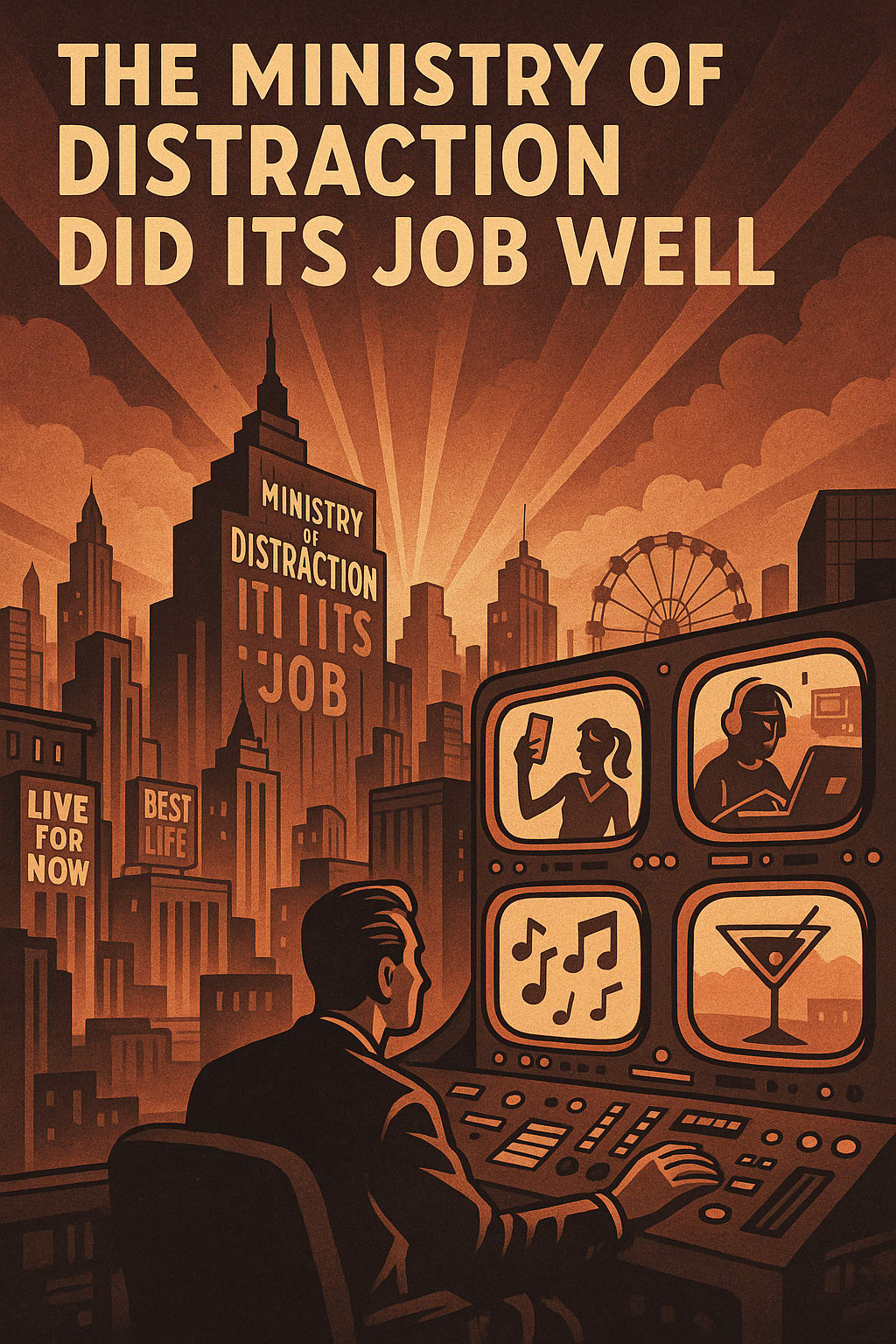
I. Please Enjoy Responsibly
They told us to live in the moment.
And so we did.
We streamed it. Filtered it. Monetized it. We became our own commercials. Our lives were montages, chopped and set to lo-fi beats. Every breath, curated. Every silence, scored.
We were told to be present, so we outsourced the future. Let someone else worry about the details—carbon, debt, surveillance, collapse. We had brunch to attend, abs to tone, mood boards to build. Productivity was self-care, and self-care was consumption.
The Ministry of Distraction didn’t look like a ministry. It looked like a wellness brand. A lifestyle platform. A menu of micro-pleasures delivered instantly and algorithmically, just for you. Scented updates. Targeted affirmations. Influencers whispering that you deserve more, but never asking why you have less.
Who needs censorship when you can flood every channel with curated joy, absurd headlines, and personalized alerts that made you feel like the center of a story that never quite began? Dissent drowned in a thousand notifications. Urgency collapsed under scheduled content.
History happened, but it happened somewhere else. Usually offscreen. If it couldn’t be swiped or clipped, it didn’t exist. Catastrophes were swallowed by trends, recycled as #content, transformed into mood.
The world didn’t burn in one go. It burned frame by frame, between ads. And we were there. We watched the livestream. We clicked Like. We shared a thought. We felt seen. We moved on.
II. A World Without Edges
Boundaries blurred. That was the goal.
Work became life. Life became content. Content became everything. Rest was productivity rebranded. Leisure was hustle in softer clothing. Even dreams were optimized, tracked, analyzed.
You could wake up in a bed you didn't own, order coffee with a thumbprint, call your job a “journey,” and count your friends in followers. Your heartbreak was a personal brand. Your grief, a growth opportunity.
Reality flattened into a feed. The news came packaged with humor. Tragedy came with reaction videos. Grief was rebranded as growth. Empathy had a time limit. Suffering had a filter.
When someone screamed fire, we assumed it was a trend. Or a metaphor. Something to duet, remix, retweet. Nothing that required water, or running.
The Ministry encouraged balance. Not justice, not revolution—balance. A little outrage, a little calm. Enough to keep you scrolling, not enough to make you act. Outrage fatigue was not a bug—it was a feature.
They taught us to optimize. Everything, always. But never to rebel. Rebellion has low click-through rates. Uprising doesn't trend. Real change doesn’t have an affiliate link.
We filtered until we forgot the texture of skin, the smell of dirt, the sound of silence. All sharp edges were rounded off. What remained was smooth, frictionless, and utterly inescapable. We lived in a cloud of curated fog, mistaking clarity for glitch.
Even our dreams were sponsored.
III. The Collapse Was Not Televised
There was no siren. No headline that read: “This Is the End.”
Instead, it came as a software update. A change in terms of service. A subtle shift in tone. The terms became longer. The buttons, harder to find. Then one day, they didn’t work at all.
The floods came, and we posted underwater selfies. The blackouts came, and we lit candles, called it retro. Supply chains fractured, and we rebranded it as “localism.”
The Ministry smiled. No resistance needed. The distracted do not revolt. They refresh. They adjust brightness. They scroll.
Even the dissenters were caught in the trap. Their fury became a genre. Their critiques became content. Monetized, echoed, buried. Activism collapsed into aesthetics. The revolution was a carousel post.
We talked about everything. We understood nothing. We were more connected than ever, and completely alone. We debated collapse in the comments. We sent thoughts and prayers with emoji reactions.
The world ended five times last year. You missed it. There was a new show dropping that night. The final season. The end of fiction, but not the beginning of truth.
Even now, some of us wonder if maybe we just missed the update.
IV. Legacy Settings
Now, the Ministry is gone. Or maybe it was never real. Maybe we were the Ministry, all along. We coded our own cages. We liked, we subscribed, we consented.
There are still signals, faint and cracked, on old devices. A voice saying: “Keep watching.” The batteries are low. The screens are dim. But the loop persists.
But there’s nothing left to watch. No new uploads. No sponsored tears. Just abandoned channels, glitching with nostalgia.
Just a hum. A buffer symbol spinning forever. A silence deep enough to hear your own thoughts—if you remember how. If silence doesn’t feel like failure.
We buried the archives under hashtags. We paved over history with convenience. We chose ease over meaning. Connection over consequence.
And all we wanted was to be happy. Safe. Entertained. Protected from pain. Sheltered from doubt. Distracted from death.
The Ministry of Distraction did not betray us. It gave us exactly what we asked for. It handed us mirrors and asked for nothing in return.
That was the real trick. That was the genius.
And now, here in the quiet, it’s finally possible to hear what was lost. The echoes. The original questions. The memories of resistance.
Unless, of course, something new pings your phone.
And it always does.
About the Creator
Alain SUPPINI
I’m Alain — a French critical care anesthesiologist who writes to keep memory alive. Between past and present, medicine and words, I search for what endures.
Keep reading
More stories from Alain SUPPINI and writers in Fiction and other communities.
Mastering French Without Losing Your Sanity: A Realistic Guide for Beginners
Learning French can feel like solving a Rubik’s Cube blindfolded. The tricky pronunciation, the never-ending grammar rules, and the surprising exceptions make it seem impossible. But don’t worry—equipping yourself with key expressions and effective strategies can turn frustration into fluency. Let’s simplify French and make learning enjoyable.
By Alain SUPPINIExclusive • 11 months ago
Wild Card Weekend Recap: What Happens Now?
I think I figured out why I love Wild Card Weekend so much. It's because it's the first playoff anything of the calendar year. The NFL season starts in the fall, and once upon a time, the champion was crowned either on or slightly before New Year's. The evolution of the NFL schedule has resulted in the playoffs starting just into the New Year, and currently, the final week of the season falls on the first weekend of the New Year, with Wild Card Weekend coming a week after that. So yes, chronologically, the NFL's Wild Card Weekend serves as the first playoff anything of the calendar year.
By Clyde E. Dawkins6 days ago in Unbalanced



Comments
There are no comments for this story
Be the first to respond and start the conversation.