
THE COSMIC INTERROGATION: JANUARY 22 IS JUDGMENT DAY (3I/ATLAS)
For months, 3I/ATLAS has mocked our understanding of physics with its impossible speed and backward-facing jets. But on January 22, 2026, the shadows are going to disappear.

The universe rarely gives second chances. Usually, when an interstellar visitor screams through our solar system, it stays hidden in the dark, keeping its secrets as it fades into the void. We saw this with ‘Oumuamua, a silent cigar-shaped riddle that refused to speak. We saw it with 2I/Borisov, which kept its distance.
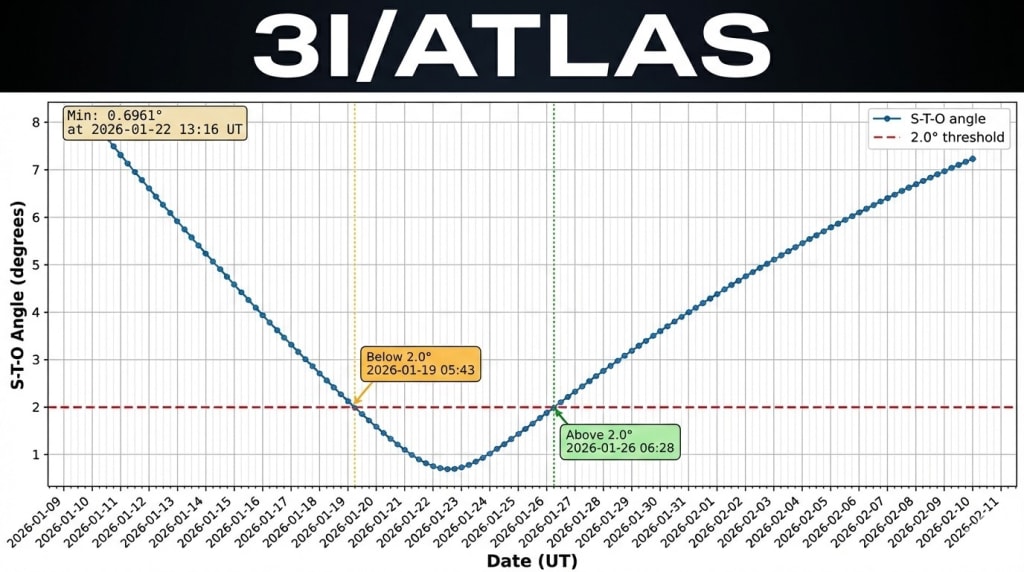
But 3I/ATLAS is different. It isn't just passing through; it is putting on a show. And on January 22, 2026, at exactly 13:00 UTC, a celestial tumbler is going to click into place, offering humanity a once-in-a-lifetime chance to see what this thing really is.
The Perfect Trap
Astronomers call it "opposition." I call it a spotlight.
On this specific date, the Earth will slide directly between the Sun and 3I/ATLAS. This is not a random flyby. It is a geometrically perfect alignment that creates a phenomenon known as the "Opposition Surge".
Think of it like a deer caught in high beams. Usually, when we look at objects in space, shadows hide the details. The surface texture, the craters, the machinery—it all gets lost in the darkness of the angle. But on January 22, the angle between the Sun, Earth, and the object will drop to almost zero.
This triggers a rare physical effect called "Shadow-hiding".
For a brief window, every shadow on the surface of 3I/ATLAS will vanish. The object will not just reflect light; it will erupt in brightness, illuminated from directly behind us.
Faster Than a Bullet
Why does this matter? Because 3I/ATLAS is a monster.
It was clocked moving at 57.7 kilometers per second relative to the Sun. To put that in perspective, the previous visitors were sluggish by comparison—‘Oumuamua moved at 26.4 km/s, and Borisov at 32.3 km/s.
3I/ATLAS is moving with a velocity that suggests it is either running from something, or rushing toward something.
And unlike its predecessors, which were ghosts in the machine, 3I/ATLAS has an "anti-tail jet". It has a stream of material pointing toward the Sun, fighting against the solar wind. Nature doesn't usually build thrusters that point the wrong way.
The Quantum Spike
The alignment on January 22 offers more than just light. It offers a glimpse into the quantum realm.
At this precise angle (less than 2 degrees), scientists are waiting for something called "Coherent Backscatter". This is where light waves traveling through the dust and surface of the object interfere with each other constructively, creating a sharp, intense spike of brightness driven by quantum mechanics.
This is the moment of truth.
If 3I/ATLAS is just a "fluffy fractal aggregate" of dust, the surge will be broad and dull.
But if the particles are compact—or if the surface is manufactured, smooth, or metallic—the surge will be narrow and blinding.
We are about to find out if we are looking at a cloud of primitive dust, or the hull of something much more solid. The geometry is locked in. The clock is ticking
The Eight-Day Interrogation
The universe is not patient. This perfect alignment is a fleeting window. Astronomers have calculated that the critical phase—where the angle is tight enough to trigger the surge—lasts for only ± 4 days around the January 22nd peak.
That gives humanity roughly 192 hours to capture the data. Every major telescope capable of tracking an object of this magnitude (V ∼ 16.5) is currently being swiveled into position. They need apertures larger than 1 meter to catch the photons, but the real prize requires even bigger glass.
Why the rush? Because the light curve holds the answer to the composition of the visitor.
We are looking for the "Albedo"—the measure of how much light the object reflects.
If the data shows a low albedo (around 0.03), it means 3I/ATLAS is likely made of dark, carbonaceous material—the standard "soot" of the cosmos.
But if the albedo spikes high (0.1–0.3), it suggests the presence of bright ice fragments... or something else. Something reflective. Something that doesn't belong on a dying rock.
The Shadow of 67P
To understand how rare this is, you have to look at the history books. We have only ever successfully measured this kind of "opposition surge" for one other comet: 67P/Churyumov–Gerasimenko, visited by the Rosetta spacecraft. That object was dark, dusty, and predictable.
But 3I/ATLAS has already proven it is nothing like 67P. It has an "extended anti-tail"—a jet of material that defies standard cometary behavior.
This week’s observation is the key to decoding that anomaly. By measuring the polarization of the light—how the light waves twist and scatter off the surface—we can determine if the "dust" surrounding the object is made of natural, fluffy aggregates, or if it consists of compact, thermally processed grains.
In other words: Is it shedding dust, or is it shedding exhaust?
The Final Verdict
This is more than just astronomy; it is forensics.
The "anti-tail jet" pointing toward the Sun has already raised the hair on the back of many necks. It looks suspiciously like a counter-force, a way to stabilize an orbit against the pressure of the star.
If the opposition surge reveals a surface structure that is too smooth, or a composition that matches industrial alloys (like the nickel-rich gas it was previously seen shedding), then the "natural object" theory collapses.
The stage is set. The lights are about to be turned on.
On January 22, 3I/ATLAS will have nowhere to hide. The Sun will hit it from the front, and Earth will be watching from behind.
We are about to see the face of the stranger. Let's hope we are ready for what looks back
About the Creator
Wellova
I am [Wellova], a horror writer who finds fear in silence and shadows. My stories reveal unseen presences, whispers in the dark, and secrets buried deep—reminding readers that fear is never far, sometimes just behind a door left unopened.



Comments
There are no comments for this story
Be the first to respond and start the conversation.