
It wasn't a crime to own personal effects, I reassured myself. It wasn't! Strongly discouraged, was more like it. At any rate, it never felt precisely legal. When we had moved away from individual style to uniforms, it seemed superfluous to own things. The goal was to supply common ground - and we had it now, in bucketloads. It didn't much matter what size or height you were when you were dressed in the same neutral-toned charcoal grey outfit, impossibly managing to be equally flattering and unflattering on everyone, male, female, or otherwise.
Owning things made you different. There was no need to own; like a hotel, everything could be provided if you needed it. And really, the less you owned, the better for everyone. All the trash, all the damaged goods, all the vintage bric-a-brac, they were all recycled and upcycled. The metal from this locket, I thought, ought probably to be melted down into a drill bit or screw.
But I still had it, and had had it for almost two years. Because my mother had given it to me before she Disappeared.
I didn't really know where people went when they Disappeared; it was as if they ceased to have been. Everyone disappears at the right time. Their age and gender aren't important, they go when it's their time. We don't remember them when they're gone, because it would make us sad. We let go and move on.
It's the only way to be happy. That's why we don't own anything. We just let go and move on, never looking back.
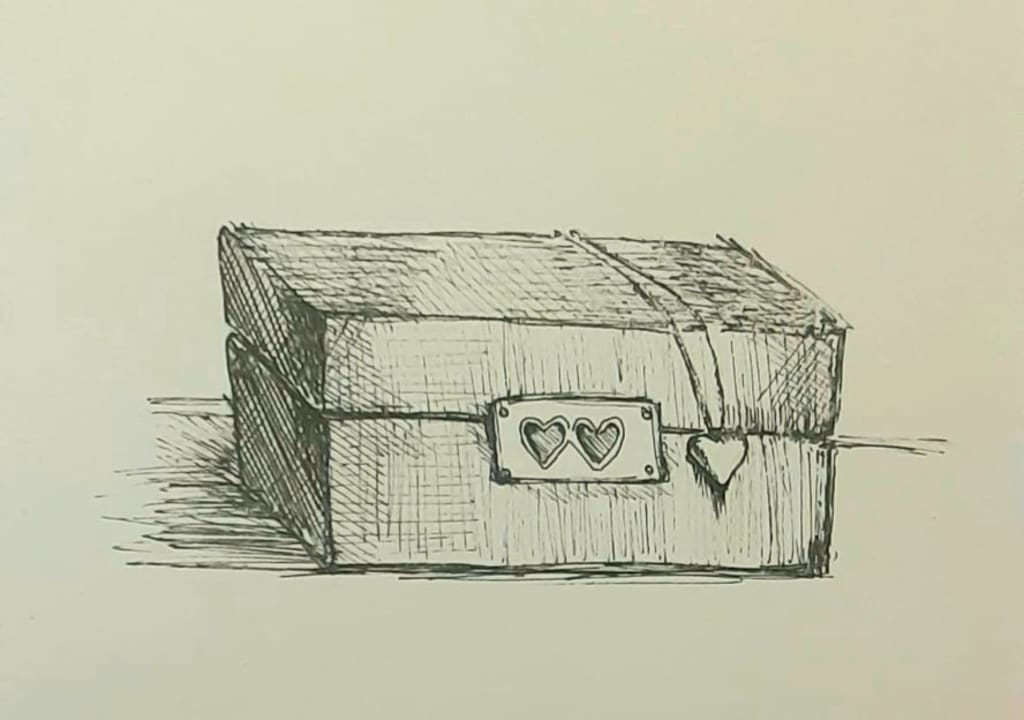
I absently turned the locket between my fingers. It was heart-shaped, made from rusted and tarnished metal. My mother had had it since before people wore uniforms. When she gave it to me, she told me it had been given her by her great-grandmother.
What must it be like, to have a great-grandmother? It was unusual now to see even a grandmother; usually people Disappeared well before then.
I could see my mother's face, clear as day, when she had first showed it to me. "This is for you. But I need to tell you a story about it."
It was one of those moments you don't really think about when it's happening, but that imprints fully into your memory. I could remember the buzzing of a fly as it repeatedly flew full-tilt into the window, the smell of stewed apples in the room, even the pattern where the light hit the wall.
I did try not to think about it too much. It wouldn't bring my mother back, and it really was a strange story. I laid down in my bed. The sheets were soft and smelled clean. I still didn't understand why she had told it to me.
Closing my eyes, I allowed the memory to wash over me. I could hear my mother's voice in my mind, her accent that never lost its rough vulgarity. And it was just as she had told it to me.
Pandora was a woman who married a god.
At her wedding, she received a box from one of the guests, which her husband told her not to open.
She asked him why not, and her husband told her to stop asking stupid questions.
Her curiosity consumed her, so she tried to put it away in the closet, but he insisted on displaying it pride of place in the hall.
Pandora would walk by that box half-a-dozen times a day. And each time she asked what was in it, he told her she was a stupid woman asking stupid questions. Eventually, Pandora decided if she was such a stupid woman, she might as well open the box.
Inside it was a stack of Polaroids. Each one was a photo of her husband performing a hideous act. In one, he had his genitals in the mouth of a pig. In another, he was groping his secretary. In another, he was standing over a bleeding man with a broken bottle in his hand. In yet another, he was surrounded by young teenaged girls in varying states of undress.
She felt like she would vomit as she flipped through the pictures. Her heart was pounding in her ears. But she could not stop looking.
Then she saw the last photo, and it filled her whole mind. She looked at it for longer than any of the other photos; in fact, she couldn't stop looking at it. It was a picture of the two of them. He was so beautiful, his eyes shining with adoration as he looked at her. And she was looking back at him the same way.
Pandora loved him in that moment more deeply than she ever had before. Putting the beautiful picture back into the box, she hurried to the fireplace with the rest of the Polaroids and flung them into the fire.
That way she would only have the beautiful picture to remember.
She opened the box many more times, just to look at it, and with such a beautiful picture to look at, she soon forgot all about the other pictures there had been.
"Why?" I had asked. My mind was full of whys.
"Hope is a blinding light," replied my mother, "that can hide anything."
I understood nothing. But then she had started coughing, and I could see flecks of blood staining the hand she used to cover her mouth.
Then she had given me the locket.
"There is hope in this," she told me. "So you had better not open it."
Still confused, I took it, wordlessly, from her outstretched hand. Moments later, I was ushered out of her room. I never saw her again.
Despite tacitly agreeing not to open the locket, I had tried many times. With no success; the mechanism had become so tarnished it refused to budge.
My eyes still closed, I began picking at it again absently, with a thumbnail that split under the pressure. Then I felt something I didn't expect - the lock giving way. My heart beat a little faster. Carefully, I pushed it all the way open.
Inside, there was nothing. I truly didn't expect it to be empty, so I turned it around a couple of times, and shook it gently. Nothing fell out; nothing was in there, except my own reflection.
I squinted at myself dubiously. I didn't feel any more hopeful.
I closed the locket and I laid back down. When I closed my eyes, I saw my mother, clear as day. As she was, the last time I had seen her. She was in pain, clearly. The blood from coughing was sticky streaks down her white hands.
Her eyes, however, were intent. Bitter.
She had been trying to tell me something else, I was sure of it. The words of the story fell soundlessly out of my mouth as I repeated it over, once, twice, my mother's image filling my mind as she told it.
The locket grew warm, clenched in my fist. The chain bit deeply into my skin. I'm going to have marks, I thought idly.
"There is hope in this. So you had better not open it."
Perhaps the hope had escaped, I thought.
Perhaps it was never there. It was my mother's voice, in my head.
In a single moment, the blood turned to ice in my veins. The world I lived in, and the future before me spread out in desolation, meaningless, empty. There had been hope in the locket. Until I had opened it, anyway. Now there was nothing but empty futile years to live, pondering the meaning of her story. It was as if I had lost her again, more fully.
My eyes stung. I would not cry; I couldn't. I didn't know how. No one needed to cry anymore. What we needed was always provided. No more, no less. There was simply no reason to cry. Not even babies cried.
And then suddenly there was a wetness escaping my eye. I could feel it trickling warmly down the side of my face into my ear. I brushed at it. What did it mean?
There was only one place I could think of to go. I went to the Confessional.
The Confessional was a place where - or rather, a person to whom - we went if we felt guilty. Guilt was not a regulated emotion; a little was known to heighten performance at work. It was also helpful in maintaining patriotism. But a surfeit might make us sick. The Confessional wasn't always the same person, but they were always old - the only old people who hadn't Disappeared. They would judge us impartially, and if necessary, assign a punishment or fine. There was rarely a need to punish; usually just a need to listen. Guilt was usually punishment enough, they always said.
I didn't tell the Confessional my mother's story. I wanted to keep the disturbing feeling of it to myself. I just told them that I had saved a locket she gave me.
"You've had the locket for over a year," the Confessional commented. "Why are you telling me about it now?"
"Because I want to forget her." I had to. It was all I could do.
The Confessional nodded. He put out his hand. "Give it to me."
I put it into his hand.
Quickly, he flung it into the fire. I could hear the rusted metal crackling in the heat. "There; it's gone now."
"Do I have a punishment?" My voice sounded thin and querulous.
He laughed, and shook his head kindly. "My dear, no. We all cling too long to things we don't need, and you've finally let go. But allow me to give you something." Hoisting himself out of his chair, he tottered to the corner, rummaging through a cupboard until he produced a single pill in a blister-pack, and a glass of water.
"What's that?" I asked.
"It will help you forget her."
I took the pill and swallowed it. Almost instantly heat pooled in the base of my stomach. The memories, the story, the locket - everything disintegrated into a cloud of sparkling dust. I had one single second of intense sorrow before my mother, and everything she had said, was gone from my mind. I felt fresh and calm again.
"Do you remember the story?" came the question from the Confessional.
"What story?" I replied, perplexed.
"Very good," he said.
About the Creator
Leigh H
Start writing...
Keep reading
More stories from writers in Fiction and other communities.
Happy VD
Something was definitely wrong. I’d always laughed about burning piss, but holy fuck, this was no joke. My dick felt like it was on fire, and not in the good way. I’d been on the prowl a lot since Debbie dumped me, tagging a groupie at every gig. Best way to get over one woman is to get over another few.
By Harper Lewis6 days ago in Fiction



Comments
There are no comments for this story
Be the first to respond and start the conversation.