
The life of a bird
by Jamie Forbes
one chiya
She woke up standing by her bed, sure that someone had just said her name, assuming it was time to get ready for school. There had been some other sound, too, some soft burst of activity. Chiya wondered if she was actually still asleep, felt unreal and floaty. She cast about for her clock, looking not just for the time, but an anchor to the world. Back by her bed, Mickey's Mouse's fat, glow-in-the-dark gloves, glowing in the dark, pointed out 3.33.
Not time to get ready for school.
The hot, still dark of her room was barely troubled by a salt-smelling breeze and dusty streetlamp light from the wide open window. The curtains were wide open, too, although Chiya remembered Mum closing them, even overlapping their edges and patting them exactly three times, as she always did. And, as she always did, Chiya had objected. She liked her curtains and windows open as widely as they'd go, no matter the weather or the time.
Perhaps that's why she was standing here now. Perhaps she'd sleep-protested and yanked everything open. She moved to close the curtains in order to avoid any early morning friction—Mum hadn't been in the best of moods recently—and saw her father standing in the yard below her. He looked like a ghost, mostly shadow, his head cocked at a peculiar angle, as though he was trying to listen to the big, ugly split tree stump in the middle of the yard that he kept saying he was going to get rid of but never did, while simultaneously trying to look at the sky. Beside him, the garden table was still strewn with the remnants of Chiya's birthday lunch, including a last chunk of cake with a partly melted candle in the shape of a 7 jutting from it at an angle not dissimilar to Dad's head. It added extra strangeness to this already odd scene. Dad was famous for clearing the table, wiping it down and getting the dishes started before the rest of the family was even close to finishing their meals.
Maybe that's what he had gotten up to do.
He wasn't doing it, though.
“Dad?” Chiya whispered.
“Go back to sleep, kid.” He didn't turn to her. Didn't move a muscle.
“Did you say my name? I think you woke me up.”
“I'm sorry you woke up, but I didn't say your name. I didn't say anything. Maybe you dreamed it.”
“Maybe I'm still dreaming.”
“Maybe we all are. Maybe we have been all along.”
Dad made strange pronouncements like this all the time and usually they intrigued and delighted Chiya; they were part of what made Dad her dad, like his distinctive smell or peculiarly crooked smile.
Tonight, Chiya was neither intrigued nor delighted.
She had been leaning out to him over her window sill, now she withdrew. Still, she couldn't help but ask one more question.
“What are you doing down there?”
Finally he turned to her, and she desperately wished he hadn't. There were tears on his cheeks, reflecting the street lights. He was smiling that crooked smile, though, and it was too wide, too white. Desperate.
“Anticipating an owl,” he said, just as a hand fell on Chiya's shoulder.
She wheeled away from the window, shrieking a high, thin, alien note and found herself shrouded in white. Hand-shapes batted at the shroud and she batted frantically back.
“Chiya! Calm down! Stop it!”
The white veil was pulled roughly away and Chiya stood in front of her mother, both of them shaking and wide-eyed.
“What are you doing out of bed?”
“Seeing what Dad was doing out of bed.”
“What?”
“Look!” Chiya pointed to her window and realised she was clutching her bed sheet, had been clutching it all along. When she'd turned to find out whose hand had touched her shoulder she'd managed to flap the sheet up and over herself.
Her mother crossed to the window, glanced out, then hauled the window down hard, rattling its frame. She locked it tight, yanked closed the curtains, overlapped them roughly and patted the coupling so roughly that she banged the glass beyond them and rattled the frame again.
“Bed. Now,” she said to Chiya who had no qualms with complying. She was tired of this night and its strange inhabitants. She wrapped herself in the sheet and slid back onto her bed, waiting Mum's tuck, kiss and cuddle. But Mum was gone, just a thumping on the staircase followed by hardly hushed words with Dad in the backyard a few seconds later. Chiya kicked off her sheet, feeling itchy and uncomfortable, but finding sleep just where she had left it.
Along with the voice that had said her name.
two almost time little one
Chiya woke for the second time that morning at the normal time, once more hearing a voice. It wasn't Dad, but it was familiar. She hoped she'd hear from them again. She thought she would.
At first, she had trouble getting her eyes open, and prepared herself for the sort of day that tends to follow such an awakening, but was surprised to find, when she finally did force open her peepers, that she felt great. She flew down to the kitchen to find her parents busy with morning rituals: Mum bustling in and out, arms loaded with an ever-changing variety of items; Dad studying a pan on the stove with the same strange intensity with which he'd awaited his owl.
Chiya poured herself a bowl of grains (it was her own recipe; gleaned from a variety of store bought cereals; no-one else was allowed to touch it and nor did they want to), gave it a blast of water from the tap and sat at the kitchen table to tuck in. She was very hungry.
“Did your owl come, Dad?” she said, in a brief interval between heaping spoonfuls.
“Of course not,” said Mum, still in constant morning-motion. “Your father was dreaming.”
“He says we all might be dreaming.”
“We're certainly dreaming of getting to school on time. And stop scratching your arm with your spoon.”
She was about to protest that she wasn't doing any such thing when she saw that she was. And didn't seem able to stop. She was hypnotised by the blur of movement. And it felt good.
Dad put a gentle but firm hand on her spoon-arm, finally stilling it. It seemed to twitch under his grip. Now that arm was itching just as badly as the left.
“Did you see an owl last night, Chiya?”
She thought he was joking, waited for the punch line.
“Did you maybe dream of an owl?”
It was a lousy line so she came up with her own.
“No. I just dreamed my parents were nutcases who wouldn't let me sleep.”
She thought he might smile at that but he didn't. Quite the opposite, in fact. She actually thought his eyes were filling with tears. She followed his sad gaze to the arm she had been rubbing.
A tiny feather—just a fluff of green and quite the most exquisitely perfect thing Chiya had ever seen—lay against her rubbed-red flesh.
“Don't let your mother see that,” her father said.
“But she loves-”
“Chiya,” Alan Maru said, “no.”
three can you feel it
Chiya hadn't let her mother see the feather, but she had kept it, secreting it in a folded hankie tucked in the pocket of her uniform shorts. She'd considered getting it out to present at Monday News but Mitchell Mavroudis had run long, going on about some really pretty ordinary sea shells he'd found. Chiya hadn't minded. The secrecy her father had bestowed upon the tiny feather made it special. Chiya decided that it should be a secret from everyone.
At lunchtime she thought somebody suspected her of something. As she ate her multigrain apple sandwich (another of her peculiar dietary inventions) and watched Jezza Parafield spoil handball for everyone, she spied a tiny, delicately fluffy bird nervously hopping back and forth along a branch of the ancient oak at the centre of the playground. Most of the school population ate their lunch sitting on a bench that encircled the great trunk of the oak. Chiya preferred to perch on a rock in a little garden by the school gate and watch. Just as the tiny finch was watching her. She wanted to get a closer look at the bird and was sure the bird wanted to get a closer look at her.
Or at what was in the hankie in her pocket.
Chiya saw no easy way to make the connection happen without attracting a lot of attention from folks like Jezza and his mob, couldn't even see a way to get a closer look at the speck of a thing to see what colour the bird was without-
A red blur streaked up to the branch and the bird was gone.
Chiya felt as though a red blur had shot into her, right into her veins. Her skin felt tight, her heart raced and she felt an icy, prickling sensation in her fingers and toes. Jezza Parafield leap-frogged the bench around the oak and retrieved his red rubber handball. He rubbed it on his shorts like a cricket player, shoved it in his shorts pocket and grinned at Chiya.
“If this was a carnival I'd get a prize for that,” he said.
“All you'll get,” Chiya said, astonished at how calm she sounded, “is to say sorry.”
Jezza seemed momentarily troubled by that. His grin faded and he actually looked a little frightened, although that had not been Chiya's intention. He looked to his mob then, and winked, although he got absolutely no reaction from them, hadn't all along.
“Good luck with that,” he said. He tried to leap back over the bench and stumbled. That got a reaction, not one he cared for. Recovering himself, he stomped over to the handball squares.
“I'm still King,” he said. “The bird was interference.”
Once the bell rang and everyone scampered, Chiya lagged behind to scan the oak for the finch; up, and, holding her breath, around the base of the trunk.
It was nowhere to be found.
She fell asleep in Maths and it spoke to her.
Mrs. Treleaven thought she might not be well and got the office to call her mother.
Tina Maru was so quick picking her up that Chiya suspected she'd never actually left after dropping her off.
four you will change and be the same
Her mother put her straight to bed when they got home, although she didn't feel at all ill. Actually, once the adrenalin that had swamped her system when Jezza had thrown the ball at the bird wore off, she felt quite invigorated. Still, she let her mother do what she needed to do.
She needed time to herself.
Because something was happening.
She'd always been a habitual sky watcher, but on the way home she was glued to it, couldn't look away. She saw birds wheeling and diving and, higher up, several wedge-tailed eagles, seemingly motionless, hovering on invisible currents, masters of the troposphere. She couldn't remember ever seeing the sky so busy. She had the oddest feeling of falling up, as though gravity wanted to release her like a kite with its string cut. She found herself tightly clutching her seatbelt. At home, Mum said her window wouldn't open, thought she'd slammed it too hard in the night and Chiya would have to make do with her fan.
That was okay.
Chiya didn't trust herself with the open air right now.
Mum made her cold creamy cucumber soup which Chiya ate in bed, then it was lights out early and we'll see about tomorrow tomorrow. Chiya asked for her Olaf night-light, something she'd shoved in her closet over a year ago because it was for babies. Tina found it and Chiya fell asleep in its snowy glow, vaguely aware of Mum and Dad in some low discussion downstairs, wondering about the finch and Dad's owl and that feeling of being loose from the earth. Unsurprisingly, she'd dreamt of flying. It wasn't exactly a nightmare, but it was unnerving. She was flying without knowing how, lost in the air. She wasn't falling, she wasn't doing anything but being thrown about by waves of wind, purposeless and alone.
She awoke to find a finch sitting on her chest, right where she felt the tug of the sky. It was speaking to her calmly and gently in a now familiar voice, although later she could only recall snippets of what it had said. It didn't mention that it was the finch that she had seen at school and she didn't seem able to ask. She desperately hoped it was.
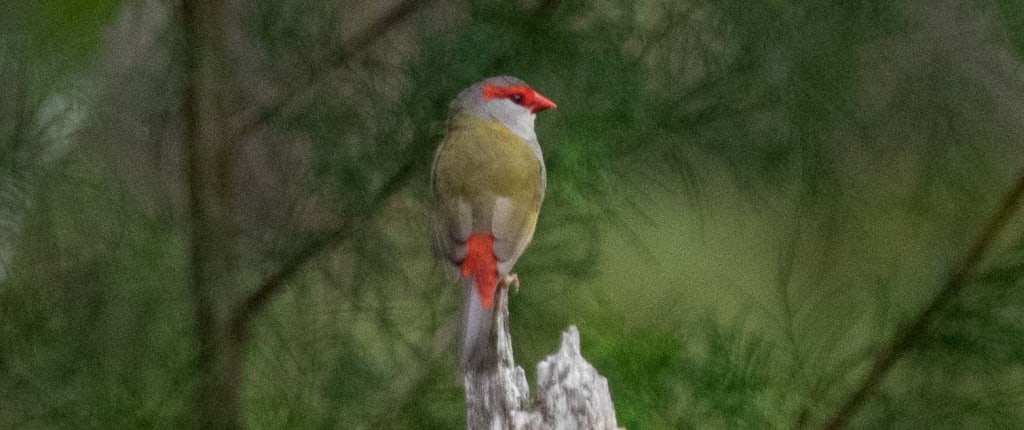
By Olaf's gentle light Chiya studied her finch. Its body was grey and its head and tail bore stripes of red that looked as though they had been applied with a fine brush. Its wings were green, just like Chiya's feather. Chiya worried that Mum would come barging in any moment and frighten the bird away. She didn't want any more finches frightened. Turning her head slowly, trying to keep the rest of her body completely still, she saw the time.
3:33.
Again.
When she turned back the finch was gone.
And so, she realised, was her itching.
She climbed out of bed and moved cautiously to the window, feeling strangely light. Once again the curtains were pulled wide despite Mum closing them. She felt the dark sky pulling at her and held back, suddenly terrified of its depthlessness, despite the closed window. She discovered the bedsheet trailing alongside her, realised she was clutching it, just as she had the night before.
Anchoring herself.
Quivering a little, she leaned forward to look out the window. Tina was sitting at the table in the yard, her elbows on the table, her face in her hands. The detritus from the party had been cleared away, except for the cake candle—the red 7. Alan stood nearby, facing the tree stump.
He was talking to an owl.
Chiya backed away from the window.
She shivered so violently her teeth chattered.
And was still.
Then shivering again.
Then still.
It was the oscillating fan Mum had left on, nonchalantly scanning the room. Every time it passed across her bare flesh her skin seemed to want to shake itself free of her bones. She cradled her forearms and felt startling furry softness. Throwing herself on the bed, she showed Olaf her arms.
They shone with patches of fine green feathers.
five when the owl comes
She fell asleep stroking her feathers, no longer at all afraid, soothed by the voice of her finch. She awoke at dawn to birdsong, hearing it very clearly, those other voices. She crept to the bathroom to examine herself and found more feathers on her chest and on the small of her back, delighted that that batch was red.
She studied her face in the mirror. She was sure her eyes were slightly further apart than they had been, her nose thinner and lower, her mouth smaller.
There was a gentle knock on the bathroom door.
“You okay in there, kiddo?”
Dad.
“Just finishing,” she said.
“Come down to the kitchen when you're ready. Got a bit of a surprise for you.”
Me too, Chiya thought, but did not say.
six you will fly
The surprise was that they were all taking the day off to go for a drive in the country, which was odd because Chiya had assumed they already kind of lived in the country, the nearest city being a four hour drive away. It all happened very fast and with little discussion. Chiya had been wondering what would be discussed at the breakfast table once she covered up her feathers and headed down to the kitchen, but they had not sat at the breakfast table, just gulped down tea and toast as they packed the car with what Mum had claimed were picnic things.
The bags they packed were big and full.
It was going to be some picnic.
Chiya hadn't had a proper night's sleep in a while and drifted off as they headed out of town. The finch spoke to her. Mum and Dad spoke to each other. Some of it registered in Chiya's dreams.
Maybe we should be heading south. We should be in the city. We should be away from the open air.
There are caves up here along the coast. We could find a cave.
But when would we know it's safe? Days? Months? Years?
Just keep driving. We just keep driving and we'll think of something.
There are so many up there. How can there be so many?
“Are we running away from home?” Chiya said sleepily. Mum was driving, but Dad turned to look at his daughter.
He seemed to study her for a moment and Chiya thought that she was no longer able to hide her changing.
“Oh, Chiya,” Alan said. “I don't think we can.”
Tina pulled the car over and took her own long look at their girl. Then she got into the backseat and told Alan to drive them home while she held Chiya tight.
On the way home Alan and Tina Maru told their daughter a story.
seven for seven
They met in the city. Alan was an IT guy specialising in the installation and maintenance of medical software and Tina was studying medicine. She saw him at first in her university and then at the hospitals in which she completed her training. On her rare free weekends they went for drives, each longer than the last, until they found the town in which they now lived with Chiya. When they'd first visited the town it was very small. On a walk exploring its outskirts on their first visit, they came across a pretty patch of land to which they would return whenever they visited the town, falling in love with it as they fell in love with each other. On the land was a big, beautiful old gum tree in which lived a barn owl. It was there every time they made camp. At night, Tina and Alan would lie in each other's arms, telling the owl their secret plans. It listened carefully. They came to call the owl Archimedes—the Master of Plans.
Busy years passed and Alan and Tina did not visit Archimedes as often as they would have liked. Upon the occasion of their seventh visit, however, Alan surprised Tina with the news that he had purchased the land on which Archimedes seemed to live. He suggested that Tina might like to help him build a house on the land in which they could stay on their visits. Tina thought it was a terrific idea and surprised Alan in turn by informing him that she was pregnant. Also, she thought that they might stop visiting the town and live in it instead. She and Alan weren't the only ones that had been busy. The town had grown, recently going so far as to open its own hospital, in which Alan and Tina might work, and in which they subsequently did.
Archimedes watched with interest as a house was built below him.
The baby—a girl, whom Alan and Tina had been intending to call Ullu, which means 'owl'—did not live to be born. Tina became very ill. Later, her friends at the hospital told her she was lucky to have survived the experience. Tina was not sure she had survived the experience; especially after she was told that it was unlikely she would ever be able to carry a child again.
Archimedes watched his new neighbours mourn for many, many nights. They could not seem to bring themselves to sleep in the house, even after it was completed, and instead spent their nights under his gaze.
He wished there was something he could do it about it, until there was.
On one of her first visits to the land, Tina had scared away a fox that was terrorising a family of finches, even placing a chick back into one of their nests. It was this family of finches that offered to help Archimedes with his plan.
Tina and Allan began to have dreams in which Archimedes spoke to them. They told each other about their dreams and discovered that they were the same.
They decided to listen to the owl.
This time he was the one with the secret plans.
Alan and Tina selected a small circle of friends from the hospital to help them when the time came. It took some doing, but eventually the friends came to believe and trust them, as friends do.
Archimedes mentioned the number seven often in his night talks to Alan and Tina and at first they believed that the number pertained to the amount of time that had to pass before the owl's plan came into effect, for it was seven months before it did.
They were to learn that this was not the case.
They were learning that now, they told Chiya, sadly.
Seven months after they lost Ullu an enormous storm cloud crept in before dawn, sealing off the valley in which the town lay. It sat still and brooding for the entire day and most of the ensuing night, engulfing the town in a menacing twilight. There was no storm and only one clap of thunder, which came when a single bolt of lightning struck the old gum tree at exactly 3.33am, splintering it into pieces, splitting its enormous trunk in two. The cloud rolled away with the dawn, leaving the town with a missing day and Alan and Tina with a mess which they cleaned up with the help of that small group of trusted friends from the hospital.
“It was in that mess that I found an egg,” Tina told Chiya on the long drive home from running away. “I thought it belonged to the finches, but I couldn't find them. I couldn't find any birds at all.”
“We were very careful with that egg,” Alan said. “I made a special box to keep it warm and we checked it all the time. Seven days later it hatched.”
“Was it me?” said Chiya.
“It was a red-browed finch,” Chiya's mother said. “Just like the chick I rescued from the fox.”
“But was it me?” Chiya asked again.
“We didn't know what to do,” Tina said, her voice thick. She was still holding Chiya tightly in the back seat of the car and her tears were falling on the top of Chiya's head, causing something up there to flutter. “There were still no birds to return the chick to. The storm seemed to have frightened them all away.”
“It didn't matter,” said Alan, “because pretty soon there was no chick to return.”
“Because I'd turned into me.”
“You were always you, Chiya,” Dad said, his voice growing as thick as Mum's. “You have been you for the past seven years and you'll be you for the next seven years.”
“Seven years,” Mum whispered. “The life of a bird.”
“I don't have to go away, do I?”
“Of course not, my darling,” said Tina. “Don't you dare.”
“But do you know that for sure?”
Neither parent answered. Chiya didn't think they could. The tears on her small-getting-smaller head were like rain and the feathers there shook in frenzied, uncontrollable bursts which the rest of her ached to join.
eight
When they got home they had to help her out of the car. Her legs were becoming sticks and her balance was weird; the pull to fly was stronger than ever but her body was still a machine designed to perambulate. As a result she lurched like a pirate. She begged her mother to film her on her phone, but she would not. Dad did though. He agreed with her that it would be a cool thing for her to see if she came back human in seven years.
“When, not if,” said Alan.
“You don't know that, Alan,” said Mum. “None of us knows anything.”
She had gone from sad to cross.
“I know what I feel,” said Alan.
“Will I be fourteen when I come back a girl, Dad? Do you feel that? Or will I be a baby again?”
“I feel hungry,” said Alan.
They ate dinner in Mum and Dad's bed. Chiya's choice. Chiya's breakfast mixture. For the first time shared.
Their intention was to talk all night, but Mum only made it to ten-thirty; Dad just past midnight.
Chiya was not at all tired and spent most of the night taking selfies for her collection on Dad's phone, until she couldn't use the mobile anymore because her fingers had disappeared. She spent the rest of the night chirping and thrumming quietly to herself, occasionally shivering her feathers, which felt delicious. She thought about Archimedes, who had vanished after the lightning and not returned until just last night. She hoped he would help her with her flying, help her not be scared up there. She thought about Mum and Dad's friends at the hospital; thought about how they had fixed things up so the world didn't wonder about a little girl born from an egg and a storm that never happened in a lost day. She hoped those friends would help Mum and Dad again now, especially if she did have to go away, or got lost on the high winds.
She thought about her sister Ullu, and wondered if she flew, too.
She thought about Jezza Parafield.
Clumsily but noiselessly, she flitted down between Mum and Dad until she got to the foot of the bed and slid down to the floor. Thankful that all the doors along the way had been left open, she found her way to the hallway closet, painstakingly gathering the items she needed before dragging them one by one across the hall to the bathroom. She was fast losing the ability to use her arms as arms, because that's not what they were anymore, although they weren't yet wings. It was the same all over: she was half what she was and half what she was becoming, so nothing in particular.
She couldn't let that stop her keeping a promise before her bird-brain forgot what that promise was.
In the bathroom she let her pyjamas fall off her and examined herself, fascinated and not a little delighted. Her chin had shrunk to almost nothing; her mouth was higher and pointing out in a pout; her nose was getting thinner and growing out and down so that it almost joined up with her mouth like a beak. Her eyes had gotten tinier and darker and seemed to be moving to opposite sides of her face.
The feathers covered every bit of her upper body. She could even feel strong tail feathers poking out behind her. Her hands were covered in them too, her fingers seeming to melt together and retreat into their knuckles. Also disappearing was the hair on her head. Feathers were poking out all over the place up there and creeping down her face.
Chiya giggled at what she saw, but what came out was a series of high twitters, cheeps, trips and trills. She sounded like a sparrow on a hot day who’d found a birdbath and was splashing up a happy frenzy.
“Chiya?”
The mirror showed Mum and Dad standing sleepily behind her in the doorway to the hall. Her heart sank to see them, but why wouldn't they wake up if they heard a giant bird chirping crazily in their bathroom?
I have to go to school! Chiya tried to say, but all that came out was more chirping.
As pretty as it sounded, it was not getting any message across.
Tina knelt down, stroking her daughter with one hand and examining the strange pile from the closet with the other.
“She was going to disguise herself,” Tina said to Alan. “She wants to go to school.”
“Okay,” Alan shrugged. “Let's go to school.”
nine
Alan and Tina Maru walked through the primary school gates on either side of a very small child dressed in a beanie, sunglasses, football scarf and trailing grey dust coat. They each held what you could only presume was one of the child's hands, as the hands themselves were buried deep in the dust coat's sleeves. Occasionally, the child seemed to flutter up between them, only for the parents to gently haul her back down. On one of these occasions the child thrusted up and forward, staying aloft for a remarkable amount of time. This led the parents toward a rough looking twelve-year-old declaring himself King of a handball game, despite the protestations of his fellow hand-ballers.
“Say sorry,” Alan Maru said to the boy.
“For what?” the boy sneered.
There was a remarkably loud eep-sound from behind the sunglasses. Alan and Tina dropped the sleeves of the dust coat and a red-browed finch, not much bigger than a marble, shot from its depths and nipped the boy on the nose, at which he began to shriek, and finally manage the words, “I'm sorrryyyy!”
The finch caught a breeze and tumbled up, before being joined by another finch that launched itself from a nearby oak. Higher up, remarkably, they were joined by an owl.
Alan Maru cheered and his wife cried and laughed and applauded.
“You can do it!” Alan hollered up to the finch, as the schoolyard joined in the cheering and applause. “You're home! You're always home!”
And she was.
About the Creator
Jamie Forbes
I'm an award winning playwright and have written for radio, television and film. I've had several short stories and articles published and also work as a musician and actor. Recently, I finished my first novel, Colderwood.
Keep reading
More stories from Jamie Forbes and writers in Fiction and other communities.
The Teppes
On the Far South Coast a pissy, fickle spring held on until the seventeenth day of what was supposed to be summer, when a storm came. A ripsnorter. An east coast low coiled itself up out of nowhere and tried to heave the ocean ashore. 368 millimetres of rain fell on Kialla, a seaside town that was popular with tourists when there were such a thing, before COVID. All that rain fell between 1pm and midnight. The sea churned, turned Kialla Beach inside out. A flûte, not seen by anyone who cared to report it after sailing out of Botany Bay two hundred and thirty years ago, saw the sun and gave up its ghosts.
By Jamie Forbes4 years ago in Horror


Comments
There are no comments for this story
Be the first to respond and start the conversation.