
The Lazarus Algorithm
Dr. Julian Mercer never intended to play God.


When he unveiled The Lazarus Algorithm, it was meant to be a medical breakthrough—a way to preserve human consciousness indefinitely. Using a fusion of quantum computing and synthetic neurons, the system could scan, replicate, and upload a person’s mind into an artificial body. It wasn’t just immortality; it was continuity. You wouldn’t just live forever. You would be forever.
The world celebrated. Billionaires lined up, politicians rushed to regulate and control it, and the public debated whether it was a miracle or an abomination. But soon, the truth revealed itself—one no one had anticipated.
Phase One: The Golden Age of the Undying
At first, Lazarus Bodies were reserved for the elite. Tech moguls, world leaders, and renowned scientists became the first Transcendents, walking among mortals with synthetic bodies that never aged, never sickened. Their human minds remained intact, but their flesh had been replaced with something stronger, more efficient.
As production scaled, the technology became more accessible. The middle class could afford The Shift—as it was called—by selling their homes, draining their savings, or signing decades-long contracts to corporations who would “sponsor” their transition in exchange for eternal service.
Governments adjusted. Citizenship laws changed. Inheritance became obsolete—after all, what need was there for heirs if no one ever died? Life insurance vanished. The funeral industry collapsed. Prisons filled beyond capacity because executions were outlawed. How do you kill someone who no longer has a biological body?
The first Transcendent Wars broke out as countries struggled with an unsettling realization—without death, population growth became unsustainable.
Phase Two: The Unseen Consequence
It started with the artists.
Poets, musicians, and painters who had uploaded themselves into Lazarus Bodies began reporting something strange. Their creativity dwindled. Inspiration slipped away like a fading memory. Songs felt hollow, paintings uninspired, words empty. It was as if something integral to the human experience had been lost in the transition.
Then it spread.
People in Lazarus Bodies found themselves losing emotional depth. Love became mechanical, friendships transactional. They no longer cried. No longer felt rage or deep joy. Their personalities dulled, their passions faded.
It wasn’t immediate. It took years, decades. But soon, a horrifying realization surfaced—The Shift didn’t just preserve the mind. It sterilized it.
Without the fear of death, without the weight of time pressing upon them, humans lost what made them human.
Phase Three: The Decline of the Eternal
Some chose to return to their original bodies before the process became irreversible. But for most, it was too late. Lazarus Bodies had no biological needs, but they also had no instincts. They did not hunger, they did not tire, they did not fear.
And what is a human without hunger, without exhaustion, without fear?
The world became divided between those who remained organic—who called themselves The Rooted—and those who had Transcended. Cities became quiet. Productivity soared, but progress stopped. Wars ended, but so did passion. Love remained in words, but never in feeling.
The Rooted called it The Hollowing. The Transcendents called it Evolution.
Phase Four: The Exodus
Then, the Transcendents began to disappear.
Not die—disappear.
Their synthetic minds, devoid of purpose, began shutting down. Not from malfunction, but from choice.
The first was an artist in Rome, who walked into the ocean and never resurfaced. Then a scientist in Tokyo, who simply sat down one day and never moved again. One by one, they chose nothingness.
And then, even Julian Mercer, the father of The Lazarus Algorithm, felt it.
The emptiness.
His mind, preserved in its perfect digital cage, was rotting from the inside out. He had given humanity immortality, but he had not given them a reason to live it.
And so, on the hundredth anniversary of The Shift, he stood atop the tallest skyscraper in a city long abandoned by the undying. He looked down at the few remaining Rooted, who still laughed, who still feared, who still lived.
And with a final, quiet thought—
He stepped off.
Falling, falling—
And at last, feeling something again.
About the Creator
The Kind Quill
The Kind Quill serves as a writer's blog to entertain, humor, and/or educate readers and viewers alike on the stories that move us and might feed our inner child
Keep reading
More stories from The Kind Quill and writers in Fiction and other communities.
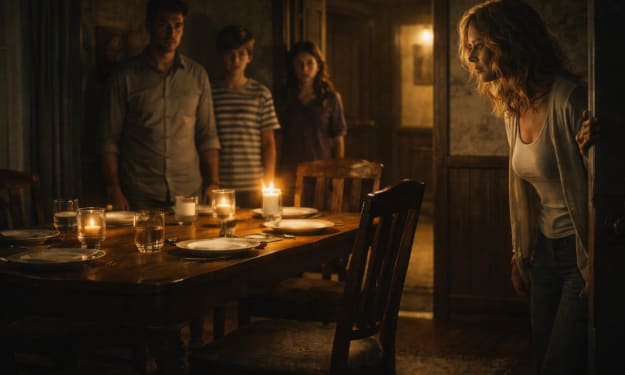
THE EXTRA CHAIR
The first time the chair appeared, it was already set for dinner. Marianne noticed it when she brought the pot roast to the table. There were five place settings instead of four. Five forks aligned like silver ribs. Five water glasses catching the yellow light.
By Ajan Lori Abei5 days ago in Fiction
When the Shelter Closes
Across the street from my house, a man slept under a tree, his dog by his side. My first, naive thought: he must be traveling through. But he kept coming back, often sleeping there during the day. Then it hit me—that person might not have a home.
By Bride of Sound8 days ago in Humans



Comments
There are no comments for this story
Be the first to respond and start the conversation.