
The Last Stamp of Memory
A Journey Through Time and Loss

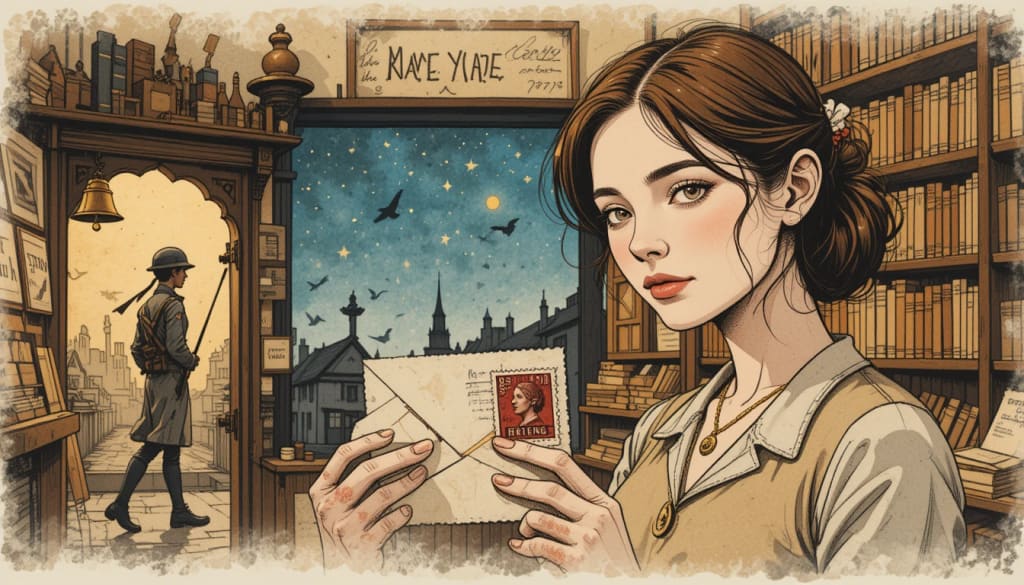
In the quiet town of Eldridge, England, in 2023, the scent of ink and old paper filled the cluttered shop of Mr. Hawthorne’s Philatelic Emporium. For 19-year-old Clara, this was more than a workplace—it was a sanctuary of stories, each stamp a fragment of history. As she sifted through her late grandfather’s collection, Clara uncovered a mystery tied to her family’s past, a tale of love, sacrifice, and the final stamp that would bind her to those she’d lost. This is the story of Clara’s quest to preserve the last stamp of memory.
Clara had grown up in Eldridge, a place where cobblestone streets and ivy-clad cottages seemed frozen in time. Her grandfather, Arthur, had raised her after her parents died in a fire when she was five. Arthur, a retired postmaster and avid philatelist, filled their home with tales of stamps—each one a portal to distant lands and forgotten lives. He’d taught Clara to read the world through postmarks, from the bold reds of colonial India to the delicate blues of wartime Britain. When Arthur passed away the previous year, his shop became Clara’s inheritance, along with a box of unsorted stamps and a lingering sense of loss.
The shop was a treasure trove: wooden cabinets stuffed with albums, envelopes yellowed by time, and a brass bell that jingled above the door. Clara, with her chestnut curls and ink-stained fingers, spent her days cataloging Arthur’s collection, her grief softened by the rhythm of her work. But the shop was struggling—online collectors favored digital marketplaces, and Eldridge’s younger generation saw stamps as relics. Clara’s aunt, Margaret, urged her to sell the shop and move to London, but Clara couldn’t bear to let go of Arthur’s legacy.
One rainy afternoon, while sorting through the unsorted box, Clara found an envelope unlike the others. It was addressed to “Miss Evelyn Ward” in Arthur’s precise handwriting, postmarked 1944, and bore a rare 1935 Silver Jubilee stamp, its edges frayed but vibrant. Inside was a letter, its ink faded but legible, and a photograph of a young woman with Clara’s eyes. The letter spoke of love, of promises made under wartime skies, and of a stamp that held a secret. Clara’s heart raced—she’d never heard of Evelyn, yet the woman felt like a piece of her.
Her search began at the town library, where Mrs. Ellis, the librarian, recognized the name. “Evelyn Ward was your grandmother,” she said, her voice soft. “She and Arthur were engaged during the war, but she left Eldridge in ’44. No one knew why.” Clara was stunned—Arthur had never spoken of Evelyn, only of his life after the war. The revelation cracked open her understanding of her grandfather, urging her to dig deeper.
Clara’s ally in her quest was Samir, a 20-year-old history student who frequented the shop for his own stamp collection. Samir, with his warm smile and knack for research, offered to help. Together, they pored over records, uncovering Evelyn’s story. She’d been a nurse during the Blitz, stationed in London, where she and Arthur met. Their love bloomed in stolen moments—letters sealed with stamps, dances under blackout curtains. But in 1944, Evelyn vanished from Eldridge, leaving Arthur heartbroken. The Silver Jubilee stamp, Samir discovered, was part of a limited misprint batch, rumored to conceal coded messages for the Resistance.
The letter’s clues led Clara to a hidden compartment in Arthur’s desk, where she found a journal. Its pages revealed the truth: Evelyn had been recruited for a secret mission, delivering messages for the Special Operations Executive. The stamp was her final gift to Arthur, a coded farewell she couldn’t speak aloud. She’d planned to return, but a bombing raid claimed her life in 1945. Arthur, devastated, kept her memory private, raising Clara with love but never sharing his pain.
Clara felt a mix of awe and sorrow. Evelyn’s courage mirrored Arthur’s quiet strength, and their love, preserved in ink, was a bridge to her own identity. But the shop’s fate loomed—Margaret had found a buyer, and Clara had weeks to decide. Samir, sensing her turmoil, suggested a bold idea: host a philatelic exhibition to honor Arthur and Evelyn, drawing collectors to save the shop. Clara hesitated, her shyness a barrier, but Samir’s encouragement and Evelyn’s bravery inspired her.
The exhibition took shape in the town hall, with Clara and Samir curating Arthur’s collection. They displayed the Silver Jubilee stamp, its story typed on a card beside it, alongside Evelyn’s photograph and Arthur’s journal. Clara wrote a speech, her words weaving her grandparents’ love with her own journey. As she worked, she grew closer to Samir, their late-night talks revealing his own dreams—to study archaeology, to uncover stories like Evelyn’s. “Stamps are like artifacts,” he said, his eyes bright. “They hold the past.” Clara smiled, feeling seen in a way she hadn’t since Arthur’s death.
The exhibition day arrived, crisp and golden. Collectors came from across England, drawn by the rare stamp and Clara’s story, shared on social media by Samir. The hall buzzed with voices, the brass bell from the shop ringing as a centerpiece. Clara stood before the crowd, her voice steady as she spoke of Arthur’s love, Evelyn’s sacrifice, and the shop’s role as a keeper of memories. “Every stamp is a story,” she said, holding the Silver Jubilee. “And every story deserves to be remembered.” The crowd applauded, and offers poured in—not to buy the shop, but to fund its preservation as a philatelic museum.
Margaret, moved by Clara’s passion, withdrew her push to sell. The shop would stay, a testament to Arthur and Evelyn. Clara felt their presence in the stamps, in the shop’s creaking floorboards, in her own resolve. Samir, accepted to his archaeology program, promised to visit, their friendship a new stamp in Clara’s collection of memories.
In 2024, Clara stood in the shop, now a museum, the Silver Jubilee stamp framed above the counter. Visitors came to hear Evelyn’s story, and Clara, now studying history, wrote their tales in a journal of her own. The last stamp of memory had bound her to her past, but it also set her free—to live, to love, to carry the stories forward.
About the Creator
Shohel Rana
As a professional article writer for Vocal Media, I craft engaging, high-quality content tailored to diverse audiences. My expertise ensures well-researched, compelling articles that inform, inspire, and captivate readers effectively.
Keep reading
More stories from Shohel Rana and writers in Fiction and other communities.
Butterflies in the Sunshine
In the rolling hills of Tuscany, Italy, in the summer of 2024, the sun bathed the fields in golden light, and butterflies danced like flecks of living color. For 17-year-old Sofia, this landscape was both a refuge and a challenge—a place to heal from a past that still clung to her like a shadow. Her story, woven with moments of quiet courage and newfound connections, would unfold under the wings of butterflies, in the warmth of the sunshine.
By Shohel Rana7 months ago in Fiction
Affection and Healing for Yourself
During the night of the last quarter moon, I gathered my ritual supplies. I carefully handled the chunk of black tourmaline that would protect me from your overall negative and narcissistic energy. I carefully walked the house with my stick of selenite in hand, asking the universe to cleanse our working space.
By Alisha Wilkins ✒️🦋🖋️a day ago in Fiction



Comments
There are no comments for this story
Be the first to respond and start the conversation.