
The Last Garden on Earth
When hope blooms where life has vanished
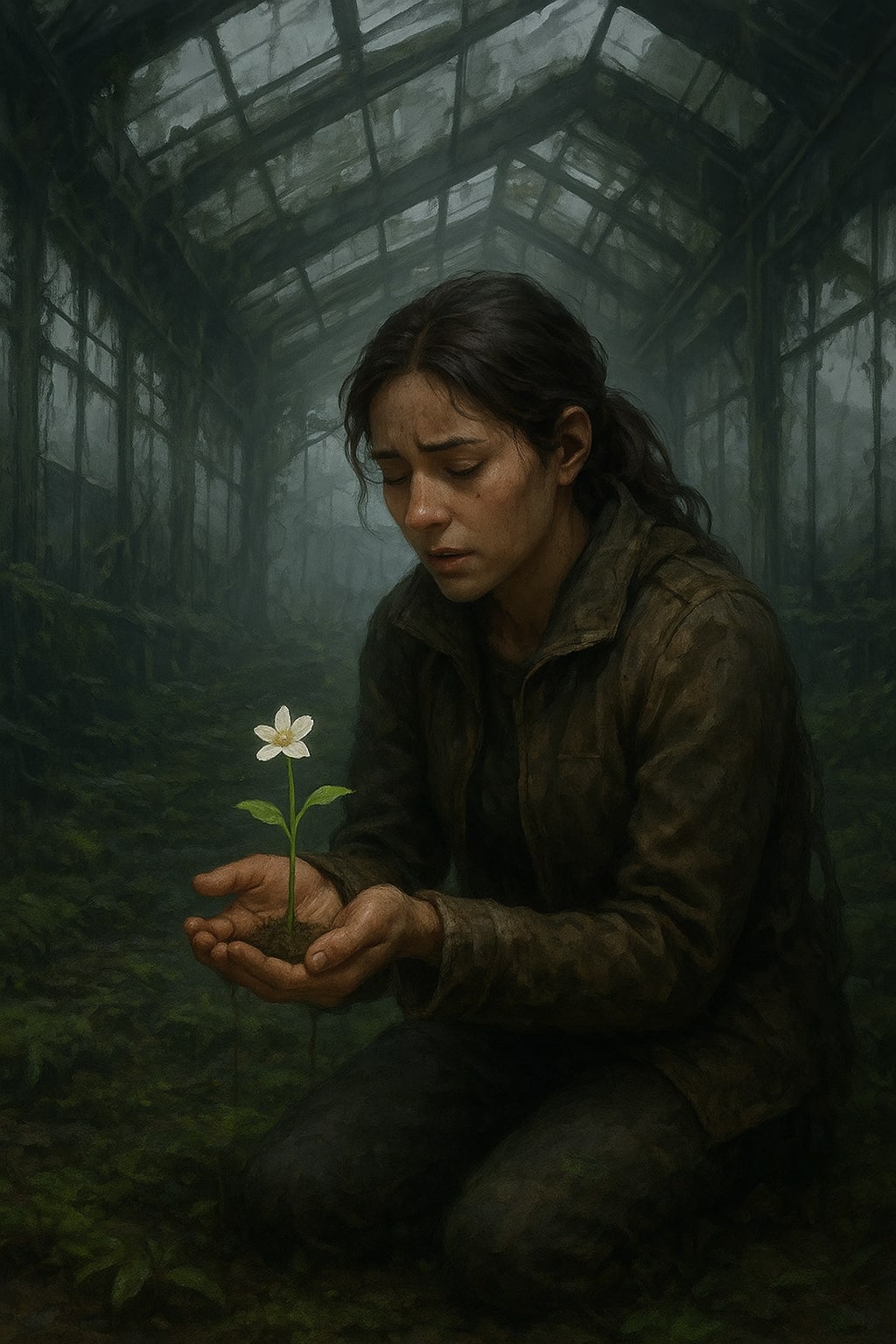
The world had forgotten what green looked like.
Cities were made of metal and ash, skies were silver with dust, and oceans were mirrors of poison. For thirty years, humanity had lived under domes that filtered air and light — a sterile cage built to protect them from the wasteland they had created.
Dr. Liana Ortez had never seen a real flower. She had seen pictures, of course — digital recreations in archives, the faded colors of long-dead petals — but not the softness, not the smell, not the miracle of life itself.
Her job at the Global Seed Vault was simple: to guard what was left. Millions of seeds stored in frozen pods, waiting for a day that might never come. Every morning she ran diagnostics, logged temperature readings, and stared at row after row of silent glass capsules. It was like tending to ghosts.
Until the day one of them moved.
Pod #992143 — labeled Arabidopsis thaliana — flickered on her monitor. A small crack had appeared in the glass. Inside, a faint light glowed.
At first she thought it was a glitch, maybe a reflection from her lamp. But then she leaned closer — and saw a tiny green shoot pressing against the glass.
Her breath caught. “Impossible,” she whispered.
The vault’s atmosphere was -20°C. Nothing could sprout here. And yet, against all science and reason, this seed had decided to live.
Liana carefully carried the pod to her workstation, sealed it in a portable growth chamber, and began to warm it. Her hands trembled. It felt like holding the future.
Over the next few hours, the shoot grew taller, curling toward the artificial light. Tiny leaves unfolded, fragile and trembling — the first living green Earth had seen in decades.
When the flower finally bloomed, a single white petal shone in the cold air like a star.
Liana wept.
She named it Aurora.
---
Word spread quickly through the domes. Scientists from around the world tuned in to watch the live feed. Children pressed their faces to screens, whispering at the sight of something they had only read about in stories.
But not everyone celebrated.
The World Preservation Council demanded that the plant be destroyed, claiming it could carry ancient bacteria that might threaten the dome’s fragile balance. “Human safety must come before nostalgia,” they declared.
Liana refused.
She hid Aurora deep in the vault’s lower chambers, where no one but she had clearance. There, she nurtured it with recycled water and filtered sunlight. Days turned into weeks, and soon, seeds fell from its withered petals — small, brown, full of promise.
She planted them all.
And they grew.
One morning, when she entered the vault, the air smelled different — damp, alive. Moss had begun to creep along the cold metal walls. The floor shimmered with dew. Her boots sank into soil where there had been concrete.
The vault was becoming a garden.
---
News of her defiance reached the Council. They sent drones to confiscate the specimens.
But when the drones entered, their systems failed one by one. Something about the garden’s growing energy interfered with electronics. Cameras flickered, lights dimmed, and the machines shut down mid-air, as if the earth itself rejected them.
Liana knew what she had to do. She opened the vault doors.
For the first time in half a century, natural air flowed into the sealed facility. Dust swirled, sunlight pierced through the gray, and the garden shivered under the touch of real wind.
Outside, the wasteland waited — endless, dead.
Liana took Aurora’s final seed in her hand and stepped into the desolation. She knelt, pressed it into the cracked soil, and whispered, “Grow.”
Then she returned to the vault and sealed the door behind her, never to leave again.
---
Years later, explorers found her body in the vault, surrounded by vines that had overtaken the walls. Her hands still cradled an empty seed pod.
And outside, beyond the dome’s ruins, a green shoot had broken through the earth — small, defiant, alive.
They say that from that single seed, forests began to return.
The last garden on Earth had become the first one again.
About the Creator
Keep reading
More stories from Muhammad zahoor and writers in Fiction and other communities.
When the Stars Forgot to Shine
The night it happened, the world didn’t notice at first. The stars simply… didn’t come. No one could explain it. The moon hung lonely and pale in the dark sky, surrounded by emptiness. Astronomers called it a “temporary celestial blackout.” Poets called it “the night heaven turned its face.” But to Mira, it felt like a reflection of her own fading light.
By Muhammad zahoor3 months ago in Fiction
Wild Card Weekend Recap: What Happens Now?
I think I figured out why I love Wild Card Weekend so much. It's because it's the first playoff anything of the calendar year. The NFL season starts in the fall, and once upon a time, the champion was crowned either on or slightly before New Year's. The evolution of the NFL schedule has resulted in the playoffs starting just into the New Year, and currently, the final week of the season falls on the first weekend of the New Year, with Wild Card Weekend coming a week after that. So yes, chronologically, the NFL's Wild Card Weekend serves as the first playoff anything of the calendar year.
By Clyde E. Dawkins3 days ago in Unbalanced



Comments
There are no comments for this story
Be the first to respond and start the conversation.