
The Bench That Never Moved
A gentle story about time, memory, and the strangers who quietly change us

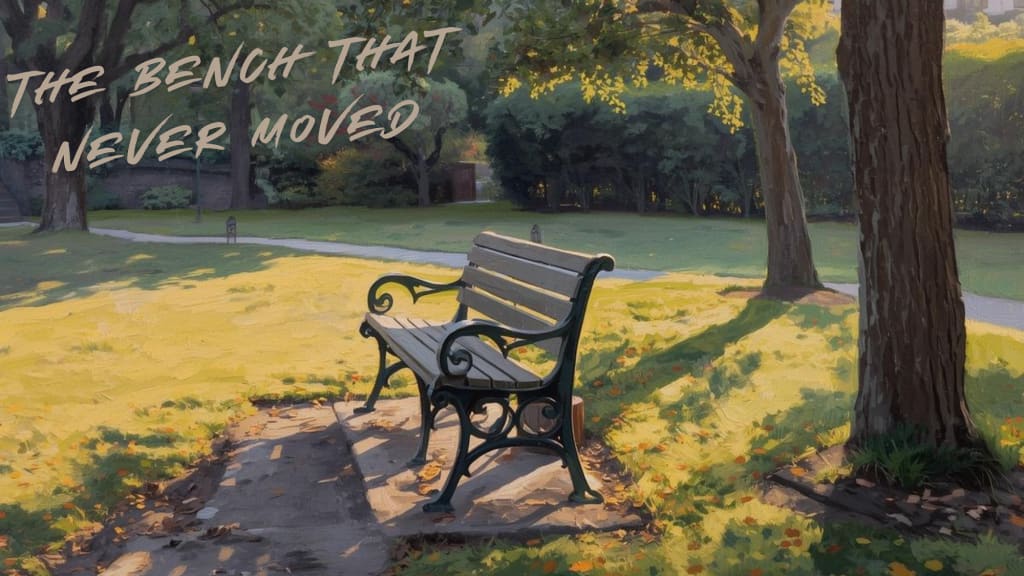
The bench had been there longer than anyone could remember.
It sat beneath a wide banyan tree at the edge of the park, its wooden slats worn smooth by decades of waiting. Paint peeled from its iron legs, and one corner leaned slightly, as if tired but unwilling to fall. People passed it every day, yet few stopped long enough to notice it.
Except Arun.
Every morning at exactly 7:10 a.m., Arun sat on that bench with a paper cup of tea warming his hands. He faced the walking path, watching joggers pass, children chase pigeons, and old couples move slowly in sync. The bench was his routine, and routines, he believed, were anchors in a drifting world.
Arun was not lonely—at least, that’s what he told himself.
He had retired three years earlier from a job that demanded constant conversation. When the noise faded, the silence felt earned. Still, silence has a way of growing louder when it stays too long.
One Tuesday morning, the bench was occupied.
A young woman sat there, sketchbook balanced on her knees, pencil moving quickly. She glanced up when Arun stopped.
“Oh—sorry,” she said. “I didn’t know someone sat here.”
“It’s a public bench,” Arun replied gently. “It doesn’t belong to me.”
She smiled and shifted slightly to make space. Arun hesitated, then sat down. They shared the bench in silence, broken only by birdsong and the scratching of graphite on paper.
The next day, she was there again.
Her name was Meera. She was an art student who came to the park to draw people without interrupting them. “They’re most honest when they think no one is watching,” she explained.
Arun chuckled. “Then I must be very honest. I do nothing special.”
“That’s not true,” Meera said, sketching him. “You come every day. That means something.”
Their conversations grew slowly, like sunlight spreading across the grass. They talked about small things at first—the weather, the stubbornness of pigeons, the best time to drink tea. Eventually, Meera asked about his life.
Arun spoke about his job, his wife who had passed away years ago, and how the bench had become a quiet companion after she was gone.
“She liked this park,” he said. “We used to sit here together. Same bench.”
Meera nodded, understanding more than words could explain.
Weeks passed. The bench witnessed their routine: Meera sketching, Arun sipping tea, both watching the world move forward. Some mornings, Meera showed him her drawings. Others, she simply sat, listening.
One morning, Arun didn’t arrive.
Meera waited, glancing at her watch more times than she cared to admit. She stayed longer than usual, sketchbook closed, eyes fixed on the path.
The next day, the bench was empty again.
On the third day, Meera asked a nearby vendor if he knew the older man who always came for tea.
“He fell ill,” the vendor said. “Hospital. Should recover, they say.”
Relief washed over her, mixed with something unexpected—worry she hadn’t realized she carried.
Days later, Arun returned.
He walked slower, leaned on a cane, but smiled when he saw Meera leap up from the bench.
“You kept my seat warm,” he teased.
“Always,” she replied.
That morning, Meera didn’t sketch. Instead, she handed Arun a folded piece of paper.
“I drew the bench,” she said. “And you. I wanted you to have it.”
Arun studied the drawing carefully. The bench stood strong beneath the banyan tree, and beside it sat a man who looked peaceful, present, and quietly important.
“No one’s ever drawn me before,” he said softly.
“People don’t realize they’re worth noticing,” Meera replied.
Seasons changed. Meera graduated. Life pulled her in new directions. Eventually, she stopped coming to the park every morning.
But the bench never moved.
And Arun still came.
Sometimes, he watched strangers sit there—laughing, arguing, resting. Sometimes, he imagined Meera sketching them, capturing moments no one else would.
The bench remained, holding stories without asking for credit.
And Arun learned something simple but lasting: even the smallest places can become meaningful when shared, even briefly, with someone who sees you.
About the Creator
ORM_Specialist
Hi, I'm Rohit — with 9+ years in ORM and SEO, I help brands build trust, grow influence, and dominate the digital world. https://www.fiverr.com/s/991eeWe
Keep reading
More stories from ORM_Specialist and writers in Fiction and other communities.
The Last Light in Apartment 407
Apartment 407 had been dark for weeks. Maya noticed it every night when she returned from work, climbing the narrow stairs of the old brick building with a tired sigh. Most windows glowed warmly by the time she reached the fourth floor—televisions flickering, lamps casting soft shadows—but 407 stayed empty and silent. No light. No sound. Just a closed door at the end of the hallway.
By ORM_Specialist17 minutes ago in Fiction



Comments
There are no comments for this story
Be the first to respond and start the conversation.