
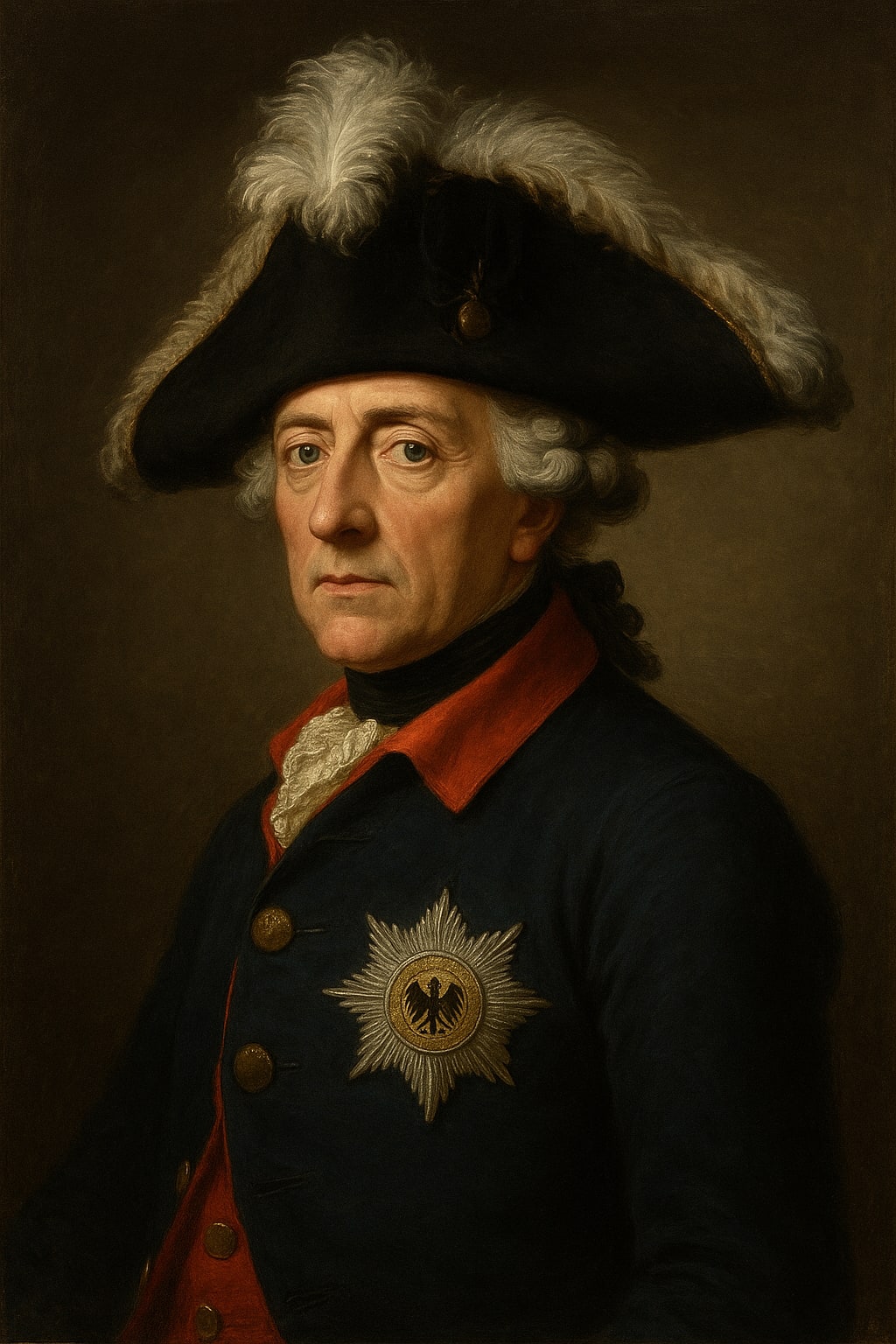
In the cold halls of Berlin Palace, the King of Prussia stood by his window, watching snow fall on his kingdom. His name was Frederick, but his people called him the Great.
He was not a man of laughter, nor one who smiled easily. His hands, though old and worn, still carried the memory of a sword—and the grace of a flute. For when wars ended and the drums fell silent, he would play soft music that drifted through the corridors like a memory of peace.
Years ago, he had fought to defend his small nation against giants—Austria, Russia, and France. Many nights he had not slept, thinking his army would break, his kingdom collapse. Yet somehow, through courage and cunning, he had endured. His people followed him not only out of fear, but because he never gave up, even when the world turned against him.
Now, in his final winter, the King no longer thought of battles. He thought of his garden at Sanssouci, of the roses he had planted, and of his dogs waiting by the fire. He thought of music, of the flute he once played beside Voltaire.
As the snow covered Prussia in silence, the old king whispered, “Power fades, but ideas remain.” Then he smiled—a rare, gentle smile—and the King of Prussia set down his sword forever.
And though the palace lights dimmed that night, the melody of his reign continued to echo across history.
About the Creator
Keep reading
More stories from writers in Fiction and other communities.
Wild Card Weekend Recap: What Happens Now?
I think I figured out why I love Wild Card Weekend so much. It's because it's the first playoff anything of the calendar year. The NFL season starts in the fall, and once upon a time, the champion was crowned either on or slightly before New Year's. The evolution of the NFL schedule has resulted in the playoffs starting just into the New Year, and currently, the final week of the season falls on the first weekend of the New Year, with Wild Card Weekend coming a week after that. So yes, chronologically, the NFL's Wild Card Weekend serves as the first playoff anything of the calendar year.
By Clyde E. Dawkins5 days ago in Unbalanced




Comments
There are no comments for this story
Be the first to respond and start the conversation.