
The House That Forgot Our Names
Memory fades slowly, but sometimes all at once.
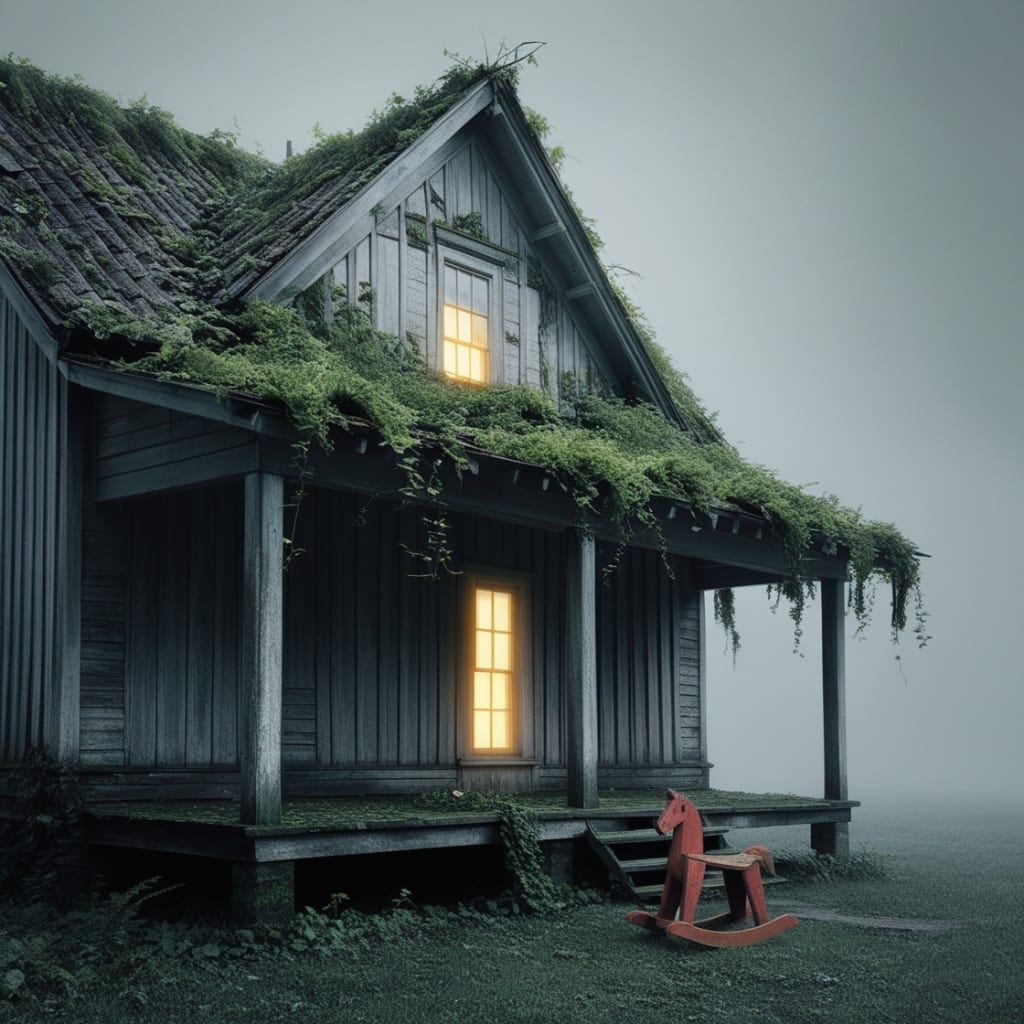
The house was waiting.
But it didn’t remember who we were.
It stood exactly where it always had — at the end of Wren Hollow Road, behind a gate that no longer latched, wrapped in ivy like an old secret. The windows were still cracked at the corners, like eyelids struggling to stay open. But something had changed.
“It looks smaller,” I said.
Mara didn’t answer. She was already halfway up the path, her boots silent on the moss-soft stone. She hadn't been back since the funeral. Neither had I.
We were children the last time we stood here. Now, our mother was buried in the orchard, and our names felt heavier on our tongues.
We stepped inside together.
The air smelled like dried lavender and rot. Dust clung to every surface like a thick memory refusing to be disturbed. The wallpaper curled inward like it was trying to forget itself.
I placed my hand on the banister. It didn’t creak.
Not in the way it used to.
The house always creaked for us.
It knew our weight. Our steps. Our rhythms.
Now, it was silent.
Indifferent.
Like a stranger holding its breath.
“This isn’t how I remember the hallway,” Mara whispered. “Wasn’t the coat rack by the door?”
I looked.
There was no coat rack. No hooks. Just blank wall.
And the floor felt longer than it used to — stretched, unfamiliar.
“Maybe Mom moved it.”
“No. She wouldn’t have.”
She was right. Our mother hated change. She believed houses had memory, and moving something was like rewriting a story already told.
Maybe that’s what scared me now — it wasn’t just that the house had changed. It was that it had changed without us.
We wandered from room to room, each one colder than the last. The kitchen had lost its warmth, even though the old kettle still sat on the stove. The den, where our father read books aloud by candlelight, now held no trace of his voice. The fireplace was bricked shut.
I ran my fingers across the mantle.
No dust.
As if someone — or something — had been here, just before us.
In the upstairs hallway, we passed the linen closet. I paused.
“It was here,” I said.
“What?”
“The wall. Look — the wallpaper’s different.”
Mara squinted. “You’re right. That’s not the same pattern.”
She brushed the wall with her fingertips. The pattern shimmered, almost like it was breathing. Then it faded — revealing a door.
A door that shouldn’t have been there.
We stared at it.
“This isn’t—”
“It wasn’t here before,” she finished.
But it felt familiar.
I opened it.
Behind it was a room with no furniture, no windows, no sound.
Just a mirror.
And on the mirror, a phrase was scrawled in something faintly red:
“Leave your names at the door. You’ve been forgotten.”
Mara gasped. “What the hell?”
I stepped closer. My reflection wavered — not distorted, just… hesitant.
When I reached out, the mirror rippled beneath my fingers.
For a split second, I saw the house — as it was before. Full of warmth. Laughter. Light.
And then, I saw something else.
Empty halls. Forgotten birthdays. An attic filled with photographs with no faces.
The house wasn't haunted.
It was grieving.
And grief, over time, forgets the shape of love.
“We shouldn’t be here,” Mara whispered. She backed away. “It doesn’t remember us. It doesn’t want us here.”
“No,” I said. “It’s not that it doesn’t want us. It just doesn’t know how to hold us anymore.”
Because we didn’t come back.
Not after the arguments. Not after Dad left. Not after Mom faded into herself.
We abandoned it.
And it mourned.
We went to the attic — the place where all the forgotten things lived.
The door groaned as we opened it, and for the first time since we arrived, the house made a sound that felt familiar.
Dust rose like ghosts. Boxes lined the walls, untouched.
I opened one.
Inside: a family photo.
But our faces were blank.
Just silhouettes.
Like someone had erased us.
Mara opened another. Letters. Dozens. All addressed to names we didn’t recognize.
I flipped through them, heart pounding.
All the handwriting was our mother’s.
But none of them were for us.
“She tried to remember,” Mara said quietly. “She wrote to us… but forgot who we were.”
I nodded. “And the house remembered that forgetting.”
We stood in silence.
Then — a sound.
A hum.
The same tune Dad used to hum in the den.
We turned.
In the far corner, something glowed faintly.
A record player. Spinning on its own.
We walked toward it.
The air shimmered.
And suddenly — the attic transformed.
Not fully.
Just flickers.
For a moment, it was as it once was:
Blankets on the floor. A lantern. Us as children, playing shadow puppets against the wall.
The house remembered us.
Just a flicker.
But it was there.
I stepped forward and whispered, “It’s us. We’re home.”
Mara joined me. She held my hand. “We didn’t mean to leave forever.”
Another flicker.
The shadows grew warm.
The photograph in my hand — our faces were returning. Slowly. A smile. An eye. A blur of color becoming memory again.
That night, we slept on the attic floor, like we used to.
The house creaked.
The wind whispered names down the chimney.
And the walls… they softened.
In the morning, we left the door open.
Let the sun in. Let the silence go.
We left the family photo on the mantle, fully restored.
We did not take it with us.
Because the house needed it more.
As we stepped outside, Mara turned to me.
“Do you think it will remember us next time?”
I looked back at the house.
It no longer felt cold.
Just quiet.
Alive, in its own way.
“I think,” I said, “it already has.”
About the Creator
Keep reading
More stories from Abuzar khan and writers in Fiction and other communities.
We Were the Last Two Dreamers in a City That Stopped Sleeping
The city hadn’t slept in twenty-seven years. Sleep was outlawed after the Dream Collapse — when the government decided that dreams were dangerous, unpredictable, and treasonous. “Order is built in waking,” they told us. “Dreams make rebels of men.” And so, they erased them.
By Abuzar khan6 months ago in Fiction
The CEO’s Bitter Game
Avery Sinclair had spent the last three years rebuilding what her family had lost. Her father’s company, once a thriving enterprise, had been ruined in a single deal orchestrated by Damien Blackwood — the ruthless CEO whose name still made her blood boil. But Avery had a plan. She would rise, stronger and smarter, and one day, she would make him pay.
By Millicent Chisoma day ago in Fiction



Comments
There are no comments for this story
Be the first to respond and start the conversation.