
The Green Light: Part 3 of 4
Being the Good Host
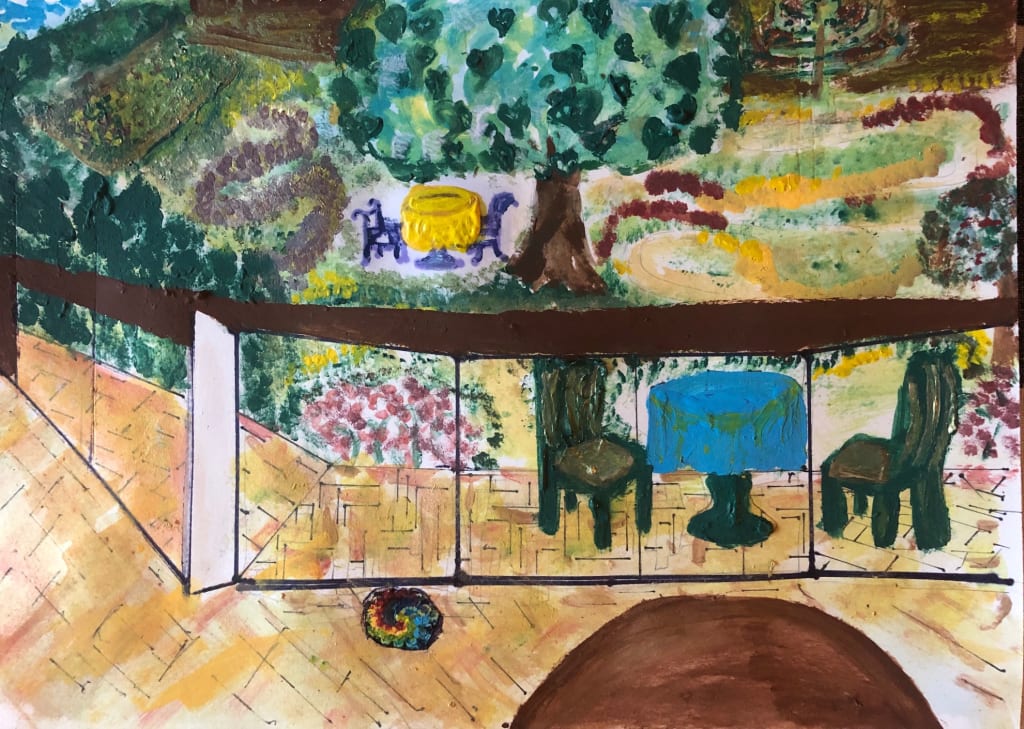
Over the years, Kat had been a creator imbued with the spirit of H.G.Wells. Her spouse, Robert supported her efforts. On this sultry August day, Robert was sporting an eye patch to protect a recent eye injury.
As they toured the garden. Robert sighed. "I feel like a cyclops. To what, exactly, the Universe wants me to turn a blind eye?"
"Didn't the cyclops forge thunderbolts for Zeus that held the flash of lightning? Maybe this is an opportunity to see beyond what you think. In the valley of the blind the one-eyed man is king.”
They stopped and looked at trees Robert had spent years training. Although said before, I repeated myself. “I love these trees. I think you are a genius who knows how nature flows in time and space. It is a perfect flattened Mercator projection of the phi ratio!”
Robert took Kat's hand, “Thank you. You always inspire a Marcel Proust moment. He says 'the real voyage of discovery consists not in seeking new landscapes but in having new eyes with which to see.' I espaliered these pear trees, pruning the branches that came from the grafted wild roots to prevent disease, maximize yield and minimize space. Nature is the genius.”
Kat commented, “Sweetheart, you also have an eye for beauty. Tell me, with your left eye covered, does it mean you use your right brain less?”
Robert knew about eyes. “Sight is a complex function. Images get reversed onto the retinas. Objects to the left make images on the right side of each eye. Messages from the left eye cross over and join messages from the right eye, that go directly to the right brain. Similarly, objects to the right, are sensed by the left side of either eye and both go to the left hemisphere.
Each eye sends information to both hemispheres, which each have a visual cortex. The hemispheres just deal with the opposite half of the environment. But they cannot share information. So, my brain is working as normal, with half of the input -from only the right side- being processed by my left brain." Quoting Shakespeare’s Sonnet 46 he said "Mine eye and heart are at mortal war, how to divide the conquest of thy sight. "
Taking his arm Kat added, “How is it that you know so much? You tap into your Yin emotional, creative and intuitive energy to make this the best minute ever."
“I'm glad you took my arm, my depth perception is off.”
Kat squeezed his arm saying "My pleasure. My love, since eyes are the window to the soul, losing your vision in one eye has put you in the company of great gods. The right eye of Ra represents the sun god, and the left Eye of Horus -which was lost in battle- represents the feminine counterpart. It was healed and restored by the goddess Wadjet, the 'green one of wholeness and rebirth, from whose tears mankind was formed'. She wore a double uraeus, representing the double serpent, weaving through the spinal cord, linking the root chakra to third eye and forming wings before going to the cosmic realm."
Kat continued. “Odin sacrificed an eye to drink from Mimir’s well of wisdom. He got enlightened and could preserve the head and wisdom of Mimir and decode the meaning of runes.”
Robert chuckled. “You do know your myths!”
“Tell me, “ Kat queried, “Does your research impact your treatment?”
Robert smiled. “Any null hypothesis is based on proving a contradiction. When we know something is wrong, we can test what else might offer sufficient reason to explain the truth. My research is part of a scaffolding of thought that requires strong support, otherwise, all the work beyond that point falls apart.”
Robert looked closely at the pear tree. He picked up a rolly, pill bug. “These Woodlice look like ancient Trilobites, the first organisms known to have eyes.”
Kat laughed. "A Thomas Hardy novel featured Trilobite fossils. The hero falls into a precipice and at the instance of near death he looks into the fossilized blue eyes of a 500 million year-old trilobite fossil and recognizes that the first vision of a complex eye facing death has not changed. The heroine saves the day, removing her undergarments to make a rope to rescue the hero.”
“An example of the naked ape who ignores social convention who often survives,” Robert chuckled. “The extinct trilobite Olenellus fossil found embedded in fool’s gold - iron sulphide pyrite deposits - had calcium carbonate rhomboid crystals thought to hold endosymbiotic sulphur bacteria that were located in luminous organs called photospheres. These still are found in bioluminescent nyctiphanes krill, and are the ancestral source of a universal homeobox gene, with HOX genes."
"That was a mouth full" Kat smiled.
Robert continued. " The most primitive one-celled organisms have pigmented eyespots, that capture and compress light at low levels. They use photoreceptive opsin pigments that evolved independently from maternally-derived obligate endosymbionts with mitochondria containing different HOX genes. They diverged into differentiated photoreceptors and eyes with opsins that change into isomers- different forms of the same molecule- and are the key to a lock.
Low light stimulates retinal opsin, called rhodopsin, that makes visual purple in rods of the human eye. This alters the physical chemistry of fermenting gut bacteria. Through Quorum sensing, using magnetic jets, the bacteria respond to light stimulus and adjust the mitochondria, containing endosymbionts, and control the nerve cells in the heart and brain.”
Kat's curiosity was genuine. “Tell me more.”
Robert obliged.
“HOX genes regulate gene expressions and determine cell fate. They regulate development of external segmented structures like limbs, wings, genitalia, and simple and complex eyes. HOX genes control size distribution and behaviour of worker Carpenter Ants. Removing HOX genes eliminates structures behind the constricted waist.
HOX factors, found in imaginal discs of insect arthropods, are associated with cellular memory from previous transformational states between metamorphic egg, larvae, and adult stages. What is learned by the larva passes to an adult.”
Pointing at a branch, he said, “ Look here - Aphids and ants. Aphids live on tree sap after hatching from the winter eggs. The first eggs are wingless females that reproduce, asexually. They secrete honeydew, an insect excrement, that carries a fungus that lives only in ant colonies. Worker ants hold the role of shepherds, protecting herds of aphids that they farm. They milk the sugar-rich juices of Honeydew, the only food the ant larvae can digest. The nectar called liquid gold, the sacra vita and Soma, is a thick dew that is dried and condensed to make manna, the bread of the angels, a gift from the gods, that is still made in Arabia.
There is a coevolutionary arms race between pathogens of social organisms. A virus controls a complicated interspecific cycle involving aphids, bacteria, nematodes and fungi. In the fall, cloned females form males to fertilize the eggs that are laid in winter on the plant, unless conditions trigger a generation of winged aphids. The virus changes the honeydew so it forms a barrier on leaves, preventing photosynthesis. This creates ideal conditions for fungi growth that affects nematodes and plant roots that, in turn reduce aphid numbers, stimulating a migration to new host trees where lay eggs closing the viral cycle.”
“Yikes” Kat said in contemplating the magnitude of these processes.
Robert continued. “Virus-like particles are used in vaccines against the Toxoplasma gondii parasite that affects cats and humans. Cats eat mice infected with the single celled parasite and grow cysts in the hippocampus and amygdala that irreversibly increase dopamine, decreasing fear response and altering vision. Mice, under the control of parasites, approach the cat and are eaten, allowing the bacteria to sexually reproduce in the cat’s gut, then be eliminated in the feces that mice eat to complete the cycle of transmission."
“Gross” Kat shrieked.
“It gets worse. Chromatophores contain opsins that control proton gradients, which in cephalopods like squid, connect to neurotransmitters causing instantaneously colour change for camouflage. A parasitic flatworm with Chromatophores invades snails eyestalks and takes control of the snails mind. Zombie snails are driven to go into the open, as the worm pulsates colours imitating a caterpillar, resulting in a bird eating the snail, completing the parasite's life cycle.”
“What next,” Kat wondered aloud.
“Light influences a complex series of transformations in Human gut bacteria that control the metabolism of tryptophan, a precursor for serotonin production in the brainstem. Serotonin makes Melatonin, a free radical scavenger, in the retina and pineal gland during times of darkness. Melatonin controls cellular molecular clocks, circadian rhythms, and magnetic fields of a subatomic quantum compass used or navigation by migratory species."
“Gosh,” Kat exclaimed. Bacteria control the pineal? That's the seat of the soul!”
Robert patiently explained. “In part. Melatonin influences cryptochrome proteins that are associated with Blue light. Brief flashes of blue light on the forest floor regulate stomatal openings and photosynthesis in plants. In humans, during the daytime, blue light can boost attention and mood, however at night, blue light from cell phones and computers or scattered in the atmosphere during a full moon, interferes with melatonin production, affects sleep, is toxic to the retina and can damage the molecule retinol, made of rhodopsin protein.”
Kat asked, “ Doesn’t Vitamin E help this damage?”
“True enough” said Robert. “External light cues affect guanine nucleotide receptors called G proteins, that set up opsin signalling cascades which control stress responses. G proteins use glutamine as part of a transformational cycle. Glutamine forms the main excitatory neurotransmitter, glutamate in the mitochondria and the major inhibitory neurotransmitter, gamma aminobutyric acid ( GABA). Electrical impulses from light alter glutamate and GABA, and can change the crunchy lignin and cell wall of pears, and the gut micro-biome of animals.
Glutamine, known as the Gin or Q, is the self-sustaining spirit of a genie that cycles between being the autogen of the soul and a diverse heterogen that balances polarity and duality. Along with Melatonin, glutamine regulates endosymbiotic fauna that can feed the less evolved parts of the reptilian brain sugar, or nourish the more evolved thinking parts of the human brain with fatty acids.”
Kat shared an image that flashed. "I am beginning to understand how the micro-biotic brain in the gut, can alter the brain formed in the nerve cells of the heart and the mind. Certain diets, meditating in a dark room, and using breathing techniques affect bacteria that influence Melatonin.
"I've read that Melatonin elicits a calming, quiet wakefulness and natural dreaming. Melatonin is linked with oxytocin associated with the emotions of love and happiness and can activate dimethyltryptamine, the spirit molecule, a powerful hallucinogen that evokes an out of body religious mystical, visionary state of the soul that connects an individual to the great timeless spirit."
Robert chuckled “Time to listen to the great spirit that is using us as a host and feed the soul found in our higher brain.”
We walked into the house. Robert saw the gift Kat had left him on the floor. "What's this?" he asked.
“I painted a God’s eye mandala on a rock for you. According to the Huichois in the Sierra Madres of Mexico who weave these, the mandala acts like the evil eye, protecting against evil forces. I hope it creates an environment that lets you know my attachment and caring, that since the dawn of civilization, has provided conditions for health and healing." Kat replied.
"You are my rock and I do appreciate how you set up conditions of health." he said smiling. After a kiss and a hug, they started to prepare supper, as obliging hosts to a greater force.
About the Creator
Katherine D. Graham
My stories usually present facts, supported by science as we know it, that are often spoken of in myths. Both can help survival in an ever-changing world.
Keep reading
More stories from Katherine D. Graham and writers in Fiction and other communities.
The Long Thaw
Years pass as quickly as an impression leaves a mark on the soul. I was visiting friends I had met as a student in Scotland. I had since moved. I had forgot how, when sunshine is scarce, grey shadows mark the dark season and reveal what hides on the other side of the divide.
By Katherine D. Graham4 years ago in Fiction
Ludacris and Nelly draw backlash over bookings at MAGA-coded music festival
Ludacris and Nelly headlining a mostly right-wing event is good for them. It’s also great for the genre of hip hop. The two rap veterans have showcased their talents on other stages. Why can’t they perform for mostly MAGA folks and grab that bag?
By Skyler Saundersa day ago in Beat


Comments
There are no comments for this story
Be the first to respond and start the conversation.