
The Girl Who Drew Doors
Every time Amelia sketched a door, it opened.
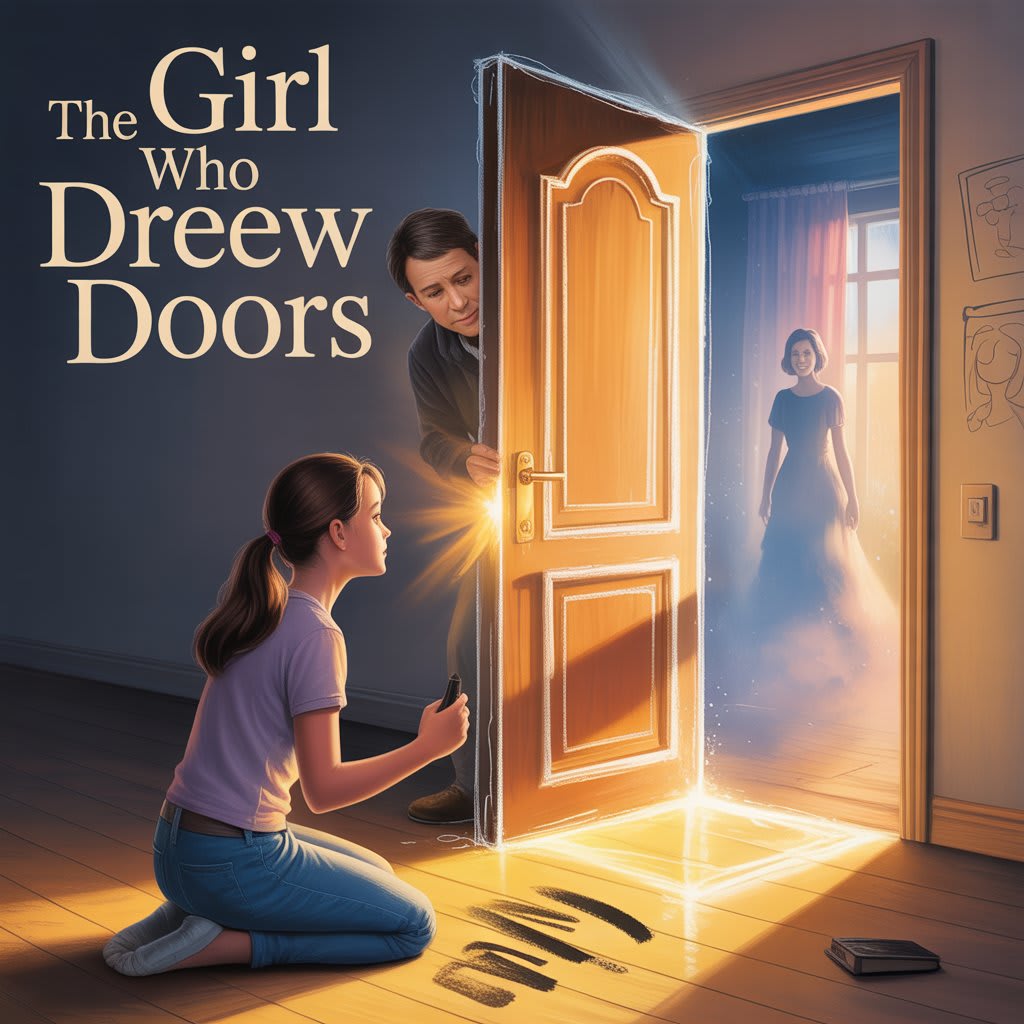
She discovered the gift at seven, crouched on the kitchen floor with a stub of crayon, drawing a rectangle on the wall. When she tugged the doorknob she’d scribbled in the middle, the plaster dissolved into a warm, cinnamon-scented room that belonged to her grandmother. Grandma had died two years earlier. The room was just as it had been—rocking chair, knitting basket, the faint radio static of a long-silenced station. Amelia stepped through, touched the armrest, and cried with relief. When she returned to the kitchen, the drawing vanished.
Her parents didn’t believe her at first. “A vivid imagination,” her father said. “Just like your mother.” But after she drew a second door—this one leading to his boyhood treehouse where he’d hidden his first guitar—they began to watch her with equal parts wonder and unease.
They set rules. Only small drawings. Only during the day. Never alone. The doors showed memories, not the present, they told her, so she couldn’t use them to spy or to find lost things. Amelia nodded but kept her secret thrill tucked under her ribs like a sparrow.
Years passed. Her mother fell ill, a gray shadow of the lively woman who once painted murals on Amelia’s bedroom wall. Hospital visits became routine. On the night the machines beeped slower and the air smelled of antiseptic rain, Amelia sketched a door on the underside of her hospital clipboard. It opened to a sunlit field where her mother was laughing, hair a red banner in the wind. Amelia stepped inside and ran to her.
“Don’t stay long,” her mother whispered, touching her cheek. “Memories aren’t meant to hold you.”
When Amelia returned to the hospital room, the monitors were flat. The door had vanished. Her father held her mother’s hand and stared at nothing.
After the funeral, the house became a labyrinth of closed doors—real ones. Her father drifted from room to room like a ghost, not playing guitar anymore, not eating much. Amelia wanted to help but didn’t know how. Then she remembered the one rule she’d never broken: “Only memories.” What if she could draw a door not to a memory but to a possibility?
One stormy evening she took a stick of charcoal and drew on the living room wall. This time the frame was taller, wider, lined with curling vines. She sketched a keyhole glowing like an ember. When she turned it, the door swung inward, and instead of the past she saw a dim corridor stretching away into mist. Soft footsteps echoed inside. Someone was waiting.
Her father stumbled in. “Amelia—what have you done?”
“I think I can bring her back,” she said. “Just for a moment.”
He hesitated, then followed her through.
The corridor led to a small wooden door at the end. Light spilled from beneath it, golden and pulsing. Amelia reached for the knob but it turned on its own. The door opened.
Her mother stood there, whole and smiling. “You shouldn’t be here,” she said gently.
Tears blurred Amelia’s vision. “I miss you. Dad misses you. Please—come back.”
Her mother’s eyes softened. “This place isn’t the past or the future. It’s what you make of it. But every door costs something.”
Behind her, her father’s voice cracked. “Let me talk to her. Please.”
Her mother touched his face. “You already are.”
The walls trembled; the corridor began to fade. Amelia felt the floor tilt under her shoes. “What’s happening?”
“You drew a door without knowing where it led,” her mother said. “It opened into the space between memories. Stay too long and you’ll both be lost.”
Amelia’s father reached for her mother’s hand. For an instant their fingers touched; then the light swallowed him. “Dad!” she screamed.
The corridor collapsed. She seized her mother’s arm but caught only air. The door slammed shut, throwing her back into the living room. The wall was blank. Her father lay unconscious on the carpet, his hand still outstretched.
When he woke an hour later, his eyes were wet but clear, as though he’d been crying in a dream. “I saw her,” he whispered. “She told me to play again.”
From then on he began to eat, to smile, to strum his guitar softly at night. Amelia still drew doors, but never without care. Sometimes she glimpsed her mother at the edge of her sketches—smiling, waving, reminding her that memory was a gift, not a trap.
One afternoon, as sunlight pooled on the kitchen tiles, Amelia drew a tiny door on a scrap of paper and slipped it into her father’s guitar case. When he opened it later and plucked a chord, a breeze smelling of cinnamon and paint swirled out. He smiled, closed his eyes, and played a song she’d never heard before but somehow already knew.
And for a heartbeat, the whole house felt like home again.
About the Creator
Keep reading
More stories from Tariq Ahmad and writers in Fiction and other communities.
The Clockmaker’s Daughter
He promised to come back from the war. The river kept the secret of whether he did. Every dawn for three years I walked to the banks of the Liriope, where the fog hung low and the water whispered like a confidant. I carried his last letter in my coat pocket, creased and soft from being read so often the words were fading: “I’ll return with the spring floods, Mara. Wait for me.”
By Tariq Ahmad5 months ago in Fiction
TUS NUA - ch 49
TUS NUA – ch 49 New Beginnings – Mia and Midnight (*)(*)(*) As Mia spoke on the phone to Ali’s sister, Ellen, Finola slipped quietly away and walked to the stream behind Tus Nua. Carefully, she put a block on her family so no one could know what she was about to do.
By Margaret Brennanabout 11 hours ago in Fiction



Comments
There are no comments for this story
Be the first to respond and start the conversation.