
The Garden of Regrets
Every regret you’ve ever had grows into a flower in a secret garden… and one flower refuses to bloom

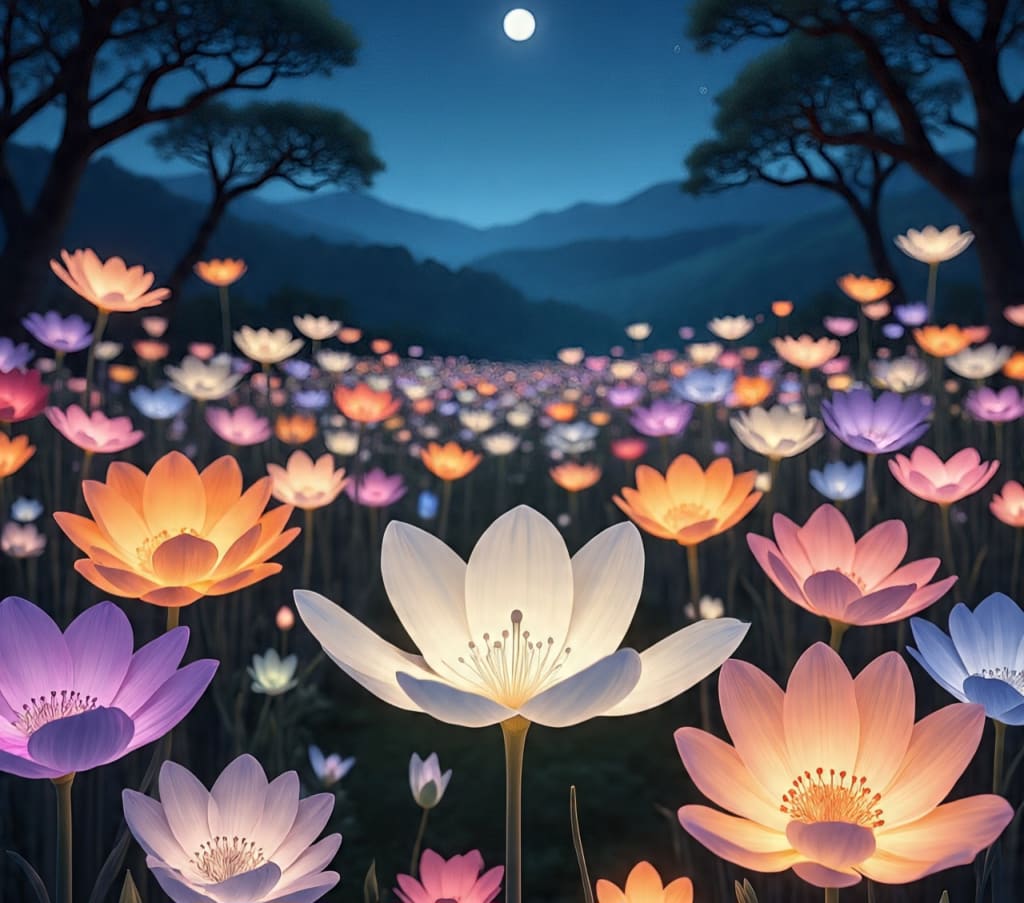
Most people carry regrets like shadows—silent, invisible, pressing down in quiet moments. But mine grew in soil.
I first discovered the garden on a night when sleep betrayed me. Tossing restlessly, I opened my eyes and found a faint glow leaking through the cracks in my bedroom floorboards. Following it, I was drawn to a door I had never noticed before. When I opened it, I found myself standing in the middle of a vast, moonlit garden.
The air was heavy with fragrance. Rows upon rows of flowers stretched endlessly—roses, tulips, daisies, orchids—each one alive with impossible color, each one humming faintly as if whispering. I didn’t need anyone to explain. I knew instantly: every flower represented a regret I had carried.
I knelt before a violet tulip and, as my fingers brushed its petals, I was flooded with the memory of the friend I’d abandoned in high school, too afraid to stand against the bullies. My chest ached. A regret, blooming into life.
The garden became both sanctuary and punishment. Some flowers were small, regrets that barely mattered—a missed bus, a forgotten birthday card. Others were towering, stretching high into the sky, their roots thick and deep, representing choices I could never undo. With each visit, more flowers grew. Some days, I woke to find new buds waiting for me, fresh reminders of mistakes I had tried to forget.
But one flower refused to bloom.
It was a single stem in the center of the garden, wrapped in green leaves, its bud perpetually closed. I tried everything: watering it, whispering apologies, even weeping at its base. But it never opened. And the more I returned, the more it tormented me. What regret was so heavy, so impossible, that even the garden could not give it life?
Years passed. The garden grew wild with color, regrets layered upon regrets, each petal reminding me of the roads not taken, the words left unsaid, the wounds I’d caused. But always, my eyes returned to the stubborn flower at the center.
One night, desperate, I shouted into the silence.
“What are you hiding from me?”
The garden stirred. Petals quivered. Leaves rustled. And then, like a whisper carried on the wind, I heard the answer: This regret isn’t ready to bloom because you won’t let yourself see it.
I fell to my knees, trembling. What regret was I denying?
The days that followed blurred into obsession. I combed through my memories, examined every choice, every failure, every broken promise. But still, the flower remained closed.
Until the night she appeared.
Julie. My sister. Gone for years now, taken by an accident I never spoke of. I saw her in a dream, standing in the garden, barefoot in the soil. She smiled, but her eyes carried the same sadness I remembered from her final months.
“You know why,” she said softly. “You’ve always known.”
Tears burned my eyes. The truth came rushing back: the fight we had the night before she died. My words sharp, hers cutting. The last thing I ever said to her was, “I don’t care anymore. Do what you want.” And then she was gone, swallowed by the cruel randomness of life.
I had buried that memory so deep that even the garden couldn’t reach it—until now.
When I woke, I returned to the garden at once. The stubborn flower trembled as I approached. My knees gave way as the bud slowly, painfully, began to unfurl. Petals of pale white emerged, glowing faintly in the moonlight. A single drop of dew slid down its edge like a tear.
This was the regret that had haunted me most: not being there, not saying I loved her, letting anger be the last thing I gave her.
I sobbed until my throat ached, clutching the soil, begging forgiveness from a flower that could not answer. But as I wept, something shifted. The garden, once heavy with sorrow, seemed lighter. The other flowers swayed gently, as though in sympathy. And the white bloom, fragile but open, stood tall among them.
I understood then: the purpose of the garden wasn’t punishment. It wasn’t there to trap me in endless sorrow. It was there to teach me. Regrets could bloom, but they didn’t have to fester. They could be acknowledged, tended, even forgiven.
The white flower would never vanish. Neither would the others. But I could walk among them without fear. I could learn from them, instead of letting them devour me.
When I left the garden that night, the glow faded, and the hidden door sealed behind me. I don’t know if I’ll ever find it again. But I carry its lesson wherever I go: regrets are inevitable, but they don’t have to define us. Even the heaviest regret, once faced, can bloom into something fragile, painful, but strangely beautiful.
About the Creator
LUNA EDITH
Writer, storyteller, and lifelong learner. I share thoughts on life, creativity, and everything in between. Here to connect, inspire, and grow — one story at a time.
Keep reading
More stories from LUNA EDITH and writers in Fiction and other communities.
When the Storm Found Us
Noah had seen enough movies to know what this moment usually meant—the quiet before something dramatic happened, the pause when everything could either go right or crumble spectacularly. His heart pounded like a drum in his chest, palms slick with sweat as he leaned forward, hoping for a miracle. But before he could even process what might come next, Rebecca’s laughter split the air like broken glass.
By LUNA EDITH5 months ago in Fiction
A Basic Guide to Life in the Void Space
------------------------------------------- 1 ------------------------------------------------ Hello! If you are reading this, then you might be somewhere in the first level of the Void Space. This writing is a guide from the VSSG or the Void Space Survival Group for short. If you are someone new to the Void Space, then you probably have a lot of questions that you need to have answered since you ended up in this strange place from whenever you originally came from. If you are not someone new to this place, then you might want to look back at this guide for a little bit of a refresher if you feel like you need one. After all, there are people who spend a lot of time in this place, but ultimately perish or succumb to something simply because they forgot the basics. Anyway, enough with the introduction, here is some basic information on the Void Space and how you can - hopefully - survive long enough to reach us or any of the less hostile groups that have formed down here.
By Eksploristo E3 days ago in Fiction



Comments
There are no comments for this story
Be the first to respond and start the conversation.