

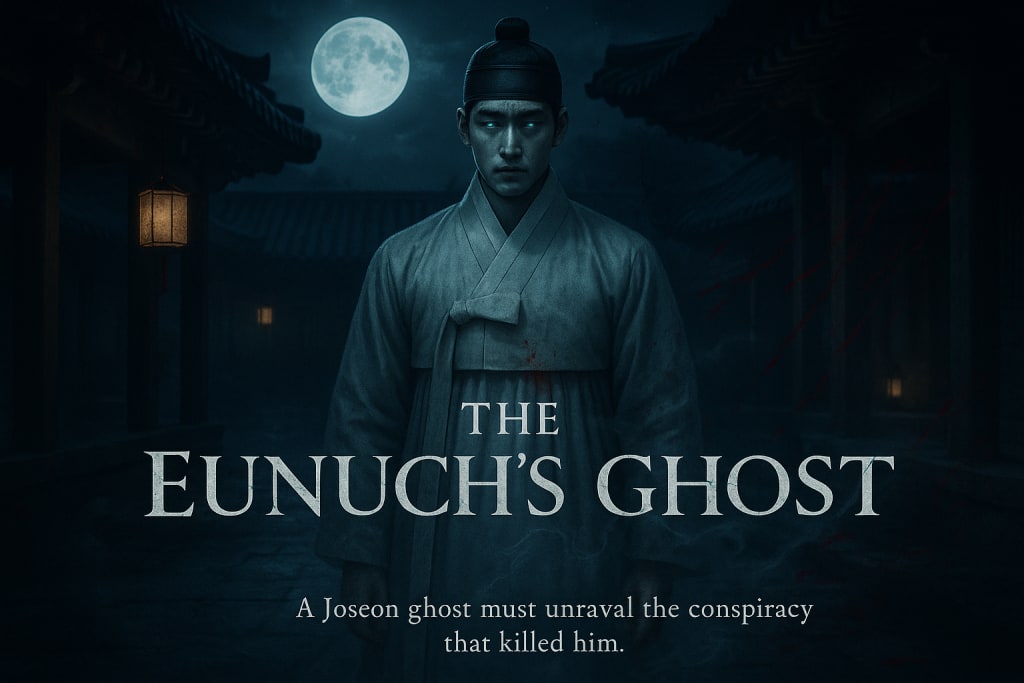
The wind howled through the pines on the palace outskirts, carrying with it the smell of rain-soaked earth and forgotten incense. Beneath the roots of a crooked tree, hidden from the eyes of those who passed by during the day, lay an unmarked grave. No headstone. No offerings. Only loose stones, hurriedly piled by men who had been ordered to dig quickly and say nothing.
The earth above it shifted that night.
The sky was heavy with clouds, and the moon was a thin crescent, pale and cold. Somewhere in the palace grounds, a night drum echoed thrice, announcing the hour. The soldiers on duty changed shifts, lanterns swaying in the darkness. Their mutters and footsteps faded.
Silence settled, broken only by the whisper of the trees.
Then the silence trembled.
A thin hand, translucent and pale, broke through the soil. It clawed upward, fingers shaking as though remembering what it was to move. The earth parted reluctantly, like fabric resisting a tear, until at last a figure pulled himself free from the grave.
Kim Jae-hwan gasped, though he had no lungs. His mouth opened, his chest heaved, but no breath came. He collapsed forward, his knees sinking into the wet ground.
For a moment, he thought he was still alive. The taste of iron lingered on his tongue, and the phantom ache of rope burned across his neck. But when he raised his hands to his throat, they slipped through the faint glow of his own form.
No flesh. No warmth.
He was a ghost.
Memories returned in fragments, jagged and cruel.
The cold stones of the courtyard. The minister’s voice reading accusations of treason. The crown prince’s face—he had been so young, trembling but silent. The rope. The jeers of guards who spat on him as his body hung limp.
Jae-hwan pressed his hands into the dirt, trembling. His chest ached with words he had never spoken. I was loyal. I never betrayed you.
But loyalty meant nothing once a sentence was passed.
The world he knew was gone.
A faint sound stirred him.
From the palace walls, faint lights glimmered—lanterns swaying as the watchmen made their rounds. The palace was still there, rising like a shadow against the night sky, its tiled roofs glistening with dew.
He stared at it, his form shivering with something he could not name. Longing. Anger. Duty.
That palace had been his world. He had scrubbed its floors, lit its lanterns, polished its silver. He had listened at closed doors, carried whispered messages, lived in silence as others ruled and schemed. He had sworn his life to the crown prince, guarding secrets with his tongue cut and his manhood taken.
And still, they had called him traitor.
He rose slowly, his feet barely touching the ground. Each step felt wrong, as if the earth rejected his weightless form. The pine branches swayed, though no wind touched them. As he passed, the air grew colder.
The palace gates loomed ahead.
The guards didn’t see him.
They leaned on their spears, yawning, whispering about rice wine and women in the village. Jae-hwan slipped past, his form melting through the wooden beams as though he were nothing more than mist.
Inside, the palace was as he remembered: vast courtyards paved with stone, narrow corridors where eunuchs shuffled with downcast eyes, the flicker of torches casting shadows across painted walls. But it felt emptier. Hollow.
He wandered through the servants’ quarters first, though the beds were filled with strangers. Young eunuchs he did not know whispered in the dark, clutching each other for warmth. Their threads of breath curled faintly in the cold air, but none of them stirred as he passed.
Then he moved toward the inner court.
The empress’s hall rose before him, lanterns burning bright even at this late hour. He lingered at the threshold, memories tugging at him like chains. He remembered kneeling there, waiting for orders. He remembered the day he had been summoned to deliver a letter to the prince—a letter that later became his death warrant.
His hand trembled as he reached out. His fingers brushed the wooden doors. For a moment, he almost felt it—the grain of the wood, the chill of the night. Then his hand slipped through.
Inside, the air shimmered with incense. A young woman knelt before the altar, her face veiled with a silk cloth. She whispered prayers, her hands folded neatly.
Jae-hwan stared. She was not the empress he had once known. This was someone new. Her figure was slight, her posture rigid, but her voice carried strength even in prayer.
“…grant me wisdom to walk among enemies, grant me courage to protect those who are faithful.”
Her words pierced him. Enemies. Faithful.
His body shook. The conspiracy was not gone. It still breathed within these walls.
And she… she would be its prey.
The air shifted.
From the shadows at the edge of the hall, another figure stirred. An old woman in plain robes, her eyes sharp as flint. She carried a lantern etched with talismans, and as she raised it, the light cut through the incense like a blade.
Her gaze fixed directly on Jae-hwan.
He froze.
No one had seen him since his death. No one had looked at him with eyes that knew.
The woman’s lips curled faintly. “So. The eunuch lingers.”
The empress turned, startled. “Lady Seo? Who are you speaking to?”
Lady Seo did not answer her. She stepped forward, lantern in hand, her voice low but steady.
“Kim Jae-hwan. Betrayer. Loyalist. Restless one. Why have you clawed your way back from the grave?”
Jae-hwan’s chest burned with words he could not speak aloud. His throat ached as if rope still bound it. The lantern’s light seared him, pinning him in place.
But his soul roared in silence: I came back… because the true traitor still lives.
And the night drum echoed thrice again.
The palace trembled with the sound, as if the past itself had stirred awake.
Jae-hwan’s ghost knelt in the incense-swirled hall, staring at the empress and the shaman who could see him. The conspiracy that had killed him was not finished.
And his time to act had begun.
The lantern’s talismans rustled as if in a wind of their own making. Lady Seo held it steady, eyes never leaving the pale shape kneeling on the polished floor. The empress rose from the altar, silk skirts whispering. Her veil hid most of her face, but not the tilt of her chin—poised, wary, unafraid.
“Lady Seo,” she said softly, “you can see him.”
“I can,” the shaman replied. “And he can see us. The dead with purpose always find their way to light.”
Jae-hwan’s fingers curled against the floor that did not warm his palms. The incense smoke curled through him without resistance; the brazier’s embers did not stir when he leaned nearer. But the lantern… the lantern’s circle of gold pressed against his outline like water against a stone.
Pulse by phantom pulse, he remembered what he had been. A shadow in service, a pair of hands, a name uttered only by his overseer and the boy-king he had once served. He bent, forehead to the wood.
The empress took one step closer. It was a careful step—back straight, shoulders squared, the way one approaches a tiger with an outstretched hand instead of a drawn blade. “Kim Jae-hwan,” she said, tasting the syllables as though she knew their weight, “why are you here?”
A thousand words crowded his throat. None could travel in the air. But the room was cool with night and the altar tiles had filmed over with breath. He dragged his finger through the condensation, and letters appeared in the faint sheen.
NOT REVENGE. WARNING.
Lady Seo’s brows lifted a fraction. “He writes.”
Min-kyung’s veil fluttered as she exhaled. “Warning of what?”
He wrote slower, concentrating until the strokes held.
TRAITOR STILL IN PALACE. YOU IN DANGER.
The empress’s gaze did not flinch. “Then you are not the enemy I was told to fear.”
“Many enemies wear masks,” Lady Seo murmured. She lowered the lantern so its light grazed Jae-hwan’s face. “Speak to me without words, restless one. Do you serve the throne? Or do you clutch the rope they gave you and become it?”
Jae-hwan remembered the rope as if it still burned in his neck—the rough braid, the stink of old hemp, the way the world flickered and went soft at the edges. He cut the memory short before it carried him away.
He raised his hand, touched his forehead, his heart, then pointed toward the lacquered table where the king’s seal customary for the empress’s decrees rested, covered by a velvet cloth. Once, he had collided with his overseer for less than glancing at such a symbol. Now he—rootless, weightless—reached toward it like a man drowning toward a shore.
“An oath,” Lady Seo said. “How quaint that duty survives the grave.”
Min-kyung looked from the ghost to the shaman. “Can he be bound to us? Not to our will,” she added quickly, “but to our cause.”
The old woman’s eyes narrowed in approval at the distinction. “Such binding is possible, Your Majesty, if the dead consents. He will not be your dog. But he can be your guardian, if he swears and you accept.”
Jae-hwan straightened. He had learned to make himself small among the living. It had not saved him. Now he did not bend.
Lady Seo drew a circle of rice grains at the edge of the lantern’s light and set three slips of paper there, each inked with a single character: Name. Duty. Release. She produced a small cup, poured a splash of clear wine, and set it where the circle’s edge met Jae-hwan’s shadow.
“It is not the taste that matters,” she said, “but the acknowledgement. Take what you can.”
The cup’s rim shimmered. Jae-hwan placed his palm over it. The wine trembled, rose in a fine film, and then was gone. A sweetness like summer wind passed through him, edged with the bite of grain and the memory of festival days he had watched through kitchen doors. He bowed deeper than he had bowed to any living superior.
The Empress Min-kyung lifted the velvet cloth and set her small hand upon the covered seal without exposing it. “Kim Jae-hwan,” she said, her voice steady and young all at once, “I accept your protection if you give it freely.”
He wrote, carefully and without flourish: I SWEAR.
Lady Seo touched flame to the paper marked Name, then pinched the ashes into the wine’s empty cup. “Then you are seen. And in being seen, you will be held to what you vow.”
The lantern flared. For a moment Jae-hwan felt a soft tug in his chest, not unlike the tug of duty that had led him by the ear through corridors for years. Grief threatened to overtop him. He pushed it back.
“If he is to serve,” the empress said, “he must have a way to speak.”
“He will have what we grant.” Lady Seo drew a length of red thread from her sleeve, tied it around the lantern’s handle, and fixed a sliver of bone to it—an old charm worn smooth with thumb and prayer. “While this burns, he may stir ink and ash, lift veil and paper, chill air and mark fog. He must not cross a threshold uninvited. He must not touch the living without consent.” Her gaze sank into Jae-hwan’s. “There are lines, even now.”
Jae-hwan dipped his head. He had survived by lines. He would survive by them again.
Min-kyung came forward and—after a heartbeat’s hesitation—unfastened a small ornament from her waist: a jade bead carved with a cloud’s curve and threaded on white silk. She held it out as though offering a bird to an open sky. “A token,” she said. “If you keep it, you may find me even in smoke and night.”
He extended his palm and the bead fell into nothing, then reappeared nestled in the hollow of his hand as if light had learned to pretend at weight. The silk looped against his wrist, unreal, perfect. He bowed over it.
“Good,” Lady Seo said. “We will need all our knots tied.”
A sound cracked the quiet.
A thread-thin twang, almost lost beneath the hiss of braziers. Then a breath—too soft for mortal ears—sucked through space with intention.
Jae-hwan spun.
In the carved rafters above the altar, a square of lattice had been loosened. From it dropped a length of silk, almost invisible, a loop knotted in its end. It fell toward the small stool where the empress had been kneeling moments before.
Jae-hwan slammed both hands up. The silk noose passed through his palms but met something colder than air and stuttered. The loop brushed the floor and settled, unable to tighten.
Lady Seo’s lantern roared blue. She flung a pinch of salt into the air; the grains danced, then sprayed toward a dark hollow at the ceiling like iron filings answering a lodestone.
“There!” she shouted.
The empress did not scream. She stepped back, quick and clean, skirts rising like a quiet wave. Jae-hwan streaked up, through beam and spiderweb, into the hollow between the roof and ceiling. The world up there stank of bat and dust and old incense. He found a body crouched low—a woman dressed as a servant, hair bound tight, hands moving fast.
She didn’t look at him. She couldn’t. But her mouth was set with a cold resolve he recognized from men on the execution dais.
She reached for a second knot.
Jae-hwan thrust both hands through the coil and kicked—but he had no heel. He had no weight. Panic surged through the shape of him, useless, human. He forced it down. There were other ways.
He pulled the heat from the knot. He had learned, in the brief minutes since the vow, the feel of warmth as it clung to things like a second skin. He seized it and tore. The silk froze. The woman gasped as her fingers numbed. The knot refused to cinch.
“Move!” Lady Seo barked from below. A bamboo pole jabbed up, the red-threaded lantern lashed to its end. The light pierced the hollow like a spear. The assassin flinched and hissed, yanking her hand away.
Jae-hwan pressed closer. Something on the woman’s belt caught his pale eye—a small sachet embroidered with cloud and goose, the stitches uneven in exactly the way Master Park’s needle had always made them. He knew the pattern. He had delivered such a sachet once, to the crown prince’s chambers—a sachet that had later been opened by the minister’s men to reveal a treasonous note inside. He had not sewn it. He had carried it. And for carrying, he had swung.
His breathless chest burned. He reached for the sachet with a tenderness that felt like grief and rage braided together—and it tumbled loose, falling through dust into the room below.
It struck the floor and burst.
Ash puffed. The smell of crushed plum blossoms and something bitter filled the air.
Lady Seo did not hesitate. She shoved the empress back, flung her sleeve over Min-kyung’s face, and hurled salt across the ash like a miser throwing coin. The ash hissed and curled inward. The bitter scent cut in half.
The assassin dropped through the lattice, brazen as a cat, landing in a roll and sweeping her hand toward the empress’s ankles—no blade, only a small lacquer bead hidden in her palm, dark as ink. Jae-hwan dove, catching at the woman’s wrist with cold that bit bone-deep. Her fingers spasmed; the bead flew from her hand and skittered under the altar.
Lady Seo’s bamboo pole cracked across the assassin’s shoulders. The woman staggered, eyes flashing. She lunged for the bead, desperate, but a foot came down on it first.
Not the empress’s.
A young court lady had arrived at the hall’s threshold, drawn by the commotion. She stared wide-eyed—then, seeing the piece under her shoe, lifted it as if to hand it to the nearest elder. The assassin’s face changed—not to fear, but triumph. She flung herself at the girl, knocking the bead from the court lady’s grasp, and caught it as it rose.
Her teeth found it before anyone could stop her.
The lacquer cracked. Black liquid ran down her tongue. She swallowed.
Her body jerked twice. She smiled with stained lips. “For the Lotus,” she whispered, and sagged to the polished wood like a sack torn open.
“Don’t touch her,” Lady Seo snapped, kneeling to peer at the bluish tinge rising in the woman’s fingertips. “Quick poison. No antidote a mortal hand can summon in time.”
Min-kyung stood very still, breathing behind the silk sleeve the shaman had thrown over her face. When she spoke, her voice did not tremble. “What is the Lotus?”
“A mask,” Lady Seo said grimly. “And a garden full of knives.”
Jae-hwan dropped beside the corpse and traced a circle in the frost on the lacquered floorboards. He wrote: QUIET LOTUS? then tapped the woman’s wrist. A faint brand gleamed like a ghost of a scar—an inverted lotus, petals pointing downward, lines cut with a needle heated and pressed.
Lady Seo bent closer. “Old,” she said. “Older than you. They prefer women for hands, eunuchs for messengers, ministers for shadows. They never kill to say a name.” She tilted her chin toward the sachet ash, now clumped under salt. “And they never bring plum blossom into a room without meaning to bury it.”
The empress’s head turned. “Plum?”
Jae-hwan wrote, less steady now: SAME SCENT WHEN I WAS ACCUSED.
Silence folded around the words like cloth. Even the crackle of the brazier seemed to draw back.
Min-kyung sank to her knees, ignoring the protest Lady Seo began. “Kim Jae-hwan,” she said, and though she could not see him in the way another dead might, she looked near enough to his eyes that he felt heat in the idea of a face. “The night the crown prince—”
“—now king,” Lady Seo interjected wearily.
“—the night he condemned you,” the empress continued, “plum blossom hung in the air?”
He nodded. A nod was a motion. A motion was a mercy. “Yes,” Lady Seo translated softly. “The scent marks the path the Lotus wanted him to walk.”
Min-kyung’s hand moved to the jade bead at her waist that was no longer there. Her fingers brushed nothing, then dropped. She rose in one motion and turned toward the back doors. “Seal this hall,” she said. “No one in or out until morning. Bring the chief of the Inner Court and the night captain. No one else. And send a runner to the king’s rooms—no—” She paused, then shook her head. “Do not wake His Majesty yet.”
Lady Seo’s mouth thinned, but she inclined her head. “As the wind orders, so the grass bows.” She snapped her fingers; the lantern’s flame settled into a steady gold. “And you,” she added to the air, “keep close.”
Jae-hwan drifted toward the screen doors that opened onto the veranda. Beyond them, the night breathed. Somewhere far, a bamboo flute played a tune for lovers with nowhere to meet. Nearby, footsteps. A carriage wheel. He turned instinctively toward sound.
Shadows slipped across the outer courtyard, lanterns bobbing. A palanquin moved swift and quiet toward the women’s quarters. Its bearers wore court livery; their heads were bowed. From the palanquin’s interior drifted a thin ribbon of fragrance—refined, winter-sweet, unmistakable.
Plum blossom. Not the smoke of the ash, but the heart of it, subtle and true.
Jae-hwan pressed to the lattice so hard his outline blurred. He reached for the palanquin as it passed—and hit the tight pull of the shaman’s lantern circle like a rope round his waist. The vow-fetch tugged, firm and unforgiving. He could not cross the threshold without invitation. He could not chase what moved beyond.
He clenched empty hands. The palanquin paused at the far veranda. A slim figure stepped out—a court lady with a veil, her gait precise. On her sash hung a norigae. Its charm was small, half-hidden in fringe, but when she turned, the moon caught it.
An ivory lotus, carved delicate. Upside down.
Jae-hwan’s fury cracked through him like ice. He hovered useless at the screen, every part of him straining toward the open courtyard, toward the woman disappearing through a side door as if she were the night’s own whisper. The scent faded. The palanquin bearers bowed to no one and melted away.
Behind him, the hall filled with motion: orders given, soldiers summoned, Lady Seo’s salt circled the body, quick quiet footsteps carried messages through inner corridors only women knew. The empress stood at the altar again, not to pray but to watch, her back straight as a blade.
Jae-hwan forced his attention down from the departing shadow. The dead woman’s wrist. The inverted brand. The ash clotted with plum. The noose. The bead. The murmur, “For the Lotus.” When the king had signed the warrant years ago, the minister reading the accusations had worn a tassel with an ivory charm that Jae-hwan had not seen clearly through his tears. He had thought it a flower. He had not thought to ask if the flower’s face was turned to earth.
He wrote into the fog that had formed anew on the floor: LOTUS USED EUNUCHS. FRAME. KILL. NOW TARGET EMPRESS.
Lady Seo crouched to read. “I believe you,” she said. “And I am tired of believing alone.”
Min-kyung stepped beside her and lowered herself to the floor with a grace that did not diminish authority. “Then we hunt,” she said simply.
Lady Seo blew the lantern to a war-bright blaze and lifted it high so the night could see. She pricked her finger with a needle she kept in her hair, pressed a dot of blood to the red thread tied to the lantern’s handle, and then pressed a second dot to Jae-hwan’s pale chest. The blood sank into his form like ink into paper.
“In my circle,” she murmured, “you may pass where I pass. In the empress’s name, you may go where she is bidden. But hear me.” Her eyes were iron. “If you touch the living without consent, if you take what is not given, if you hunger for more than duty—this light will burn you away.”
Jae-hwan bowed acceptance so deeply he felt the floor through the emptiness where his forehead should have hurt. He did not trust whatever fury had been planted in him by rope and lie. He trusted only the shape of his oath.
The empress lifted one hand, palm outward, an invitation and a command in one.
“Kim Jae-hwan,” she said, quiet, sure, “walk with us.”
He stepped forward.
The lantern’s circle widened until it grazed the screen doors. The tether loosened, line lengthening with the words as if spoken law had lengthened the leash of the dead.
Outside, the palanquin’s tracks were faint—a scuff where a bearer stumbled, a smudge of oil where a pole had brushed stone. Jae-hwan flowed along them like winter mist hugging a brook. At the far veranda, he paused where the veiled figure had vanished.
He did not know the layout of the women’s quarters as well as he had known the king’s halls. No eunuch did in those days unless invited. The door the woman had taken led into a wing where court ladies slept in rows, their pallets neat as brush strokes. Another door, however, led deeper—to chambers used by senior attendants when they waited on their mistress.
Jae-hwan pressed his ear—not ear—against wood that did not resist him. The room beyond was dark. The scent of plum lingered. On a table lay a small ivory box.
He looked back toward the hall. Lady Seo had followed, lantern held forward like a blade. The empress stood behind her, a step within shadow, a step within light.
Jae-hwan pointed.
Lady Seo slid the door open with a care that told of years of listening for the sound of hinges. The lantern’s glow fell across the table. The box was carved with a spray of lotus. Its lid was not locked. Inside, nested in silk, lay nothing but thread—white silk, red cord, and a spool of black floss slick as river stone.
No letter. No seal. No names.
But under the box, pressed thin as a dried leaf, lay a sliver of wood shaved from a minister’s seal. The shape was unmistakable in negative. The character carved there was not Yi—the grand chancellor’s name—nor Cho, nor Park nor Han. It was an office, not a man.
Tutor.
Jae-hwan felt the world tip as if a palanquin on a shoulder had shifted wrong.
The royal tutor. The man who had taught the young crown prince to write his virtues and conceal his doubts. The hand that had guided the hand that had signed the paper with Jae-hwan’s death.
He looked at the empress. She had not moved. Her eyes, visible now beneath the lifted veil, were very dark.
“We will not speak this name to the walls,” Lady Seo said. “Walls prefer powerful words; they try to repeat them until someone hears.”
“Then we write it in our blood and burn it,” Min-kyung replied, voice like a needle driven through silk. “And we prepare for court at dawn as if nothing has shifted at all.”
A drum sounded, far and measured. The hour turned.
Jae-hwan stood in the threshold, lantern-light drawing his outline into the room while shadows threaded him to the hall behind. He knew the sensation in his chest: not breath, not heartbeat. A tug. Duty. It had killed him once. It carried him now.
The empress fixed the veil back over her face and nodded once to the empty air where he held the jade bead. “Guard me tonight,” she said. “And remember everything.”
He bowed.
He would remember. He would follow the plum’s thread to the hand that tied it. He would walk in the breath between lantern and dark, in the law of a shaman and a sovereign, until the knot at the heart of the palace came undone.
Outside, the pines whispered. Somewhere, a winter wind lifted and cooled his face that had no skin. He turned his steps with the women whose voices carried the weight of morning and began, at last, to move toward his second life.
About the Creator
Keep reading
More stories from Bady Machi and writers in Fiction and other communities.
THE EUNUCH'S GHOST
The palace at dawn was quieter than any grave. Mist clung to the tiled roofs, sliding down the eaves like pale fingers. Drums had beaten the morning call, but the courtyards were not yet alive with chatter. Eunuchs shuffled in pairs, heads bowed, carrying basins of water. Court ladies swept the paths with long-handled brooms. Their whispers were muted, nervous, as though the walls themselves had learned to listen.
By Bady Machi 4 months ago in Fiction
Affection and Healing for Yourself
During the night of the last quarter moon, I gathered my ritual supplies. I carefully handled the chunk of black tourmaline that would protect me from your overall negative and narcissistic energy. I carefully walked the house with my stick of selenite in hand, asking the universe to cleanse our working space.
By Alisha Wilkins ✒️🦋🖋️5 days ago in Fiction
Thoughts on Vocal and the way the world is
"Death cannot stop true love, only delay it." – Wesley in The Princess Bride. I decided to come back to Vocal on a very cold and dark night at the end of December. I had been, and still am, convalescing from a horrible staph infection that had gone misdiagnosed for months. This, paired with the increasing challenges of being healthy, making the best choices for my co-parented child, being a wife, and being a director at a new job, was a lot to manage.
By Jazzy 6 days ago in Confessions


Comments
There are no comments for this story
Be the first to respond and start the conversation.