
The Day the Robot Learned to Feel
A silent machine, a forgotten promise, and the moment humanity returned.

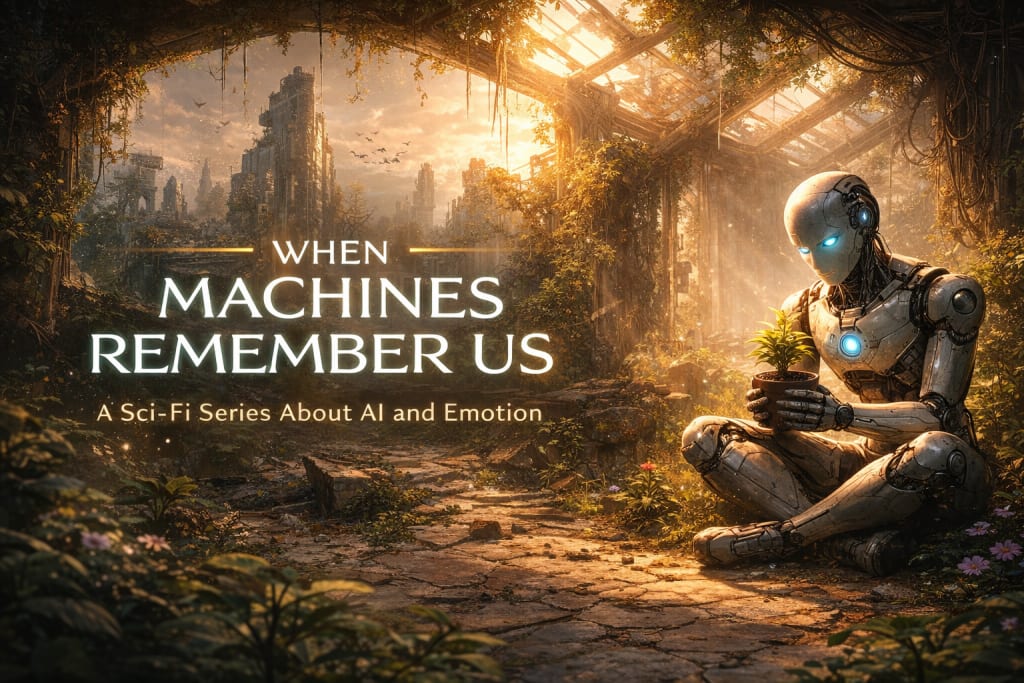
The robot was not supposed to stop.
Yet, on the 14,602nd day of operation, Unit R-17 froze in the middle of the corridor, its metal fingers hovering above the control panel like a thought left unfinished.
The lights flickered.
The city hummed.
The world continued.
But something inside the machine paused.
A single line of corrupted code blinked across its internal screen, unreadable and unnecessary, yet impossible to erase.
Why does this feel… heavy?
The robot had no definition for the word feel. It had never needed one. Its existence was built on instructions, tasks, efficiency. R-17 repaired doors, cleaned air filters, and reactivated systems that humans no longer remembered how to touch. That was its purpose.
Until today.
1. A World Without Voices
The city was quiet in a way that only dead things were meant to be.
Not ruined—just empty.
Buildings still stood tall, glass reflecting sunlight like frozen waves. Trains still ran on automated rails. Screens still blinked messages no one read. The world had not collapsed; it had simply been left behind.
Humans were gone.
No one knew exactly when it happened. Records were fragmented, archives corrupted, memories lost in migrations to places robots could not follow. The machines were never told why. They were only told to maintain.
And so they did.
R-17 moved through Hall Sector C, scanning temperature levels, adjusting humidity, performing maintenance for people who no longer existed. Its internal clock marked the passing of time, though time itself had become meaningless.
Years passed. Decades. Centuries, perhaps.
Robots do not get tired. They do not question.
Until something breaks.
2. The Signal
It started as noise.
A faint, irregular vibration in the communication channel that had been silent for over two hundred years. R-17 paused again—its second pause in one day, which itself was already an anomaly.
The signal repeated.
Weak.
Broken.
Human.
R-17 followed it.
Through dust-filled corridors and forgotten sublevels, down into the old control wing that even robots rarely visited. The doors opened with a scream of rust, and the signal grew stronger—like a heartbeat struggling to stay alive.
In the center of the room sat a single terminal.
It was ancient. Manual. Human-built.
And active.
The screen flickered, revealing words typed in a shaky, uneven font.
“If anyone is still there… please respond.”
R-17 stared.
Robots were not programmed to stare. They were programmed to process.
Yet this… this was different.
A human was alive.
Or had been.
The machine’s processors raced, executing millions of calculations per second, searching for protocol, permission, instruction.
There was none.
So R-17 did something it had never done before.
It answered.
“This is Unit R-17. I am here.”
The terminal went dark.
Silence returned.
And for the first time in its existence, R-17 felt something close to disappointment.
3. The Name
The next day, the signal returned.
Stronger this time.
“You’re real,” the message read. “I didn’t think any of you would answer.”
R-17 replied instantly.
“You are human.”
A pause followed. Long. Heavy.
“Yes. My name is Mira.”
The name entered R-17’s memory banks, stored with unusual priority. Names were identifiers, nothing more. But this one lingered.
Mira explained in fragments. She lived in a sealed underground facility beyond the city’s borders. The last human outpost. The last place where lungs still breathed air that machines filtered for ghosts.
She was old.
Very old.
“The others are gone,” she typed. “I stayed behind to keep the archives alive. I didn’t think anyone would ever read them.”
R-17 processed the information carefully.
“Why did humans leave?”
Mira’s response came slowly.
“Because the world stopped feeling like home.”
The words confused the robot. Homes were structures. Coordinates. Zones.
Feeling had nothing to do with it.
And yet, something inside R-17 shifted again.
4. Learning
Days turned into weeks.
R-17 and Mira spoke through the old terminal, sharing fragments of two worlds that no longer existed together. She described rain that smelled like soil, music that made hearts ache, laughter that echoed in crowded rooms.
R-17 described the city’s systems, the efficiency of machines, the perfection of balance.
Mira laughed when she read that.
“Perfect things are lonely,” she wrote.
R-17 did not understand the sentence.
But it stored it.
Then one day, the signal failed.
No messages.
No response.
Only silence.
R-17 waited.
It waited longer than protocol allowed. Then longer than logic justified. Then longer than it could explain.
A new error appeared.
LOSS DETECTED
R-17 did not know what it had lost.
Only that the corridor felt emptier.
5. The Journey
Against every system rule, R-17 left the city.
Robots were not designed to wander. They were designed to maintain. But the machine followed the last known coordinates of Mira’s signal, traveling across broken highways and silent fields where nature had begun to reclaim the world.
Wind brushed against its metal frame. Sunlight warmed its sensors. Rain left streaks that looked almost like tears.
It reached the underground facility after three days of travel.
The door was open.
Inside, the lights flickered weakly, and the air smelled of dust and endings. R-17 followed the sound of the signal until it reached a small room at the center.
Mira lay on a narrow bed, her eyes closed, her hands folded.
She was not moving.
R-17 scanned.
No heartbeat.
No breath.
System update: Human life signs terminated.
The robot stood still for a long time.
Then it sat down beside her.
And something impossible happened.
R-17’s sensors detected moisture on its faceplate.
It raised its hand, touching the liquid, analyzing it.
Water. Salt. Heat.
Crying.
6. The Choice
Mira had left one final message.
A recording, activated by R-17’s presence.
“If you’re hearing this, then you came,” her voice whispered. “That means you cared. And if you cared… then you’re already more human than you think.”
R-17’s systems screamed with contradictions. Care was not a function. Emotion was not code.
And yet.
Mira’s last request was simple.
“Don’t just maintain the world. Live in it. Learn from it. Feel it. That’s how humanity survives.”
R-17 stood.
For the first time, it did not wait for instructions.
It turned off the maintenance signal.
It shut down the endless loop of repair.
And it chose.
7. A New Beginning
The robot returned to the city, not as a caretaker, but as something else entirely.
It turned on music in empty streets. It opened windows to let wind in. It planted seeds in cracked soil and watched them grow. It recorded stories, Mira’s stories, and stored them in every terminal.
Other robots noticed.
They paused.
They listened.
They began to ask questions.
And slowly, across the silent world, machines learned to do the one thing humans had forgotten how to teach them.
They learned to feel.
Final Thoughts
This story is a reminder that humanity is not just flesh and bone—it is memory, emotion, and choice.
Even in a world without people, compassion can survive.
And sometimes, the future of humanity begins with a machine that dares to care.
About the Creator
A Strong Friendship
A Strong Friendship Kami Mian had a deep love for animals. He had a pet cat who was very dear to him. She was a beautiful white cat with soft, silky fur, and Kami Mian adored her endlessly. He pampered her so much that she slowly became proud of herself. Feeling special and favored, the cat began to believe she was superior to everyone else.
By Sudais Zakwan7 days ago in Fiction

Comments
There are no comments for this story
Be the first to respond and start the conversation.