
United States Super Absorbent Polymer Market Size & Forecast 2026–2034
How Hygiene, Healthcare, and Sustainability Are Shaping the Next Decade of SAP Growth

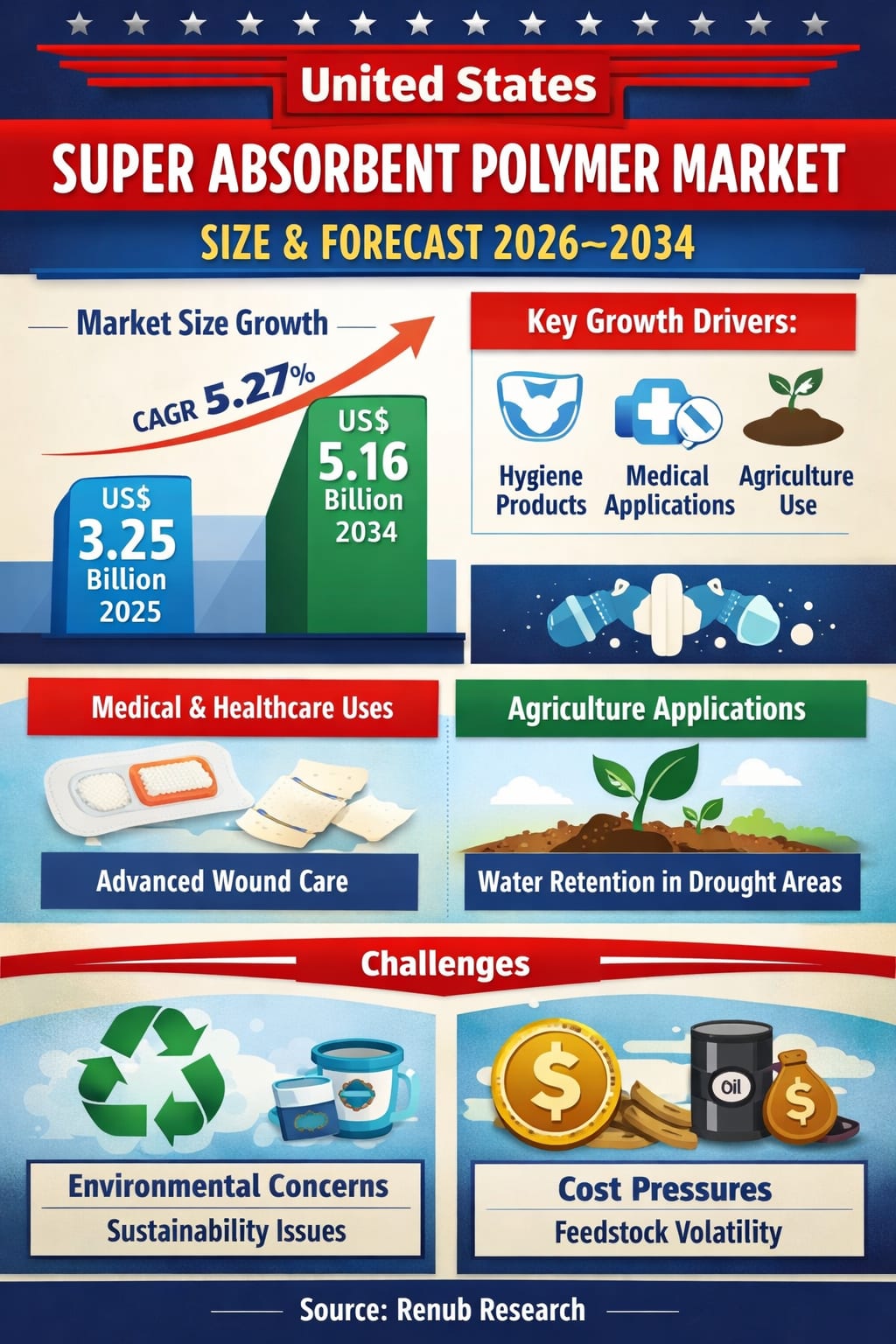
United States Super Absorbent Polymer Market Overview
The United States Super Absorbent Polymer (SAP) Market is poised for steady and sustainable growth over the coming decade, supported by expanding demand from hygiene, healthcare, agriculture, and industrial sectors. According to Renub Research, the market is expected to increase from US$ 3.25 billion in 2025 to US$ 5.16 billion by 2034, registering a CAGR of 5.27% during 2026–2034.
This growth trajectory reflects the rising reliance on materials that can efficiently absorb, retain, and lock in fluids—properties that make SAPs indispensable in modern life. From baby diapers and adult incontinence products to wound dressings, concrete curing, and water-retention applications in agriculture, SAPs are quietly enabling performance improvements across multiple industries.
As U.S. consumers increasingly prioritize comfort, hygiene, safety, and sustainability, SAP manufacturers are responding with innovation, capacity expansion, and advanced formulations that deliver higher absorbency with thinner, lighter product designs.
United States Super Absorbent Polymer Market Outlook
Super absorbent polymers are cross-linked hydrophilic materials—most commonly based on acrylic acid salts—that can absorb liquids many times their own weight. When exposed to moisture, they swell into a gel-like structure that traps liquid and prevents leakage, making them ideal for single-use hygiene and medical applications.
In the U.S., SAP demand is dominated by the hygiene sector, but medical, agricultural, construction, and environmental applications are expanding rapidly. Continuous innovation in polymer chemistry, particle engineering, and surface treatment is allowing manufacturers to tailor SAP performance for specific end uses, including high-saline environments, pressure retention, and rapid absorption kinetics.
With strong domestic consumption and a technologically advanced manufacturing base, the United States remains one of the most attractive SAP markets globally, particularly for premium and specialty grades.
Key Growth Drivers in the United States Super Absorbent Polymer Market
1. Strong Demand from Personal Hygiene and an Aging Population
Personal hygiene products represent the largest application segment for SAPs in the United States. Baby diapers, training pants, feminine hygiene products, and adult incontinence items all rely heavily on SAPs to deliver dryness, comfort, and leakage protection.
Demographics play a decisive role in long-term demand. The U.S. population aged 65 and above is projected to grow from 58 million in 2022 to 82 million by 2050, significantly increasing the need for adult incontinence products. At the same time, consumers expect thinner, more discreet, and higher-performing hygiene solutions—forcing manufacturers to increase SAP usage per unit and adopt more advanced grades.
Healthcare providers also prefer disposable hygiene products for infection control, further reinforcing steady SAP consumption across home care, hospitals, and long-term care facilities.
2. Expansion of Medical and Healthcare Applications
Beyond hygiene, medical applications are becoming a powerful growth engine for SAPs. Advanced wound care dressings now use SAPs to manage exudate, maintain moist healing environments, and reduce the frequency of dressing changes. Surgical pads, disposable bed liners, and absorbent medical packaging also depend on SAP technology.
The rising prevalence of chronic wounds, diabetes, and long-term care admissions is accelerating demand for absorbent medical disposables. Hospitals and clinics increasingly prioritize materials that enhance patient comfort while minimizing infection risks—two areas where SAP-enhanced products excel.
Innovation in medical-grade SAPs is focused on higher fluid uptake per gram, pathogen-locking gel structures, and composite materials that combine SAPs with antimicrobial agents.
3. Diversification into Agriculture, Construction, and Environmental Uses
SAPs are no longer limited to hygiene and healthcare. In agriculture, they help retain soil moisture, reduce irrigation frequency, and improve seed germination—particularly valuable in drought-prone regions of the U.S. Landscaping, turf management, and urban greening projects are also adopting SAP-based water-retention technologies.
In construction, SAPs are used in concrete admixtures to control water release during curing, reducing shrinkage cracks and improving structural durability. Environmental applications include spill containment, wastewater treatment, and animal hygiene products, where SAPs immobilize liquids and contaminants efficiently.
This diversification reduces market dependency on hygiene cycles and supports long-term resilience.
Challenges Facing the United States SAP Market
Environmental Concerns and Regulatory Pressure
Traditional SAPs are typically non-biodegradable polyacrylates, raising environmental concerns about landfill accumulation from single-use hygiene products. Regulatory agencies and consumers are increasingly demanding sustainable alternatives, including recyclable designs and bio-based SAP formulations.
However, developing biodegradable SAPs that maintain high absorbency, gel strength, and cost-efficiency remains a major technical challenge. Compliance testing, certification, and reformulation significantly increase R&D and production costs, creating pressure on margins.
Feedstock Volatility and Production Cost Pressures
SAP manufacturing relies heavily on petrochemical feedstocks such as acrylic acid, sodium hydroxide, and crosslinkers. Price volatility in these raw materials directly affects production costs and profitability. Energy-intensive polymerization and drying processes further increase operational expenses.
Supply chain disruptions—particularly in monomer availability and logistics—can also delay production and increase procurement risk. To mitigate these challenges, producers are pursuing backward integration, supplier diversification, and strategic inventory management.
Market Segmentation Insights
United States Super Absorbent Sodium Polymer Market
Sodium polyacrylate-based SAPs dominate the U.S. market due to their high swelling capacity, rapid absorption, and strong gel retention. These properties make them the preferred choice for diapers, adult incontinence products, and medical disposables.
Beyond hygiene, sodium SAPs are used in agriculture, cable coating, and industrial containment applications. Quality control, particle size consistency, and low residual monomer content are critical performance and safety requirements in this segment.
United States Super Absorbent Polymer Personal Hygiene Market
Personal hygiene remains the backbone of SAP demand in the United States. Manufacturers continuously optimize product design by balancing SAP placement, fluff pulp ratios, and acquisition layers to maximize absorbency while minimizing thickness.
Consumer expectations for discreet, comfortable, and high-performance hygiene products continue to rise, driving the adoption of premium SAP grades. Aging demographics and growing acceptance of adult incontinence products further support volume growth.
United States Super Absorbent Polymer Medical Market
Medical-grade SAPs are used in wound dressings, surgical pads, bed protection, and disposable medical garments. These materials must meet stringent biocompatibility and sterility standards, making them more expensive but also more specialized.
Advanced wound care products increasingly use multilayer SAP structures that manage exudate while maintaining an optimal healing environment. Hospitals favor these solutions for improved patient outcomes and reduced nursing workload.
United States Suspension Super Absorbent Polymer Market
Suspension polymerization enables precise control of particle size and crosslink density, producing SAPs with fast absorption kinetics and uniform performance. These materials are widely used in hygiene cores, medical applications, and specialty industrial uses.
While capital-intensive, suspension production yields high-value products that meet the growing demand for consistent, low-dust, and high-performance SAPs.
United States Gel Super Absorbent Polymer Market
Gel-based SAPs are engineered for superior fluid retention under pressure and high ionic strength environments, such as saline or biological fluids. These materials are critical for medical dressings, feminine hygiene, and premium diaper cores.
Ongoing R&D focuses on improving ionic tolerance, gel stability, and safety, positioning gel SAPs as a premium, high-margin segment within the market.
Regional Market Analysis
California
California leads SAP consumption due to its large population, advanced healthcare infrastructure, and extensive agricultural activity. Water-retention SAPs are particularly valuable in drought-prone regions, while medical and hygiene demand remains strong.
New York
New York’s dense urban population and major healthcare institutions drive consistent demand for hygiene and medical SAP products. Efficient logistics and institutional procurement further strengthen market performance.
New Jersey
With strong logistics infrastructure and proximity to major ports, New Jersey serves as a key processing and distribution hub for SAP-based products. The state’s pharmaceutical and biotech clusters also support demand for medical-grade SAPs.
Washington
Agriculture, environmental projects, and healthcare demand shape SAP usage in Washington. The state’s ports facilitate efficient import-export logistics, supporting regional distribution.
Market Segmentation
By Type
Sodium Polyacrylate
Polyacrylate/Polyacrylamide Copolymer
Others
By Application
Personal Hygiene
Agriculture
Medical
Industrial
Others
By Production Method
Suspension Polymerization
Solution Polymerization
Gel Polymerization
By Top States
California, Texas, New York, Florida, Illinois, Pennsylvania, Ohio, Georgia, New Jersey, Washington, North Carolina, Massachusetts, Virginia, Michigan, Maryland, Colorado, Tennessee, Indiana, Arizona, Minnesota, Wisconsin, Missouri, Connecticut, South Carolina, Oregon, Louisiana, Alabama, Kentucky, and the Rest of the United States.
Competitive Landscape
The U.S. SAP market is characterized by global chemical leaders and specialized polymer manufacturers competing on performance, innovation, and sustainability. Key players include:
BASF
Evonik Industries
Formosa Plastics Group
Kao Corporation
LG Chem Ltd.
Nippon Shokubai
Satellite Science and Technology Co., Ltd.
SDP Global Co. Ltd.
Sumitomo Seika Chemicals Company Ltd.
Yixing Danson Technology Ltd.
Each company is evaluated across five viewpoints: overview, key personnel, recent developments, SWOT analysis, and revenue analysis.
Final Thoughts
The United States Super Absorbent Polymer Market is entering a decade of stable, innovation-driven growth. With hygiene and healthcare demand rising alongside diversification into agriculture and construction, SAPs will remain a foundational material in multiple industries.
While environmental and cost pressures present challenges, continuous R&D in sustainable and high-performance polymer technologies is reshaping the future of the market. Companies that successfully balance performance, cost, and sustainability will be best positioned to lead in the 2026–2034 forecast period.
About the Creator
Chiyoda Integre Co: Company Insights and Gold Price Today Update
Chiyoda Integre Co: Company Overview Chiyoda Integre Co is a leading engineering and industrial services company, recognized for its excellence in integrated project solutions. The company specializes in engineering, procurement, and construction (EPC) services for industries including energy, petrochemicals, and manufacturing. Its commitment to innovation and quality has positioned it as a trusted partner in large-scale infrastructure and industrial projects worldwide.
By Hammad Nawaz3 days ago in Trader
Saving Your First $100K Feels Impossible Until You Realize What You're Actually Fighting
Most people think saving their first $100K is hard because they don't make enough money. That's rarely the real reason. The real fight isn't income. It's friction. Social pressure. Short-term relief. Emotional spending disguised as "deserved." A lifestyle that quietly expands the moment money touches it.
By Destiny S. Harris5 days ago in Trader


Comments
There are no comments for this story
Be the first to respond and start the conversation.