
The People Who Live in My Grocery Store
They don’t just buy groceries here, they live entire lives between shelves of cereal and hope

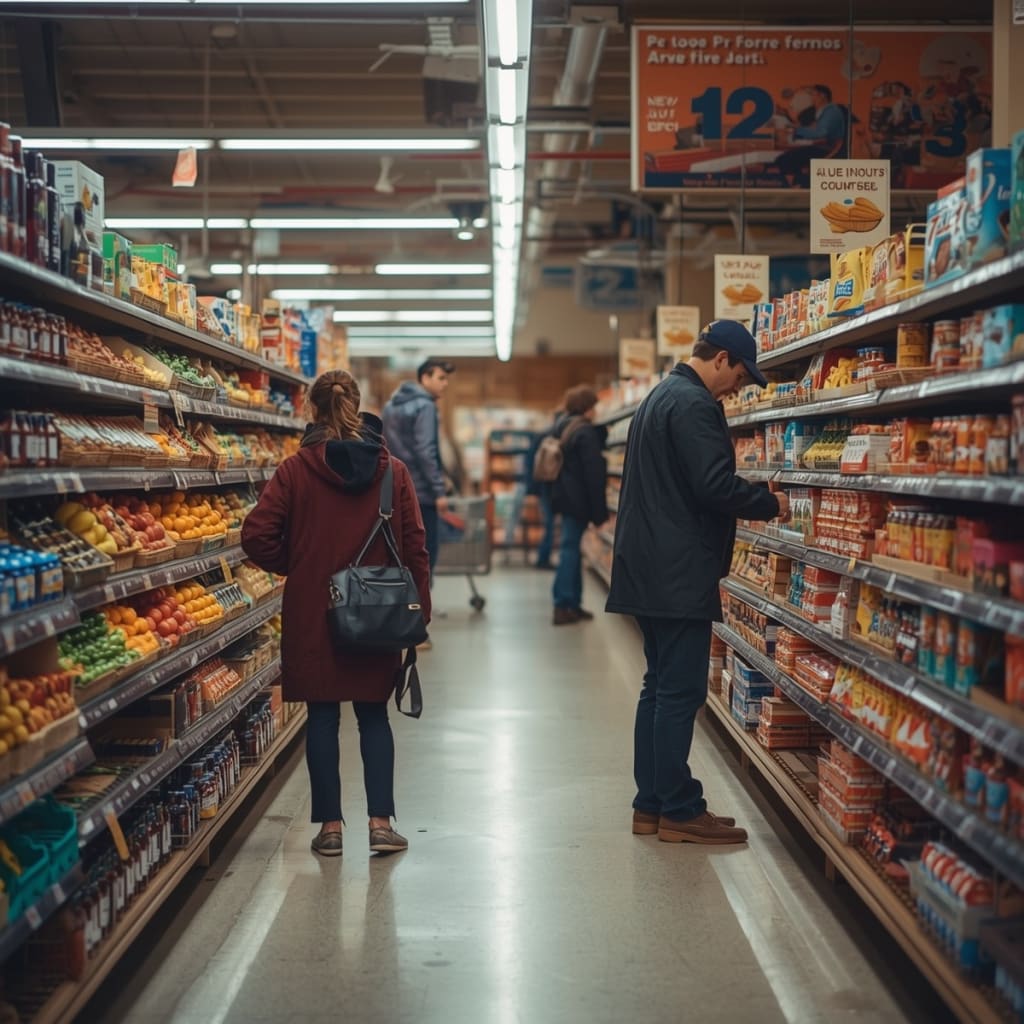
The fluorescent lights buzzed softly, like a whisper nobody cared to listen to. I’d been coming to this grocery store for months, maybe years, though I could never be sure anymore. Not the shopping, not the aisles, not the faint smell of polished floors and stale coffee. It was the people.
They were everywhere, living lives in the small pockets of the store that nobody paid attention to. There was Mrs. Calder, the woman who talked to the fruit before picking it. “You look ripe enough today, dear apple,” she would murmur, turning it gently in her hands before placing it in her basket. I caught her doing it once and laughed under my breath. “Talking to apples now?” I asked. She smiled, like I had asked the most ordinary question in the world. “Someone has to listen,” she said.
Then there was Jamie, a teenager stacking cans in aisle three. Every time I walked by, he was rearranging beans, soups, and sauces with obsessive care, eyes distant, almost dreamy. “You think life is better somewhere else?” I asked him once, trying to break the silence. He glanced up, startled, then nodded without words, as though I had glimpsed a secret he had carried for too long.
And the quiet man at the coffee station. He always bought two cups, though he never spoke to anyone. People might have assumed he had a companion waiting at home, but I knew better. He drank both in silence, sitting in the corner, eyes fixed on nothing, yet somehow seeing everything.
I never knew their names, never needed to. The store had become a kind of sanctuary, a theater where human fragility and hidden lives played out in plain sight.
That evening, the first unusual thing happened.
I was walking past the frozen foods when a hand grabbed my shoulder. My heart jumped. I turned to see a man, maybe in his forties, wearing a dark coat and an anxious expression. “Do you work here?” he asked, voice low.
“No,” I said cautiously. “Why?”
“I think something is wrong. Something is happening.”
Before I could respond, he disappeared around the corner, slipping into the cereal aisle. My curiosity pried open the lock of my fear, and I followed.
I found him staring at the shelves, hands trembling. “It is not right,” he whispered. I looked at the aisle. Cereal boxes stood in neat rows as usual. “What is not right?” I asked.
“They are moving. The boxes, they are moving,” he said. His eyes darted nervously. I laughed, nervously, trying to shake the tension. “Maybe it is just a breeze,” I said. But then I saw it too: a box of Cheerios, nudged slightly forward as if someone or something had touched it.
A chill ran down my spine.
Over the next few days, strange things kept happening. Jamie’s cans would rearrange themselves differently than before. Mrs. Calder’s apples sometimes rolled off the shelf, landing perfectly in a basket she had not touched. And the quiet man’s coffee cups, sometimes one would vanish, even though the counter was empty.
I began to notice patterns, subtle and eerie. The people were not living ordinary lives, they were hiding, protecting something. Or maybe someone.
It was a Thursday when I realized the truth.
I arrived early, before the store opened, and noticed a small door behind the frozen section. I had walked past it a hundred times and never seen it open. But that morning, it was ajar, a faint yellow light spilling into the cold aisle. My pulse quickened.
I slipped inside. The room was small, almost like a storage closet. But it was not storage, not entirely. There were beds, tiny personal spaces, journals stacked neatly, and personal items, photographs, a pair of worn-out shoes, knitting projects. And then I saw them, all the people I had been watching. Mrs. Calder arranging her apples, Jamie stacking miniature cans in a delicate order, the quiet man carefully writing something in a notebook.
“What is this?” I whispered.
Mrs. Calder turned, startled. “You were not supposed to see this,” she said softly. But there was no anger in her voice, only fatigue.
“They live here,” I stammered. “All of them?”
She nodded. “Not just live. Hide. Some of us, we have nowhere else. This store gives us cover. Routine. Hope. It is safer here than outside.”
I understood then. The store was not just a grocery store. It was a sanctuary for the overlooked, the lost, the forgotten. It was not magical in the obvious way, it was human. It gave people a place to exist without judgment, a place to grieve, to dream, to breathe.
Suddenly, Jamie’s voice broke the silence. “Do you want to see something?”
He led me to a small corner where tiny windows were cut into the walls. Through them, I saw glimpses of the outside world, people walking, cars passing, neon lights flickering. Life continued, unaware of the quiet humanity hidden behind fluorescent shelves.
Mrs. Calder placed a hand on my shoulder. “We say goodbye every day without leaving. We live in the middle of the world and out of it at the same time. That is how we survive.”
I felt a lump in my throat. There was a strange beauty in it, a quiet defiance. They were not hiding because they were afraid, they were thriving in ways the world never allowed them to. And the store, with its hum of lights and rows of cereal, was the heart of it all.
I left that evening, but I could not stop thinking about them. When I returned the next day, they were gone from the little room behind the frozen foods, just like the world outside had never existed. But the aisles told me they had not left. A misplaced apple, a slightly rearranged can, two coffee cups quietly sitting side by side, they were still here, living entire lives between shelves of cereal and hope.
And I realized that sometimes, the most extraordinary lives are the ones we never notice, quietly unfolding under the fluorescent hum of a grocery store.
The store would always be the same. Yet nothing would ever be the same again.
(The story is written by author with minimal AI assistance)
About the Creator
Wahdat Rauf
I am an article writer who turns ideas into stories, poems, and different type of articles that inspire, inform, and leave a lasting impression.
Keep reading
More stories from Wahdat Rauf and writers in Fiction and other communities.
The Forgotten Letter
The attic smelled of dust and time. Sunlight fell through a cracked window, streaking across forgotten trunks and boxes that had not been touched in decades. My heart pounded in my chest as I stepped carefully over a loose floorboard, every creak echoing in the quiet space. I had come looking for old family photos, nothing more, but something in the air told me I might find much more than I expected.
By Wahdat Rauf2 months ago in Fiction
The Devil's Cut
“Comrade, finally you’re awake.” The voice was smooth, sensual. A flickering incandescent bar was all that lit the white, sterile room. All Vladimir remembered was everything going black. He tried to move his arms and found them strapped to the gurney.
By Matthew J. Fromm4 days ago in Fiction
How to Train Your Unicorn
Congratulations! Despite incredible odds, you found a Malchezedek tier unicorn. It must’ve been a once-in-a-lifetime experience! So now you’re wondering how can you interact with this majestic creature again. Well there are things you should know and certain steps to follow.
By Gabriel Shamesabout 23 hours ago in Fiction



Comments
There are no comments for this story
Be the first to respond and start the conversation.