
The Cowherd and the Weaver Girl: An Eternal Love Across the Milky Way
Qixi Festival's Magpie Bridge: Where Stars Whisper Timeless Tales
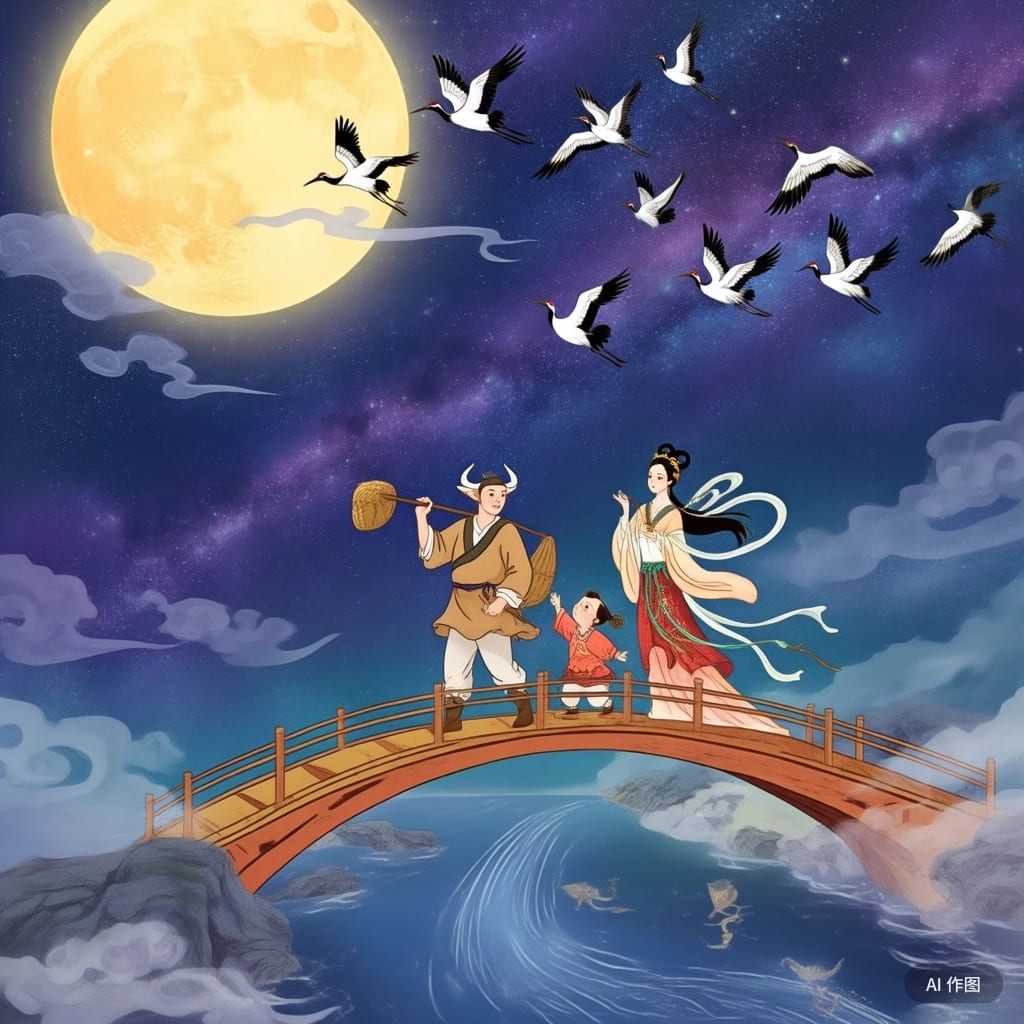
1. The Forbidden Love (禁忌之恋)
In ancient China, Zhi Nu (Weaver Girl) was the youngest daughter of the Jade Emperor (God of Heaven). Skilled in weaving starry clouds into silk, she longed for freedom from her lonely heavenly life. One day, she descended to Earth and met Niu Lang (Cowherd), a kind but penniless farmer. They fell in love, married, and had two children. Their idyllic life—he farming, she weaving—symbolized harmony between humans and nature.
Cultural Note:
The Jade Emperor: Supreme deity in Chinese mythology, akin to Zeus in Greek lore.
"Weaving clouds": A metaphor for creativity and feminine virtue in ancient China.
2. The Celestial Wrath (天庭震怒)
When the Jade Emperor discovered his daughter’s marriage to a mortal, he ordered the Queen Mother of the West (Wang Mu Niang Niang) to separate them. With a wave of her hairpin, she created the Milky Way (Yin He), a river of stars that trapped Zhi Nu on one side and Niu Lang with their children on the other.
Cultural Note:
The Milky Way: In Chinese folklore, it’s called the "Silver River" or "Heavenly River," representing an insurmountable barrier.
3. The Magpie Bridge (鹊桥相会)
Moved by their sorrow, magpies (que que) formed a bridge across the Milky Way every 7th night of the 7th lunar month (Qixi Festival). On this "Chinese Valentine’s Day," the couple reunites briefly, their tears becoming morning dew. Girls pray to Zhi Nu for skillful hands (a tradition tied to ancient handicrafts).
Cultural Note:
Magpies: In China, they symbolize good fortune and are believed to assist true lovers.
Qixi Festival: Similar to Western Valentine’s Day but rooted in agriculture (celebrated in summer when stars are brightest).
About the Creator
The Lesions of Devotion
Every day I set myself down on the freshly cut lawn and strip myself bare. I take my guitar and finger the frets and pick at the strings, listening for dissonance. My life is dissonance. I twist the tuning pegs until each string sounds bright. Then I kneel, calves pointing behind me, kneecaps facing forward. All exposed to the breeze. I close my eyes and play the melody.
By Paul Stewart4 days ago in Fiction
Where Do You Go When the Story Doesn’t End?
Sometimes stories end because the book is actually finished. Others abruptly stop because the reader has fallen asleep. But sometimes the story keeps going simply because it's developed a mind of its own, leaving you to keep turning the pages without noticing.
By Shannon Hilson7 days ago in Fiction
Should We Not Try to Get Too Political?
Here's something you often hear people say, "I try not to get too political." I understand the sentiment and I sympathize with it... while at the same exact time, I completely disagree with the notion. Whether it's referring to social media or wherever, it's kind of unavoidable. You can attempt to sidestep it, not engage, leave the less important things for actual politicians to discuss... you can want it to not take over your life, your conversations, your relationships, and that makes perfect sense.
By Stephen Kramer Avitabile6 days ago in Writers



Comments
There are no comments for this story
Be the first to respond and start the conversation.