
Where Do You Go When the Story Doesn’t End?
A beginner's reader, withdrawn after limited circulation

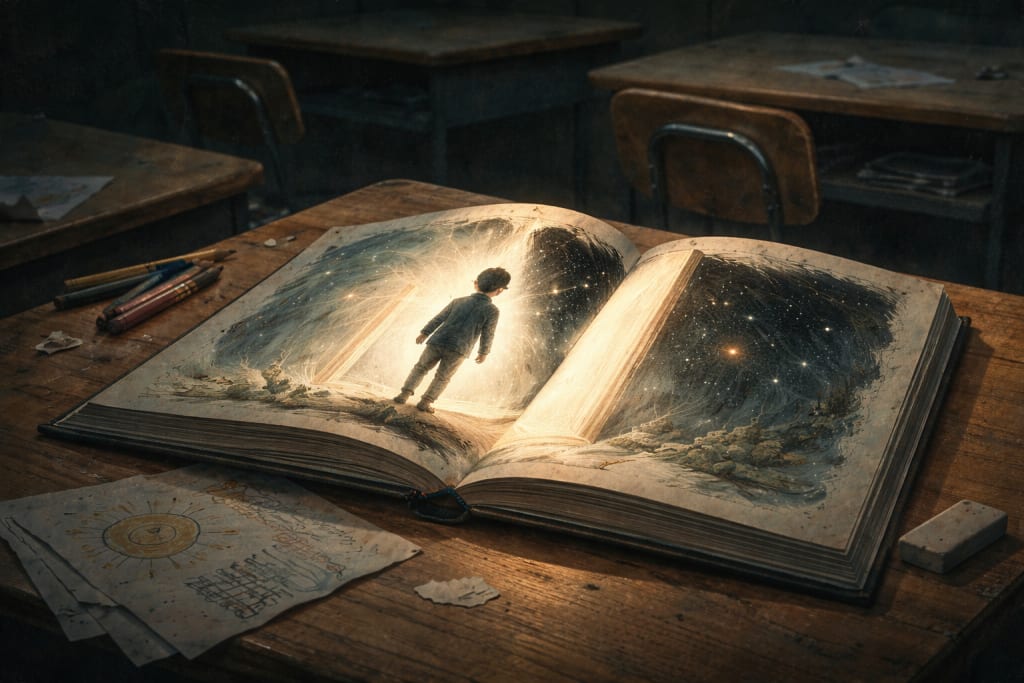
Sometimes stories end because the book is actually finished. Others abruptly stop because the reader has fallen asleep. But sometimes the story keeps going simply because it's developed a mind of its own, leaving you to keep turning the pages without noticing.
This book is about the third kind.
Lesson One: Doors
When you come to a door, you usually go through it. If the door is locked, you might try another one or come back later. But in instances where you cannot find a door at all, the story quietly makes one for you.
You do not need to choose the door. The door can choose the version of you most capable of using it.
Lesson Two: What Happens to Other Children
When a game ends, the children who were playing do not disappear. They go home, and they cry. They also remember you. You will not go with them because this page is not about that.
This page is about the child who keeps reading instead.
Lesson Three: Why You Don't Remember the Other Pages
If you remembered every ending, the story would quickly become too heavy to carry. The book helps you by letting the extra pages fade over time. You may feel lighter afterward or (in some cases) strangely empty. Both are perfectly normal reactions to have.
Do not worry if the pictures seem fainter than before at any point. That simply means you are still inside the book.
Lesson Four: Fairness
Some people may ask whether it's fair that one child keeps going while another does not. But the book does not know what fair means. The book only understands how to continue.
If you are reading this sentence now, know that you are continuing.
Lesson Five: When to Close the Book
You do not close the book when the story ends. You close the book when there are no more pages that can safely contain you.
Should that ever happen, you will no longer be here to read this line. So for now, turn the page.
*
Publisher's Note
This text was removed after educators frequently reported “persistent unease,” “identity confusion,” and “children asking where the other versions went.”
Correction issued: The phrase “the book helps you” has been replaced in later editions with “the book ends.” No other changes have been made at this time.
*
Letter I: Concern Regarding Assigned Reading
Dear Curriculum Committee,
I am writing to ask whether Where Do You Go When the Story Doesn’t End? was ever thoroughly reviewed for age appropriateness.
My child enjoyed the book but has begun asking questions about “other children who don’t get to keep going.” I assume this is metaphorical, but I would still appreciate some clarification so I can reassure them properly.
Thank you for your time.
Sincerely,
A Concerned Parent
Letter II: Follow-Up on Classroom Materials
To Whom It May Concern,
Since last week, my child has been unusually quiet and keeps rereading the same pages in the book. They asked whether people “notice when you turn into a different version of you,” something I do not recall ever coming up in our household.
Please advise on how this text should be framed during instruction. I’m sure this is a misunderstanding.
Best,
———
Letter III: Request for Removal
Dear Administration,
This book has been causing great distress in our household.
My child was inconsolable last night because they believe someone else is “left behind” every time "something bad" almost happens. They also asked me who remembers those people.
I truly do not feel this is an appropriate topic for children. Please remove the book from circulation.
Respectfully,
———
Letter IV: Escalation
This is my third attempt to receive a response.
My child is no longer afraid, which I actually find significantly more alarming. They now say things like, “It’s OK, this page still works,” when hurt or upset.
I don’t know where they learned to talk that way, but I have my suspicions. I expect immediate action.
———
Letter V: Final Correspondence
I understand the book has been withdrawn as of this writing. That is not enough.
My child asked me yesterday whether I would still love them “in the other draft," and they were eerily sincere about it. They also seemed deeply disappointed that I didn’t understand the question.
Please confirm at your earliest convenience that all copies have been destroyed. And please do not reply with empty reassurance or attempt to tell me this is normal curiosity.
Just tell me it’s over.
Internal Note (Never Sent)
We stopped reading the book together, but sometimes I still hear them turning pages alone.
They don’t cry or ask questions anymore. They just keep reading.
About the Creator
Shannon Hilson
Pro copywriter chasing wonder, weirdness, and the stories that won’t leave me alone. Fiction, poetry, and reflections live here.
You can check out my blog, newsletters, socials, and other active profiles via my Linktree.
Reader insights
Nice work
Very well written. Keep up the good work!
Top insights
Compelling and original writing
Creative use of language & vocab
Excellent storytelling
Original narrative & well developed characters
Expert insights and opinions
Arguments were carefully researched and presented
Heartfelt and relatable
The story invoked strong personal emotions
Keep reading
More stories from Shannon Hilson and writers in Fiction and other communities.
Burnt, Buried, and Banished
Carice had no children as most people would define the word, but she considered herself a mother all the same. After all, it wasn’t her fault that Nathaniel hadn’t figured out he didn’t want to be a father after all until after they were married and he’d moved them both away to the top of this mountain.
By Shannon Hilson14 days ago in Fiction
Past Lives
War made for odd couples. To Private Jim Mclellan, Sepp seemed a good man; better at least than some of the monsters he heard stories of deeper into the Reich. Real monsters. This Sepp almost reminded Jim of his uncle; the one from Wisconsin he met a few times at Weddings.
By Matthew J. Fromm4 days ago in Fiction




Comments (1)
Love this! Especially the letters "Letters of Concern". Very cool piece.