
The Clockmaker’s Secret
When an antique clock stops at the exact time of a murder, a detective must untangle a web of greed, guilt, and time itself.
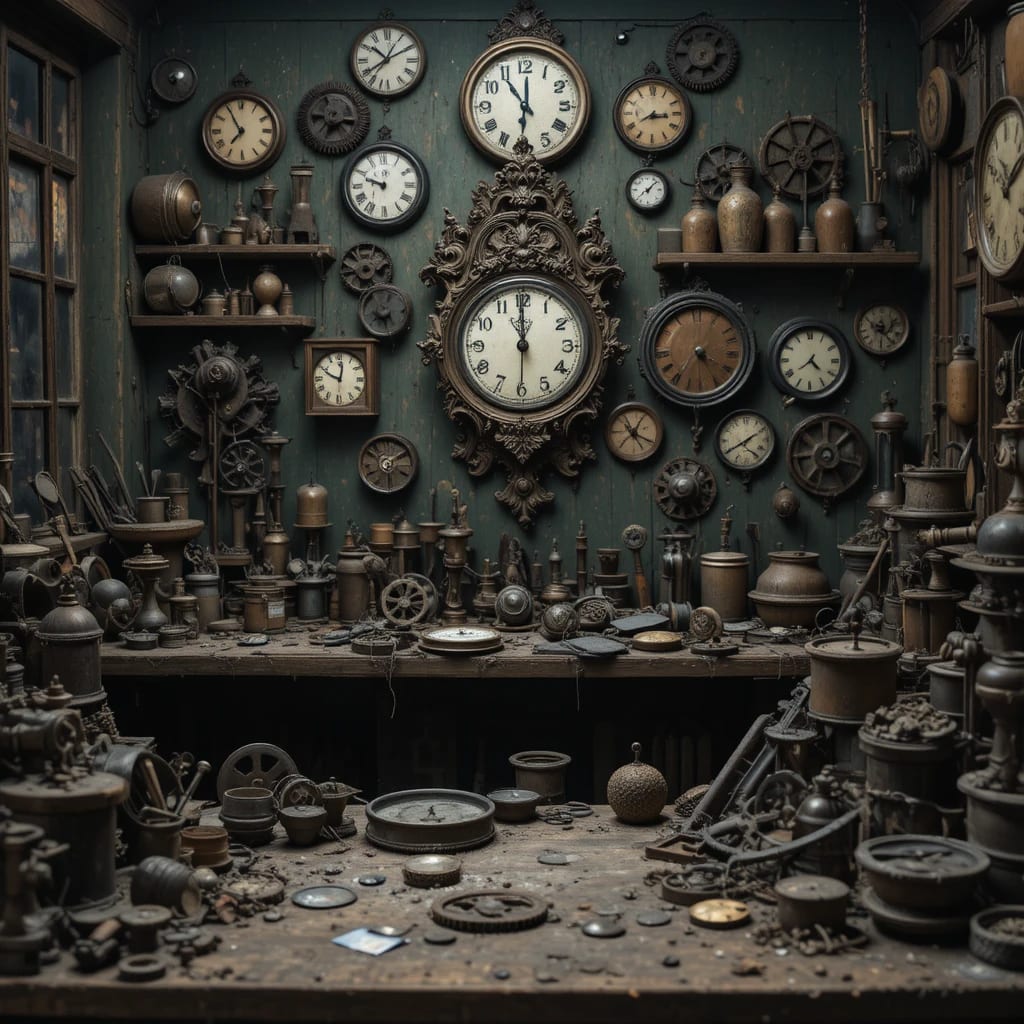
The rain came steady that night — soft but relentless, like the ticking of a thousand tiny clocks.
Detective Marian Drew arrived at the small shop on Harrow Street just after midnight. The sign above the door read:
Finch & Sons Clockworks — Since 1912
Only now, there was no Finch.
The owner, Arthur Finch, age seventy-one, lay dead on the floor behind the counter. His spectacles were cracked beside him, and a small antique clock had fallen from the shelf, stopping precisely at 11:08 p.m.
Marian knelt beside the body. No visible wounds. No signs of a struggle. Just the faint smell of oil, dust — and something else.
Almonds, she realized. Cyanide.
“Who found him?” she asked the patrol officer.
“His apprentice, ma’am. Eli Harper. Works here part-time, said he came in after closing to drop off an order form.”
Eli sat near the back, hands trembling, his clothes speckled with brass filings. “I didn’t kill him,” he said immediately. “I swear. I found him like that.”
Marian studied him — mid-twenties, nervous, intelligent eyes. “Tell me what happened.”
“I heard a crash when I opened the door,” Eli said. “He was on the floor. That clock was still ticking when I walked in — then it just… stopped.”
Marian frowned. “At 11:08?”
He nodded. “Exactly.”
Back at the lab, the coroner confirmed it — cyanide poisoning. The poison had been introduced through a small cup of tea found on the counter.
But here was the strange part: the tea had no fingerprints except Finch’s own.
So how did he drink poison he couldn’t have poured himself?
Marian returned to the shop the next morning. Every clock ticked softly around her — hundreds of them, each marking a different second in time.
The air felt heavy with the rhythm of secrets.
On the wall behind the counter hung dozens of repair tickets. Most were routine. But one caught her attention — dated two days prior:
“Custom Restoration — Hollow Frame Model 1934. Urgent.”
The customer name: Charles Evers, CEO of Evers Holdings, a local real estate magnate.
Marian knew the name. He was under quiet investigation for tax fraud and document forgery.
And Finch? He’d been his clockmaker for years.
When she visited Evers’ office, the man greeted her with a politician’s smile. “Terrible thing, Detective. Arthur was a friend. Repaired my father’s clocks since I was a boy.”
“Did you see him recently?” she asked.
“Two days ago. Dropped off a mantel clock. He said he’d fix it by Friday.”
Marian tilted her head. “And what’s so urgent about a clock repair?”
Evers smiled faintly. “You’d have to ask him that — oh wait, you can’t.”
Back at the shop, she asked Eli about the clock in question. He went pale. “That one’s gone,” he said. “Someone picked it up yesterday — before Mr. Finch died.”
“Who?”
He swallowed. “I don’t know. Mr. Finch said a friend of Evers would collect it. He didn’t even charge.”
Marian’s instincts buzzed. She opened Finch’s ledger book, flipping through the last few pages. Most entries were neat and aligned — until the final line. Written in hurried pencil:
“11:08 — He knows. Must hide it inside.”
“Hide what?” she murmured.
Eli looked confused. “Detective, Mr. Finch always said time keeps secrets better than people. Maybe he meant—”
She turned toward the wall of clocks. Hundreds of ticking faces stared back.
“Show me which one stopped at 11:08.”
They brought the clock to the forensics lab. It was a Model 1934 Hollow Frame, same as the one listed for Evers.
When the backplate was removed, inside the hollow compartment was a thin metal tube sealed with wax.
Marian carefully opened it. Inside were five rolled-up sheets — photocopies of property deeds, contracts, and offshore account ledgers — all bearing Charles Evers’ signature.
Forged.
Arthur Finch hadn’t just fixed clocks. He’d helped hide documents inside them.
Eli explained it all once the evidence came out.
“Mr. Finch said he used to do repair work for businessmen who wanted ‘special safes,’” Eli said. “Hidden compartments in clocks, picture frames, even furniture. He stopped years ago — until Mr. Evers came back. This time, he wanted him to hide something for real.”
“And Finch refused?” Marian guessed.
Eli nodded. “He told me he couldn’t do it anymore. That it wasn’t just fraud — it was about stolen land deeds. Whole neighborhoods being bought with fake names.”
Marian had her motive — but not the killer.
Evers had means and reason, but no access. Finch’s fingerprints were the only ones on the poisoned cup.
Unless…
Unless the cup wasn’t poisoned before Finch drank it.
She revisited the crime scene video. On the counter sat a small self-winding wristwatch Finch had been repairing. It ticked once every five seconds — slightly off rhythm.
She slowed the footage frame by frame. At 11:06, the watch clicked open. A small puff of vapor escaped — barely visible.
A timed release capsule.
Inside the casing — cyanide dust.
When she confronted Evers with the evidence, his calm façade cracked.
“You can’t prove I knew,” he snapped.
“Oh, I can,” Marian said, dropping the hollow tube on his desk. “You wanted to hide your crimes in timepieces. Fitting, isn’t it? Because now time’s run out.”
He was arrested that afternoon.
The story hit the papers within days:
“Clockmaker Exposes Corporate Fraud Before Death.”
Eli inherited the shop but never changed the sign. Every morning, he wound the clocks and set one apart — the old Hollow Frame model.
It still stopped at 11:08, frozen in eternal warning.
Detective Marian Drew sometimes visited, standing silently amid the ticking chorus.
She liked to think Arthur Finch knew what he was doing that night — that he’d chosen to stop time itself to leave behind a message.
In the end, truth didn’t need to be loud.
It only needed to tick long enough to be heard.
About the Creator
Keep reading
More stories from MUHAMMAD SAIF and writers in Fiction and other communities.




Comments
There are no comments for this story
Be the first to respond and start the conversation.