
The Children of Ra!
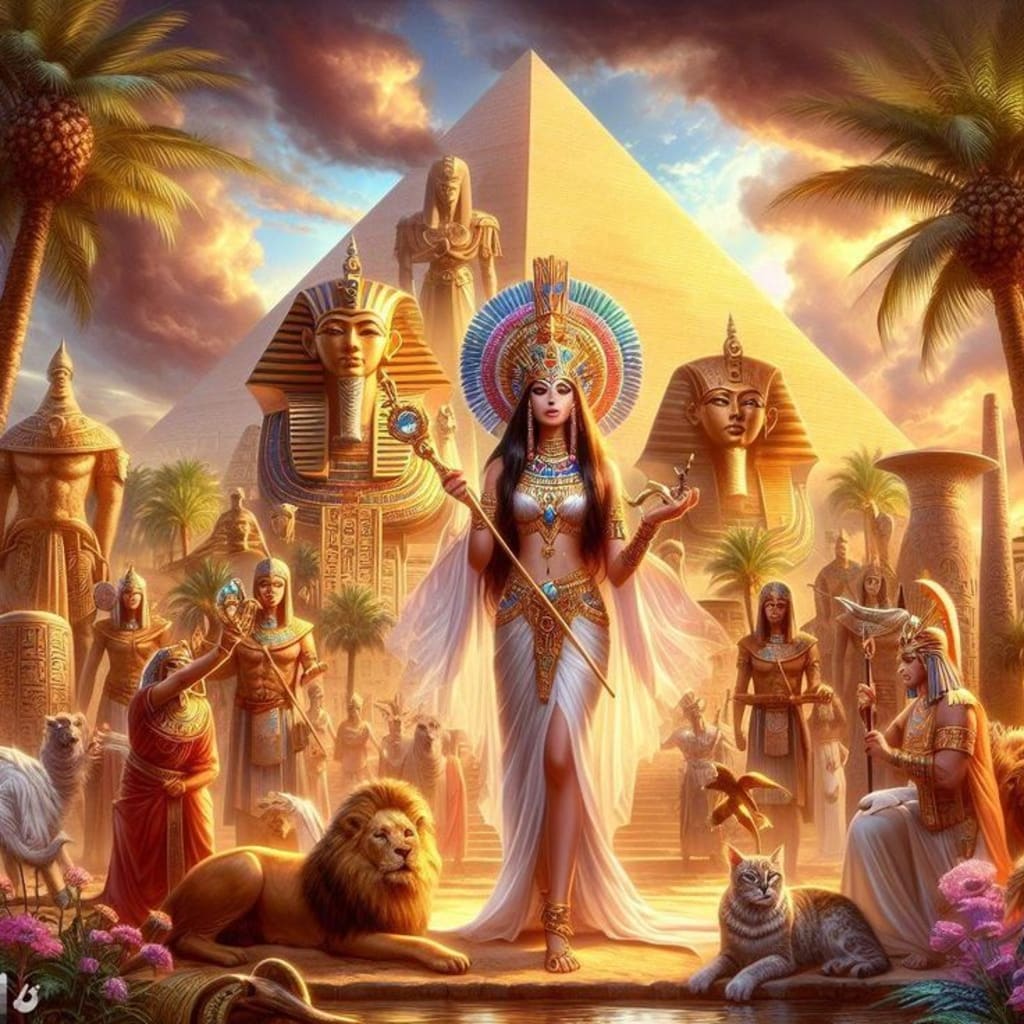
Egyptian gods and goddesses
Chapter 1: The Birth of Chaos
In the beginning, there was only Nun, the primeval waters. Infinite, dark, and formless, Nun contained all that would be, yet held nothing. From this timeless void emerged Ra, the god of the sun, shining brighter than anything that had ever existed. His light cut through the darkness, creating order from the boundless chaos. From Ra’s breath and power, the first gods were born: Shu, god of the air, and Tefnut, goddess of moisture. Together, they brought balance to the world, separating sky from earth and creating space for life to begin.
When Shu and Tefnut came together, they gave birth to Geb, the god of the earth, and Nut, the goddess of the sky. The bond between Geb and Nut was strong, but their love was forbidden. Ra decreed that Nut, the sky, should remain above, while Geb, the earth, stayed below. Yet, Nut and Geb defied this order, stretching toward each other in yearning. Furious at their disobedience, Ra commanded Shu to push them apart, creating the expanse of air that divided sky from earth.
This separation was the beginning of time, and so the world began its cycle of days and nights.
________________________________________
Chapter 2: The Deception of Set
Ra continued to rule from the heavens, watching over his creations. But as time passed, he grew weary. He sought a worthy successor, one who could rule with wisdom and justice. He chose his great-grandson, Osiris, god of life and the afterlife, whose heart was as pure as his love for his wife, Isis, goddess of magic and healing. Together, Osiris and Isis brought prosperity to Egypt, teaching its people farming, laws, and civilization.
But there was one who envied Osiris’s throne: his brother Set, god of storms, chaos, and deserts. Set’s heart was hardened with jealousy, for he felt it was his birthright to rule, not Osiris’s. He schemed in secret, plotting a way to overthrow his brother. Set’s plan was ruthless: he crafted a beautiful sarcophagus, carved with symbols of power, and held a grand feast for the gods.
When Osiris admired the sarcophagus, Set encouraged him to lie in it, claiming it was a gift fit for a king. But once Osiris was inside, Set sealed the coffin, trapping Osiris within and casting it into the Nile. The river carried Osiris far away, and Set declared himself ruler of Egypt.
________________________________________
Chapter 3: Isis’s Journey
When Isis discovered her husband’s fate, she was devastated. Driven by love and loyalty, she embarked on a quest to find Osiris’s body and restore him to life. Her journey took her through dangerous lands and into the depths of the Nile, where she finally retrieved Osiris’s sarcophagus. Yet her trials were not over.
Set, furious at Isis’s defiance, stole Osiris’s body and tore it into fourteen pieces, scattering them across Egypt so he could never be resurrected. But Isis’s magic was strong. With the help of her sister, Nephthys, and the god Anubis, the guardian of the dead, she searched the land and found every piece of Osiris. She reassembled his body and performed a powerful ritual, breathing life back into him for a brief moment.
Osiris rose, but his resurrection was incomplete. He could no longer dwell among the living and instead became the ruler of the underworld, guiding the souls of the dead and judging them in the Hall of Ma’at, the hall of truth.
________________________________________
Chapter 4: The Birth of Horus
Before Osiris departed to the underworld, Isis conceived a son: Horus, the falcon-headed god of kingship and the sky. Isis hid with her son in the marshes of the Nile Delta, protecting him from Set, who sought to destroy any potential heir to Osiris’s throne.
As Horus grew, Isis taught him the ways of justice, magic, and combat. He learned the ways of the gods and the trials he would face to reclaim his father’s kingdom. Horus’s spirit was fierce, and his loyalty to his father’s legacy was unwavering. When he reached adulthood, he confronted Set, challenging him for the throne of Egypt.
Their battle raged across the heavens and earth, lasting eighty years. Set summoned storms and darkness, while Horus’s strength and courage matched every blow. The gods watched as the fate of Egypt hung in the balance.
________________________________________
Chapter 5: The Judgement of the Gods
At last, the other gods, led by Thoth, the god of wisdom, and Ma’at, the goddess of truth, convened a divine tribunal to end the conflict between Horus and Set. Ra himself presided over the court, as both Horus and Set presented their claims. Set argued that his power and strength made him a fit ruler, while Horus maintained that he was the rightful heir to his father’s throne.
The gods debated, and finally, Ra declared Horus the victor, for he had proven himself through courage, wisdom, and honor. Set was banished to the deserts, where he would reign over barren lands and storms, a reminder of his chaotic nature.
With peace restored, Horus ascended the throne, uniting Egypt under his rule. He became a symbol of kingship, with every pharaoh seen as his living embodiment, ruling with the wisdom of his ancestors.
________________________________________
Chapter 6: The Trials of Ma’at
But the gods’ work was never done, for Egypt was always in need of balance. The goddess Ma’at, embodiment of truth and order, traveled the world to keep chaos at bay. In her hand, she held a feather, the measure of truth against which all souls would be weighed in the afterlife.
When a person died, their heart was placed on one side of the scales in the Hall of Ma’at, with the feather on the other. If the heart was heavier than the feather, it was consumed by Ammit, a beast part-lion, part-crocodile, and part-hippopotamus. Only those whose hearts were pure could enter Osiris’s realm, where they would find eternal peace.
It was said that Ma’at visited the world each day, ensuring harmony and reminding mortals of the importance of justice, truth, and balance.
________________________________________
Chapter 7: The Eternal Cycle
Thus, the gods of Egypt continued their work, maintaining the delicate balance between chaos and order. Ra rose and set each day, battling the serpent Apep, who sought to consume the sun and bring eternal night. Each morning, Ra triumphed, his journey across the sky a symbol of resilience and the triumph of light over darkness.
Isis and Osiris guarded the realms of life and death, ensuring that the souls of the righteous found peace, while Set prowled the deserts, a warning of the dangers of unchecked ambition. Horus ruled the mortal realm, guiding the people with the wisdom passed down from his ancestors.
In time, the legends of these gods and their eternal cycle became woven into the lives of Egypt’s people. The temples echoed with hymns and prayers to the gods, and their stories reminded mortals of the importance of love, honor, and balance—a cosmic dance that shaped the world around them.
About the Creator
Keep reading
More stories from Zainab Adamali and writers in Fiction and other communities.
Beyond the White Coat
Chapter 1: The Arrival of Mr. Harvey Dr. Emily Tan sat in her office, scrolling through the day’s appointments. Her first patient was Mr. Harvey, a retired teacher in his late sixties who’d recently been referred to her for a persistent cough and fatigue. When he entered, Dr. Tan noted his hopeful smile mixed with a look of desperate anticipation—a look she’d come to recognize.
By Zainab Adamaliabout a year ago in Humans
The Devil's Cut
“Comrade, finally you’re awake.” The voice was smooth, sensual. A flickering incandescent bar was all that lit the white, sterile room. All Vladimir remembered was everything going black. He tried to move his arms and found them strapped to the gurney.
By Matthew J. Fromm4 days ago in Fiction


Comments
There are no comments for this story
Be the first to respond and start the conversation.