
The Captain's Assistant
Pills, Screens & The Mystery of the Lone Window


The outside world was unknown to her, but she could see a glimpse of it through the window in his room. Sibi had been personally chosen to assist the Captain, and the Captain’s quarters were blessed with the only window in the entire compound.
The Captain was a square jawed man of clean cut decision and discipline, and his room was just the same. Between piles of paperwork and meticulous chores, Sibi stole a glance through the window whenever she didn’t feel watched. The glass was scratchless, streakless, and bordered by a black frame. Through it, Sibi could see a dead, barren field, on the outskirts of a dead, barren forest. If she was lucky, a swirling wind would toss a handful of burnt bones or a weathered plastic bag into view, remnants of life lived outside—scraps of life before The Settling.
Sibi’s grandmother didn’t like the name The Settling.
She preferred to call it “The Shackling.”
Sibi's grandmother had been the last one in the family to breathe unmanufactured air. To walk on sand and grass, to swim in the ocean. She had witnessed the slow undoing of life on the surface. In the last “outside years”, disease and pollution had choked the air. Acid had rained through the roofs. The ocean had risen over the roads, filling city streets and homes with mold, garbage and pestilent fish. Many Californians drowned, or starved to death in their high rise units. Some floated away on cobbled rafts.
Some, like Sibi’s grandmother, followed government orders, moving inland and underground.
Sibi’s grandmother was an engineer. She had helped built the compound’s first electrical grid and communications system. She had raised Sibi’s papa and auntie in the new underground society. When she retired at age 55, Sibi’s grandmother had quickly descended into madness, losing control of the nerves in her fingers, her bowels, and her ability to form words.
“Yama, tell me about The Settling,” Sibi used to say when she was five and couldn’t sleep. They had shared a small bed in a dark, brick room, back when Yama still had all her words and the movement in her hands.
“We didn’t call it that, kiddo. We were restless and full of rage. Underlife made no sense to us. We would have given anything for one more look at the stars, a campfire, or a slice of pizza. Oh.” Yama scowled, then gazed straight through the ceiling. Sibi nestled further into the crook of Yama’s arm.
“What’s peet-sa?” Sibi searched the roll of computer-generated images in her mind for something with that name and came up blank.
“One of the old foods.”
At five, Sibi knew almost nothing of the old foods. She was raised on fortified liquids of various colors and chalky consistencies. She had already transitioned to chewable pill-form meals, which tasted like bright, acidic bursts. In a few years, she would learn that some of the pills contained lab isolated nutrients derived from plants and fungi, grown in greenhouses deep in the compound. Others contained essential proteins/fats “recycled” from animal and human remains. It was common knowledge underground that every living being would be recycled, including Yama, including Sibi one day. There was no room for waste in their below-ground town. Waste in many forms was what shook their existence and sent them miles under the earth’s surface in the first place.
Sibi would also later learn that all images of “the old foods” were barred from being shown on home and public screens, because of the peculiar effect they had on the early compound dwellers. A large number of them became obsessive, consumed by images of various food shapes and textures. A precise balance needed to be struck to maintain order in the compound, so the images were banned, along with their psychological toll. Hence, she would never know what pizza even looked like.
“Why can’t we have campfires, Yama?”
“Because they would mess with the oxygen levels in the air, and they’re dangerous.”
Sibi was quiet for a while. Neither of them pretended they could sleep.
“Yama?”
“Yeah, kiddo.”
“In the screen room at school, they have ‘star mode’. You can—“
“It’s not the same, Sibiwa.”
Sibi continued through Yama’s scoffs. “They show you the stars on the screens above you. They have cricket sounds! And you can pick individual star clusters and planets and zoom in on them, like a spaceship! See them close up. Papa says we can go on Friday to go see Jupiter! Did you ever go to Jupiter before the Settling?”
“No. Jupiter was too far. And it wasn’t a 'settling,' really. It was a trap, Sibi. A shackling.”
Sibi pressed her nose to Yama’s side and squeezed her eyes shut, waiting for sleep.
Sibi graduated on her sixteenth birthday. She had planned to reenter school and become an engineer, but the Captain had chosen her to be his full time assistant, a coveted position in the compound that led swiftly to promotion and leadership.
Yama had died that afternoon, weeping and thrashing in Sibi’s arms until she grew still and eventually cold. Papa had helped carry her body to the recycling center a few levels below them. Sibi had filled out the intake forms and stood, stoic, with her father as Yama was whisked off on a conveyer belt. Her body would be transported to different rooms where she would be sterilized, possibly studied, then broken down into usable parts. She would give everything she had to the future of the compound. As would everyone else.
Days later, Sibi had her first meeting with the Captain, and her first look through an actual window. She had taken a secured elevator for what felt like half an hour. When the doors opened, her eyes were flooded with light. The actual sun beamed through the far wall, illuminating his tidy office, his wooden cabinets, his luxurious king-sized bed, and a leafy green potted plant near the immaculate window. The bricks in the walls took on new, subtle shades of red clay and rose. The sight of it all took her breath away.
Sibi had only witnessed sunlight like this in the compound's brightest screening room, known as the Sky Screen, and only for a few moments once or twice a year. The sky-screen required a great deal of electricity and careful preservation, so it was only open for special occasions, like birthdays or new Captainships.
The Captain stepped forward and extended his hand. Sibi stared at the hand of the man who managed nearly two thousand souls, who maintained countless structures and grids, who communicated between other compounds in the state, and who arranged actual trips in an outer world she knew next to nothing about.
She shook the hand of the man who had chosen her.
“Welcome, Sibiwa.” His eyes were clear blue in the sunny room. His uniform was immaculate, adorned with ribbons and pins flaunting various government accolades. He gripped her hand with polite firmness. His voice had a touch of warmth.
He handed her a file folder with her agenda and assignments for the week, then showed her the sturdy concrete desk across from his. He did not acknowledge the window.
The week after that was a blur. Sibi was tasked with two hours of morning paperwork and two hours of evening paperwork. In between she toured the compound, meeting all the people who kept the lights on and the pills stocked. She took minutes at the Captain’s meetings and kept all his notes in a ledger.
A brusque, heavyset man about Yama’s age, called Rem, began to teach Sibi how to fix screening devices: household wall screens, personal portable screens, and the consoles in the bigger screening rooms. She read thick manuals long into the night. She replaced chips, repaired faulty wires, and reset screen panels during the day.
“That should do it,” she said to a young mother and a twelve-year-old boy as she closed up the back of the screen console in their living room and pressed the power button.
The screen snapped on. Sibi was face to face with her grandmother. Yama was smiling and holding up a small switchboard she had built in the first years of The Settling. Then she was sitting at a computer, showing a colleague some kind of electrical reading. Then she was in a hard hat and overalls, running wires through a massive stone wall.
“Joyce Berlinger: everyone’s favorite smiling face at the forefront of The Settling. Her contributions to underground electrical efficiency helped get crucial high-performance screens in every room of every underground home, helping us all stay educated and connected.”
The narrator was fast and matter of fact. Yama was relentlessly vibrant.
Sibi stared. She had never known this version of Yama, though she had, days ago, held her as she writhed into death, her face twisted with pain. This woman, Joyce Berlinger, seemed nothing like the tired corpse she’d lowered onto a slow-moving beltway, to be cleaved and pulverized into pills.
Sibi pressed her whole hand to the screen. Tears dripped from her chin.
“Did you know Berlinger? My son is learning about her in school,” said the mother gently.
“She was my grandmother.” Sibi sniffed abruptly and scooped up her things.
“Everything alright?” Rem poked his head through the apartment door. “We have seven more stops before noon.”
Sibi hurried out, averting her eyes from the young, smiling Yama on the screen and mumbling goodbye as she passed through the door.
The more Sibi worked, the less sense the compound made.
She didn’t understand why, if they had access to the Earth’s surface, clearly visible from the Captain’s quarters, they were so focused on underground functions, particularly screens. Screens already ran their very existence. Compound residents left their home screens on day and night. Screens were the lighting, the timekeeping, the entertainment, the social lubricant, and the established way to learn anything at all. Screens had become the gateway to human connection and expansion. Why didn’t the news screens update progress in the outside world? Why was it they could only communicate with and learn about people in their own compound, and the other compounds and humans in general were a mystery to them? Sibi thought about the dozens of Captain’s assistants over the years who had been promoted and transferred to other compounds. They had honored them with badges, speeches, high profile interviews, and decorative send offs. They had placed them indelibly in the compound history books and films, and never heard from them again. Was this Sibi’s destiny too?
She resolved to use her closeness with the Captain to get answers.
Rem rode the elevator with her later that evening.
“I won’t say anything to the Captain about your emotional outburst this morning,” he said calmly. “I would advise you to keep your feelings contained in his presence. He can be easily displeased and has been known to send assistants off and away before they were ready.”
Rem cleared his throat and was quiet for the remainder of the ride. Sibi stood silent. A wrinkle formed between her eyebrows. Was “sending assistants off and away” a form of promotion or punishment? She wanted to figure it out sooner than later.
At her desk full of papers and tiny screens, the Captain’s room grew dark with the setting sun. Sibi caught a view of the stars through the top half of the window and thought about Yama, with her peet-sa and her campfire and her wide open space.
“How is everything going, Sibiwa?”
The Captain opened a pill bottle labeled “Dinner” and handed her three brown capsules with a small glass of water. He took his own dinner pills with water, waiting for Sibi’s reply.
Sibi stared at the pills. Did they contain cells from Yama’s useless hands? Meat from her cold body? Fat from her brain?
“Excellent, Sir. I am learning very quickly.”
“I’ve noticed,” the Captain chuckled. “Your many skills are invaluable here. You are still in your training days, and already the screen repair department is more efficient. The spreadsheets are very organized. I’m happy to have chosen you, and I hope you will guide me in keeping you happy in this position.”
Sibi took her pills, one by one, inhaling and swallowing. The water was chilled and tasted like minerals, a Captain’s perk no doubt.
“Captain, why do you have the only window? Why are we prioritizing screens and not more windows in more homes? We could be learning about the world out there, building a new life aboveground. If more people were privy to windowviews, more of us could help shape the future.”
“Ah.” The Captain did not seem surprised or frustrated in the slightest. He picked up a small screen from his desk and walked around to show her its face. A spreadsheet was open with names and numbered data from every single household in the compound.
“We do not just take in information from our screens, Sibiwa. Every person in every compound home makes decisions with their screens that make up valuable data for the rest of the world. Our compound operates by providing this data to… our higher ups.”
Sibi stood and contemplated this. Up until then she had thought of inter-compound communication as cooperative, not hierarchical. “But Sir, the window—“
“The window is a privilege, afforded only to the leader of the compound, someone with the restraint to take in the view of the world as it is and maintain the smooth operation of a world in darkness, a world in waiting.”
“I see.”
Sibi put on her calmest face, relaxed her shoulders and jaw, and sat back down at the desk to continue her work. It would do no good to question further in her frustration, that much she knew.
The Captain continued to stand next to her at her desk. He seemed to be taking her in.
“Your family has been integral to this compound’s success. I knew your grandmother, Joyce. She served for years under my own grandfather, creating the grid and the network of compound screens we still use today. None of us would be here if it weren’t for her.”
“People keep saying that,” Sibi failed to hold her tongue. “But she never seemed proud of what she did, at least not when I asked her about it. She said her work did more to imprison us than help us.”
“Do you feel imprisoned?” The Captain seemed to genuinely want to know.
“I don’t know. I have only ever been underground, until I came here to work, and saw that window.”
“The window is a soothing agent, not a gateway to some untapped fate. There is nothing in the outer world anymore except garbage and lung failure. Your grandmother understood that, Sibiwa.”
“My grandmother…” Sibi pounded the desk with her fist and stood up to face him. The Captain’s eyes were startled but not unkind. He waited for her to finish.
Sibi did not, could not utter another word. Her chest throbbed. Her face was hot. Tears pooled under her eyes. She stood there, frozen.
“You miss her,” he said simply. His hands came up to rest above her shoulders, as if asking permission to console her. Sibi looked into his clear blue eyes and let the tears fall, and collapsed forward, sobbing into his uniform, clutching the back of his coat with her shaking hands. She cried and cried. He held her close.
“It’s alright,” he said. His voice was tender, his arms sturdy. “You’ve been through a lot of change and difficulty this past week. It’s going to be alright.”
No one had held her in this way, except for Yama, when Sibi was five and couldn’t sleep.
The Captain produced a kerchief.
Sibi dabbed her eyes and lifted her face to his.
He kissed her.
Her chest felt electric. Her face remained hot, but for a different reason. He pressed his mouth to hers again. She pressed back, inhaling the smell of him, gripping his shoulders.
They became aware of a mutual wanting. With his eyes and lips locked on hers, he scooped her up and walked her over to his king sized bed. In the fog of kissing and wanting, Sibi glanced out the window and thought she saw a golden stag, ambling from the forest through the field, under the stars.
Hours later, Sibi woke under the Captain’s thick comforter, next to his melodic breathing. She remembered the stag and slipped out of the bed. Her steps were slow and silent as her eyes adjusted to the starlit room.
Sibi knelt in front of the potted plant. It was a small fiddle leaf fig—she remembered learning about them in biology and seeing one on a greenhouse tour. Its leaves were satiny and their fresh scent filled her nose. The Captain’s fiddle leaf fig had no smell at all. It was rigid, almost bouncy.
The plant was fake.
Why? Sibi wondered. With all the light coming through the window? Maybe a real plant would upset the oxygen balance in the room.
Sibi looked more closely at the window. She noticed a tiny, green cord jutting out from one side of its black frame. Up close, the glass had a confusing reflective sheen.
Sibi couldn’t help but pull at the cord. The whole side of the frame fell into her hand, revealing the cords and chips beneath the glass, and the brick wall beneath it all.
It wasn’t a window in fact, but a framed, high-functioning screen.
The images were nothing but speculation, perhaps a roll of daytime and nighttime landscapes chosen for their balance of realism and escape. The Captain’s “view” was a ruse. A waste of underground power. They were still underground. The outside world was still unknown, at least from this room.
Sibi wedged the frame back into place and stared at the projected image. She was afraid to ask herself the questions that came next.
What happened to the ones who left the compound? Were they actually being transferred, or were they just being recycled? What was the Captain's actual role, in this place?
Before she could move, a hand clapped over Sibi’s mouth.
About the Creator
Keep reading
More stories from Lucia Joyce and writers in Fiction and other communities.
"Hear Me Out"
"Hear me out, what if we ran away together?" "Where do you want to go?" "Anywhere but here. We could move to a new city or to Canada, or we could disappear from society to live in the middle of the woods. Maybe a combination of two of those things would be good. What do you say?"
By Kay Husnick7 days ago in Fiction
Broken Safe Haven - Chapter 3
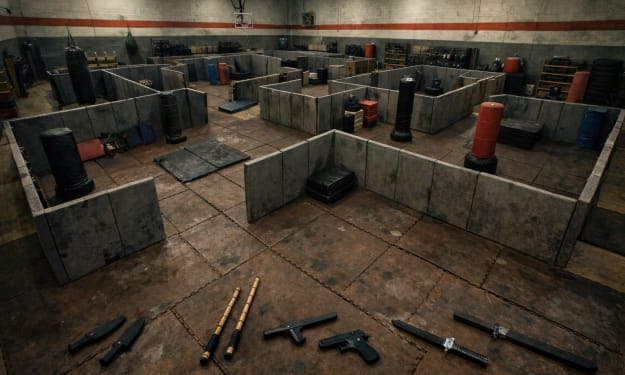
Previous Chapters Chapter 1 Chapter 2 Jordan rushed into the training room, an old basketball gym now a labyrinth of training mats, punching bags, and blunted weapons. The musk of sweaty bodies and athletic clothes their owners neglected to wash hung in the warm air. Jordan’s boots thumped against the wooden flooring as he stomped across the room.
By Eric Boring5 days ago in Fiction



Comments
There are no comments for this story
Be the first to respond and start the conversation.