
The Bureau of Unwritten Letters
Where Silence Has a Filing Cabinet

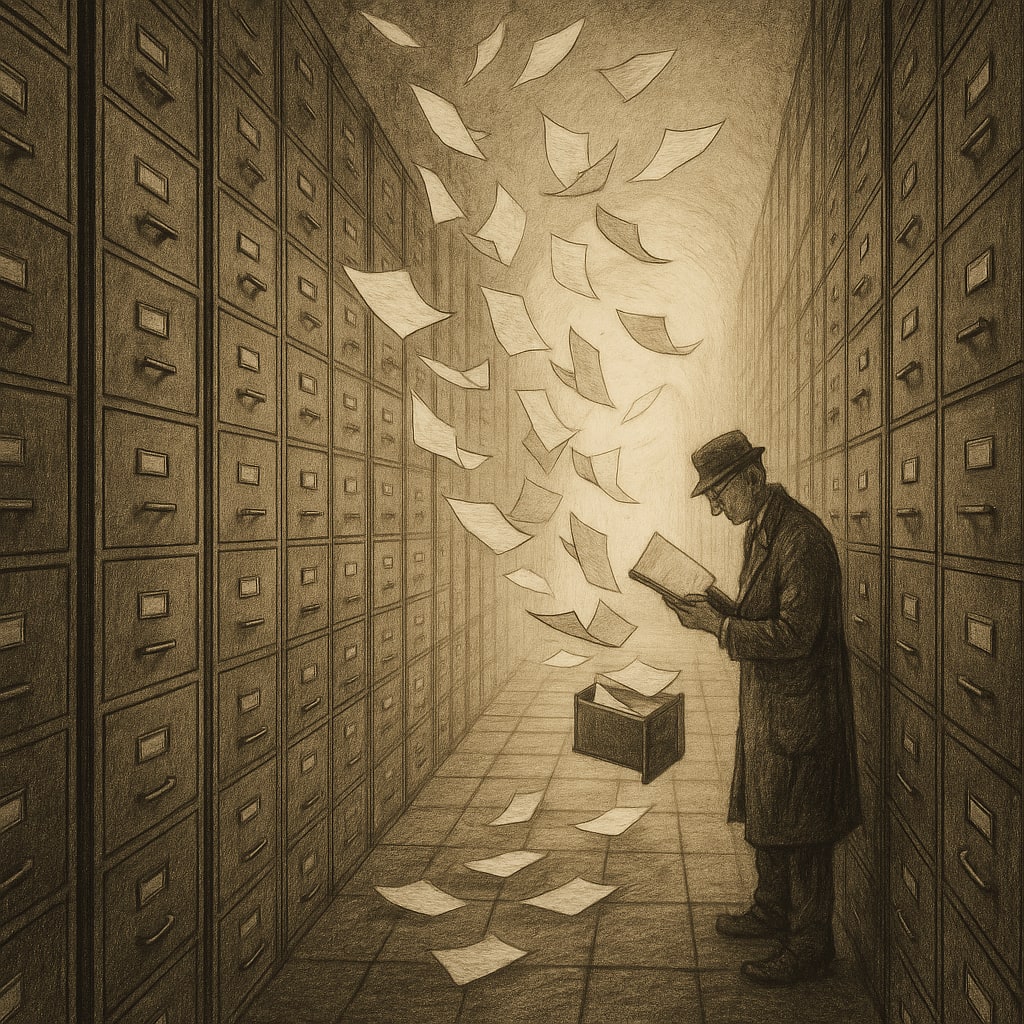
They say every word we never send goes somewhere.
The Bureau hides in plain sight, in a faceless grey building with no plaque, no bell, no sign. By day it looks like every other ministry: brick, stone, iron, humming with fluorescent light. But if you step too close, you feel the air tremble with a thousand unshed sighs. And if you dare to push open the door, you’ll hear it: the faint rustle of paper, like leaves whispering in a forest with no wind.
This is where all the unsent words live.
Every draft you abandoned.
Every confession you swallowed.
Every apology folded once and hidden in a drawer.
Every message deleted before your finger pressed “send.”
The Bureau has been collecting for centuries. And it is very, very full.
I. The Filing System
The clerks move in silence. Always silence. They wear grey gloves and spectacles thick as bricks of glass. Their faces are pale, eyes dulled by years of reading what others never dared to say.
Their job is endless. Sorting. Stamping. Stacking. Filing.
The drawers stretch for miles—steel cabinets humming like hives. They are not labeled by addressee, nor by date, but by emotion.
Regret. Fear. Love Withheld. Anger Untold. Grief Swallowed.
Open a drawer, and you’ll find them: fragile envelopes, trembling slightly, humming faintly, some warm to the touch as if the hand that wrote them still lingers. Others are cold, brittle, sharp-edged from decades of silence. Some glow faintly blue in the dark, heavy with words that might have changed everything.
The clerks never read them aloud. They sort and seal, stamp and file, as though silence itself were an economy that must be managed.
II. The Visitors
Occasionally, the Bureau admits a petitioner. Rarely, but it happens.
A widow searching for the letter she never sent her husband before the war. A man who wants to reclaim the resignation letter he drafted but never delivered. A child grown old, desperate to see the torn birthday card she once made but was too shy to give.
The clerks comply without question. They disappear into corridors of endless drawers, and eventually they return, carrying the envelope like an artifact.
They never offer advice.
But the temptation, once the letter is in your hand, is unbearable.
Most open them. Most regret it.
Because letters are time machines. They do not change the past, but they return you to the exact moment you chose silence—and silence is heavy to revisit.
One widow fainted when she read her own words, realizing she had loved him more fiercely than she had ever dared admit. A businessman, upon reading his unsent resignation, walked straight out of the Bureau and never returned home.
The Bureau does not interfere. Its clerks only file. It is not their duty to soften the truths we never sent.
III. The Malfunction
For centuries, the Bureau was steady, efficient, unquestioned. Until one day, the letters began to move.
At first, it was only a rattle. A drawer quivering. A cabinet humming louder than usual. But then envelopes slipped through the cracks, sliding under doors, fluttering into the streets like startled birds.
Soon, there was a storm.
A rain of unsent words fell across the city. People awoke to find envelopes on their breakfast tables, on bus seats, tucked into their pockets.
Some were small:
“I loved you.”
“I’m sorry.”
“Please don’t leave.”
Others were dangerous. Threats never spoken. Declarations of betrayal. Confessions of crimes. Pages of rage that had once been abandoned now landed on doorsteps with merciless accuracy.
The Bureau panicked. Clerks in grey gloves sprinted through corridors, trying to gather the escaping letters, their carts spilling. They worked desperately to restore silence to silence.
But the world had already begun to change.
IV. The Receivers
The effects were unpredictable.
A soldier’s widow found, sixty years too late, a farewell letter that soothed a wound she had carried all her life.
A tyrant woke to find his walls plastered with every threat he had once unsent, every order he had drafted but never dared sign. His enemies needed no further evidence.
A woman discovered the apology her father had written but never delivered. She wept, both healed and broken.
Lovers received confessions from ghosts.
Enemies received secrets never meant to be revealed.
And some, opening the wrong envelope, discovered words that were never theirs, yet pierced them all the same.
The city trembled. Families broke. Strangers embraced. Wars threatened. Peace bloomed in unlikely places. All because silence had finally mailed itself.
V. The Question
No one knows why the letters broke loose.
Some say the Bureau grew weary of carrying humanity’s unsaid weight. That the cabinets themselves grew bloated, swollen with silence until they could no longer hold.
Others believe the letters themselves rebelled—too long imprisoned, too long denied the chance to live in the world they were written for.
And still, somewhere, clerks in grey gloves hurry down endless corridors, filing, stamping, sealing, as though their quiet labor could hold back the flood.
But it is too late.
Because once a word leaves its drawer, it cannot be unsaid.
About the Creator
Alain SUPPINI
I’m Alain — a French critical care anesthesiologist who writes to keep memory alive. Between past and present, medicine and words, I search for what endures.
Keep reading
More stories from Alain SUPPINI and writers in Fiction and other communities.
Mastering French Without Losing Your Sanity: A Realistic Guide for Beginners
Learning French can feel like solving a Rubik’s Cube blindfolded. The tricky pronunciation, the never-ending grammar rules, and the surprising exceptions make it seem impossible. But don’t worry—equipping yourself with key expressions and effective strategies can turn frustration into fluency. Let’s simplify French and make learning enjoyable.
By Alain SUPPINIExclusive • 11 months ago
THE MOTH
Hapley was one of the most celebrated entomologists of his time, famous for his discoveries and infamous for his bitter feud with Professor Pawkins. Their rivalry had lasted for decades and had grown from an academic disagreement into a personal war. It began when Pawkins dismissed a species Hapley had named, and from that moment onward, the two men attacked each other relentlessly in papers, meetings, and public lectures. Their quarrel became legendary within scientific circles, stirring passions as fierce as any religious dispute.
By Faisal Khan4 days ago in Fiction



Comments (1)
Again, I see Borges and a lot of my favourites in this one. Excellent work, sir!