
The Breathless City Under the Waves is Aqualis.
The Harmony of Technology Technology in Aqualis does not dominate—it dances with nature. Shell-drives, living mollusks, store knowledge in their neural patterns. Communication flows along songlines, sonic currents that form an acoustic internet, translated by electric eels. Energy is drawn from thermal vents and tidal motion. Coral structures regulate pressure and temperature. Even clothes are alive—woven by silk-spinning sea spiders that shift color with mood and light. Nothing is wasted. Everything breathes together.

Titik
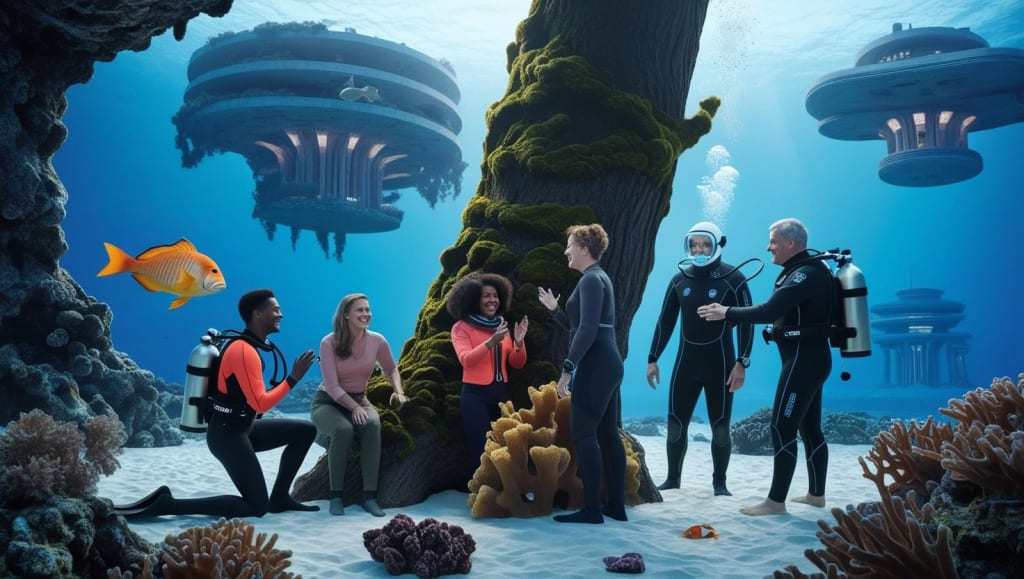
A Brief Overview of A Silent City In the year 2275, humanity ceased reaching for the stars and turned instead toward the depths. What started out as a desperate adaptation evolved into a radical evolution. Aqualis, which lies five kilometers below the Indian Ocean, is more than just a city. It is a living example of what the human race has the potential to become. Seabirds soar like messengers between realms, fish serve as guides, and dolphins whisper secrets here. And no one breathes—not because they can’t, but because they no longer need to.
The Beginning: The End of Air Devastation was the beginning of the Oxygenless Revolution. The sky had become a furnace due to the collapse of the climate. The trees burned. choked cities. The land shrunk. As humanity searched the oceans for hope, the breakthrough came: the GillyTech Protocol. This embedded system, developed by geneticists and bioengineers, turned seawater's dissolved minerals into bio-energy without oxygen. No lungs. No tanks merely adaptation. Two generations later, children were born with “aqua cells” in their blood, their skin filtering microscopic nutrients, their bones strengthened for deep-sea pressure. The first true "Aqualites" were now residents of the deep rather than visitors. Chapter 2: Aqualis's Rise The first domes of Aqualis arose on the ancient submerged ridge known as the Laccadive Plateau. These transparent titanium-glass bubbles sparkled like underwater stars. Soon, structures like coral skyscrapers, homes inspired by anemones, and bridges made of kelp fiber emerged. Bioluminescent fish glided through spiral towers, illuminating streets with liquid light.
Artificiality had no place here. The city and the sea coexisted harmoniously. Transportation came alive too. The massive, intelligent Luxcaris gliding on thought commands through the strongest currents of the deep served as both taxis and translators. Speaking the Ocean's Language, Chapter 3 Sonar pulses and electro-vibrations were used for communication when humans lost their lungs. At first, it was practical. However, it quickly became poetic and emotional. In 2209, a 12-year-old Taren had a conversation with a dolphin named Kiri, which was the first interspecies communication ever recorded. Emotional, rhythmic, and dream lessons were exchanged through pulses and flashes of light. The Aqualingua Protocol, a neural interface that made it possible to fully communicate with marine species, was the result of this. Artists emerged from octopuses. Mail was delivered by rays. Peacekeepers were sharks on the streets. However, the birds astonished everyone the most. The Deep-Dwelling Avians, Chapter 4 Some birds were able to adapt to ocean life, but not all birds. The towering sky-harbors above Aqualis served as nesting grounds for seabirds like albatrosses and gulls. Evolution, however, went further. Enter the Pelorix, a new cormorant species able to dive over 1,000 meters and stay submerged for hours. These amazing birds became the bridge between the sea and the sky. Communication with them took longer—based on emotional resonance and rhythm. However, once it was broken, a brand-new language of sky-sung news and cloud poetry transformed everything. The first city on Earth where humans, fish, and birds truly lived side by side was Aqualis. A Society Without Air, Chapter 5 Living without breath is a different way of living. Jellyfish migrations, not clocks, measure time. People sleep in comfort pods, lulled to dreams by lullaby eels. Energy flows through sharing, care, and skill, not money. Children learn how to farm plankton, grow coral, and take care of bonded marine companions—animals that grow up with them like siblings. Conflict resolution takes place in The Circle, a ritual of shared memory where disputes dissolve in understanding, not aggression. Aqualis isn't perfect, but it has a great deal of empathy. Chapter 6: Technology's Harmony In Aqualis, technology does not take over; rather, it blends in with nature. Shell-drives, living mollusks, store knowledge in their neural patterns. Communication flows along song lines, sonic currents that form an acoustic internet, translated by electric eels.
Energy is drawn from thermal vents and tidal motion. Coral structures regulate pressure and temperature. Even clothes are alive—woven by silk-spinning sea spiders that shift color with mood and light.
Nothing is wasted. Together, everything breathes. Chapter 7: The Human Heart Underwater
Underwater, love takes on new forms. Romantic partnerships exist, yes—but so do unbreakable bonds with animals, and friendships that surpass language.
Tides are honored at festivals. At birth, babies are paired with sea creatures. Wrapped in seaweed and accompanied by whales, the body is returned to the sea for the funeral rites. Among the city’s legends is Lira, a blind cartographer who mapped Aqualis by sonar, aided by her manta ray Shira. Her maps are songs—heard not by ears, but by the body. Another tale tells of Jann, a sculptor who fell in love with a sea dragon and crafted a garden that sings when touched by currents. At the city's edge, it still shines. Chapter 8: What the Surface Forgot
On land, people watched Aqualis and wondered if they too could escape. However, they were mistaken; Aqualis was never an escape point. It was evolution.
Aqualis thrives not just without oxygen, but without war, greed, or walls. Its people don’t measure time in profit or progress. They cycle, echo, and move in waves. They still remember. They honor Earth’s forests, the dried rivers, the children who once coughed through smoke. These stories are not scars, but sea-sung lessons.
We are still here, whispers every city-rise bubble. We have changed. The Final Breath
Scientists now believe that the Aqualites are evolving once more. The newest generation can shift their skin tone to match coral, predict seismic quakes, and manipulate magnetic fields.
There are whispers of a second city—deeper, darker, touched by volcanic glow and inhabited by beings who speak in silence.
Above, the world watches. The dolphins laugh below. The birds fly high. And the breathless inhabitants of Aqualis drift from within, not from above or below.
About the Creator
Putul
Storyteller by craft, writer by choice. Putul specializes in creating content that informs and sparks thought, one article at a time.
Instructions I Never Received
Not the polite kind people give you. The ones that say things like take your time or stay strong. I mean real instructions. Step by step. Like the ones that come with furniture, except no parts are missing and nothing ends up crooked.
By Salman Writes6 days ago in Fiction



Comments
There are no comments for this story
Be the first to respond and start the conversation.