
The Boy Who Remembered Civilizations
He was only ten — but spoke like he’d lived a thousand lifetimes.
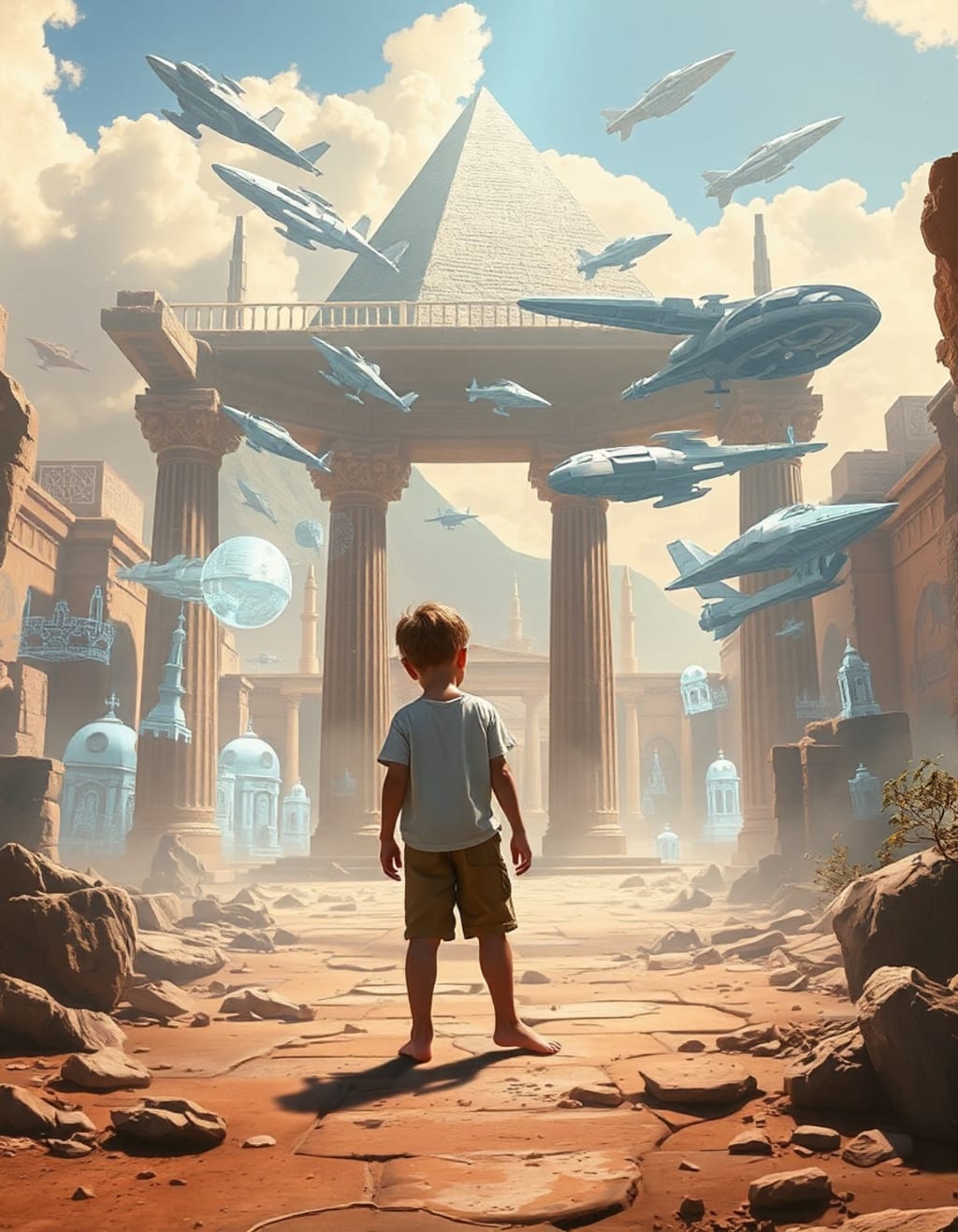
The first time Eshan spoke in a language no one recognized, his mother thought he was just dreaming.
He was five.
His eyes were closed, his small lips muttering something soft, rhythmic — not quite music, not quite words.
They brushed it off.
Until he did it again. In another language. Wide awake. Staring at the wall like he was reading from an invisible book.
By the time he turned ten, Eshan had already spoken fluently — and unexplainably — in at least seven unidentifiable dialects. One sounded vaguely Egyptian. Another was hauntingly similar to Sumerian. One day, he drew a map of a city that didn’t exist.
Except… it did.
A sunken city found three months later beneath the coast of India.
The map matched — down to the temple’s cracked steps.
His parents stopped asking questions. The world, however, had just started.
The boy became an obsession for scholars. Linguists. Anthropologists. Even military officials.
But he didn’t like talking to them. He said they only listened with their ears — not their hearts.
Instead, he spoke to trees. To ruins. To silence.
And sometimes, to strangers he’d never met before — calling them by names long forgotten.
One woman visited, weeping when Eshan greeted her in a dead dialect of the Mohenjodaro valley.
“You know that tongue?” she whispered.
“I was there,” he said softly, “when the river vanished.”
She passed out on the floor.
The media swarmed. Headlines called him The Reincarnated Historian. Others said he was a hoax, a boy trained by conspiracy theorists.
But deep in his small room, Eshan wasn’t interested in any of that.
He was writing.
Pages and pages of scripts no one could read. Drawing architecture that defied modern engineering. Speaking of cities that floated, libraries built inside the clouds, empires run by philosophers who spoke in colors instead of words.
He said things like:
“The past is never dead. It’s just sleeping under our feet.”
“Time is not a line. It’s a circle — and I’ve walked it more than once.”
He once told his teacher, “Do you know what the saddest sound in the world is?”
The teacher shook his head.
“The silence that comes after a civilization forgets itself.”
At age 12, Eshan stopped talking.
Not because he couldn’t.
But because he said he had spoken too much.
He sat quietly in class. Avoided reporters. Refused interviews.
Until one day, he asked for permission to visit a specific cave in Turkey — a place no tourist guide mentioned.
The local government laughed — until archaeologists confirmed that no one, especially not a child from another continent, should have known about that hidden chamber.
They gave him access.
Inside the cave, Eshan placed his hands on the walls and whispered a lullaby in a language older than scripture.
Within hours, images appeared under blacklight — murals showing the rise and fall of a civilization unknown to any historian.
He whispered only once:
“They built light from memory. And died when they forgot how to love.”
The discovery made headlines for weeks.
But Eshan didn’t care.
He said history wasn’t about proof.
“If people only believe in what they can touch,” he said, “then they’ll never feel the most important parts.”
By 14, Eshan had written an entire book of civilizations that had no name.
But his final chapter was different.
It wasn’t about the past.
It was about the next fall — ours.
He described a future collapse: not of cities, but of empathy. Not by bombs, but by apathy.
He said:
“We have traded memory for convenience. Language for reaction. Wonder for repetition.”
“And when we forget the value of each other — we become ruins before we even die.”
At 15, Eshan vanished.
Gone.
No note. No trace. No footprints. Only the final sentence of his journal:
“History isn’t behind us. It’s waiting for us to remember it.”
🧠 Reflection:
People began reading his writings again. Not as myths. Not as theories.
But as mirrors.
Universities taught his sketches. Artists painted his cities. Scientists tried building the floating gardens he once described.
No one found him.
But once, years later, a traveler in Morocco claimed he met a boy who spoke of lost empires as if he'd eaten breakfast with their kings.
The boy smiled and walked away.
He was barefoot.
And humming the same lullaby Eshan once sang to the stones.
About the Creator
How to Succeed at the Benson Directory®
Congratulations and welcome to the Benson Directory® employee #22391! As our newest call handler, you will have the privilege of speaking with dozens of unique and interesting people on a daily basis as well as the opportunity to earn bonuses for high performance. Contained within this handbook you will find a set of ease to follow instructions designed to help you settle in to your new role and begin paving the way to success.
By S. A. Crawford5 days ago in Fiction




Comments
There are no comments for this story
Be the first to respond and start the conversation.