

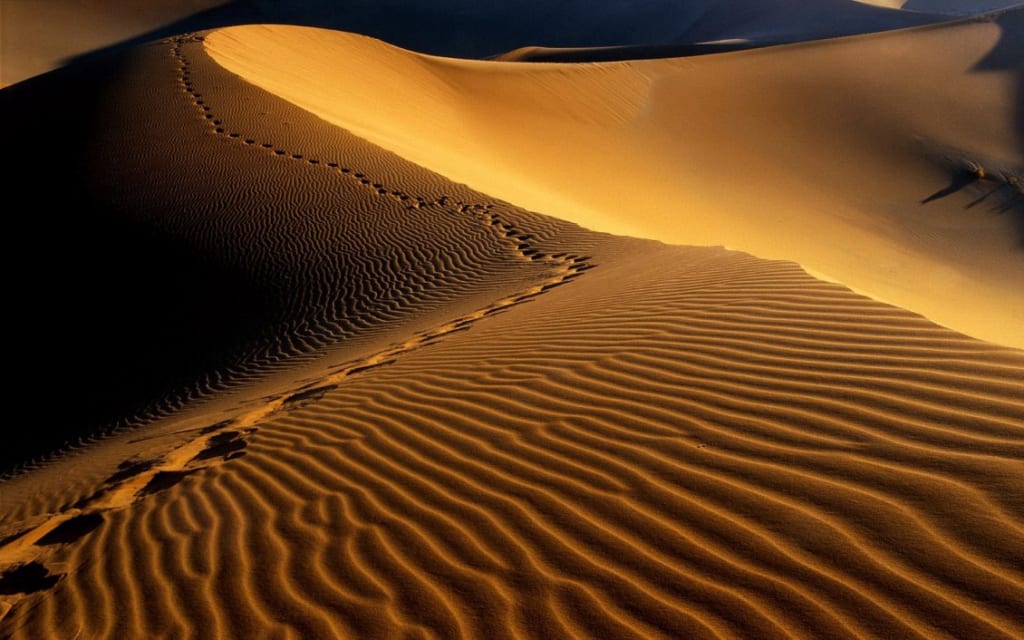
The wind kicked up flecks of sand that stung my ankles as I readjusted the cloth over my mouth. The canvas backpack I wore had enough rations for three days in the Out. We had to be back by nightfall on the third day as that is as far as our weather radar could predict. Samara, my scouting partner, had been to the Out before. I had not.
The Out was a lifeless place. From Base 14 to the dunes there was nothing but sand. It was rumored that you might see another Scout from another Haven bunker, but that was rare, and hadn’t happened in years. Since the End Wars the only people you saw were those other descendants of the original Base 14 refugees.
It was odd to feel moving air. The air in Base 14 never moved. Temperature was controlled through the walls and the floor heating up or cooling down and we never felt air move across our skin. It felt like being in soft water, like someone whispering across my skin. Samara was fidgeting with the knives strapped to her boots. Slung over her hip was a leather cord with a pouch on her left side which held in it one half of the heart-shaped locket we hoped to complete.
Scouts traced the same path from Base 14 to the dunes where the steadily-traveled trench was swept away in the choking, waterless air. From there we would need to chart our own path, hopefully not one trekked before us, as we searched through the wreckage to find the missing half of the locket. It belonged to our founder, Commander Eliza Tanner. The golden leaf-sized locket was the only artifact we had left of her. When the final days of the End Wars ceased, she went out to look for survivors. She never returned.
It was rumored she kept the final phase of her Reintegration plan in the locket. It would tell us her theory for how to terraform Earth, how to make it habitable for people again. Terraforming requires reshaping the atmosphere, temperature, topography and ecology of a planet so life can thrive there. Centuries ago they had tried these techniques to replicate an earth-like oasis on Mars. There was something like a storm on the sun, solar flares produced a great turbulence in the vacuum of space. Solar winds tore across Mars, wiping out the colony and the hopes for a future of human life past Earth. After that our planet was too horrified to try again.
Since Earth was now a burnt husk of what we read about in history books, with its fields of green and horizontal farms and forests of trees taller than the 30-foot ceilings of Base 14, reclaiming its hospitable landscape would be about the same as trying to claim that of Mars. And so, we take our scouting assignments and we sift through the marble remains of what people say was once a great Capitol.
At the crest of the dunes you can see it. Just across a dried riverbed lies a graveyard of white stone which stood gleaming in the sun. Now the marble is cracked and covered in grime, dust, and soot and whatever else was hurled at this place when the End Wars came to call. Samara grabbed my hand at the top of the mound of sand. “Are you ready for your first mission?” I could hear the smile in her voice. I looked at her, the satchel strapped to her hip, the knife strapped to her forearm. She had never run into anyone, or anything, on her missions, but Scouts always left Base 14 armed. I ran my hand over the hilt of my own blade that rested on the top of my left forearm. “Absolutely,” I said, resolution settling into my shoulders.
As we descended, Samara told me about what she had seen before. The graffiti scrawled on remnants of walls displayed past phrases of a language from which we had long since evolved. Once she heard a noise in the night, sounding similar to what we had heard on recordings of what people called wolves. She hadn’t slept all night, just sat up listening to the howls across the wind. At the break of dawn, her old scouting partner awoke to go and see what had been making the haunting cries. He never returned, and after a full 32-hour day she had scrambled back up the dunes and returned, dehydrated and panting, to Base 14 to tell us all what had happened. Two years to the day since then and here we were, about to cross the old riverbed and then on to what looked like the remains of a line of worn stone shards.
Once we ascended from the trenches of the dried riverbed we came upon the first of the stone ruins. Cracked and weather-worn though they were, one could still see that they were once majestic. The remnants of stone steps and the bases of massive white columns paved the way to the pieces of a giant man. A stone dress shoe and half of a face lay in the hollowed-out shell of what once must have been a temple to this man. Legend says his face used to adorn tiny copper coins and one of their old pieces of paper money. We have no purpose for money anymore, we choose to barter instead.
When I turned around I could see the cracked half-obelisk made of now-yellowed stone, and further still was a grand building with a domed roof. It was eerily quiet. In Base 14 there was always the sound of the generators, of children laughing as then ran between their lessons, of cadets running drills or of Commanders strategizing for the future of the community. But here there was nothing but the sound of the first non-artificial wind I had ever known.
Samara had a lead from her last trip in the Out. “The Commander always said she respected the ones who built this place. She said she had ‘big shoes to fill’ and I think she was talking—literally—about these big shoes. I mean that’s my best guess, anyway.” She looked nervous by the end of her statement, like she didn’t actually quite believe it herself.
“Let’s go,” I said, already starting towards the ruins of the steps. We made our way towards the shoe carefully. I sent up a silent thank you to the Sergeants from my cadet training who timed us as we scaled the rock wall in Base 14. Hand over foot and foot over hand we scrambled over chunks of stone and cracked marble until we were on the platform where the foot rested.
“I’m sure someone has looked here before,” Samara said, “But I think we should just try one more time.” I nodded at her, still out of breath from the climb. We poured the area for what felt like hours, the sun baking the marble around us and singeing our matching black suits that kept us cool and safe from the sun’s harsh rays. Just when we were about to give up, something caught my eye.
“I think I’ve got something.”
Wedged in a crack in the ground under the big toe was a piece of blood-red cloth. With Samara over my shoulder, I pulled out the bundle that had the weight of a small piece of solid metal. We both looked at each other, hearts racing.
I handed it to Samara. “This was your plan,” I whispered hurriedly, “You do the honors.” I could feel the energy radiating off of her, heart beating out of her chest.
Her hands shook as she peeled off the layers of cloth that surrounded whatever was inside.
I saw the sun glint off of the shining thing before my eyes came into focus and I realized the shape of the gold heart. There it was, crusted over with dust, but holding within it the folded-up paper that would show us how to come up from Base 14 and onto the Earth’s surface once more. It was what we had been searching for all these years. Tears sprung into my eyes and as I turned up to look at Samara I saw her face was streaked with them too. She put the half locket in her lap and threw her arms around me.
“We found it, we found it!” she cried, clutching the locket to her heart. “We can make Earth our home again.”
She rewrapped the locket in its cloth home and placed it in the inner pocket of her suit. Her eyes shone with pride as she looked into mine. She grasped both of my hands and said: “Let’s go home.”
About the Creator
Keep reading
More stories from writers in Fiction and other communities.
Miss Persephone's Manual to a Seemingly Ordinary Life
Miss Persephone was found at the dining table, her blue eyes swollen, her tears arriving and retreating like the tides of the ocean. Earlier that day, her family had visited her in the retirement home where she had lived for eight years. It was her eightieth birthday.
By Imola Tóth3 days ago in Fiction
A Dart at Dusk
Seconds ago, the sullen sun set on the two of us… my exuberant furry companion and me. A fresh breeze embraces us, delivering welcome relief from the day’s oppressive heat. His typical stumbling and staggering along — apace with a sloth — has turned into trip-trapping, high-stepping, almost skipping along.
By Angie the Archivist 📚🪶5 days ago in Petlife


Comments
There are no comments for this story
Be the first to respond and start the conversation.