

When technology finally caught up to the desire to live beyond a single lifetime, The Loom was born. It offered a person a chance to step into their own reality. Any life they imagined, complete and convincing in every detail. Inside, a year of experience was merely a minute in the real world. Their new reality around them was filled with people who could love, struggle, and die, yet the one who entered was spared from chance or tragedy. A wound, a fall, or a bullet became a miracle of survival, and only old age could bring their story to an end.
Every moment left behind memories as vivid as life itself, and those memories returned with them. For some, they became a gift of wisdom and joy, but for others they were a burden too heavy to carry. Professionals could soften or even erase them, though such erasure often left behind quiet gaps that never quite healed. They never truly knew they were inside, though somewhere deep within remained the choice to walk away. Here begins the life that unfolded inside the Loom.
Patrick had been obsessed with history since he was a child. When he learned about World War II, he wanted to know every detail everything. He became extremely focused on the activities of Hitler specifically. He researched everything he could was a self-proclaimed expert on the subject matter. There were many times that he which he was there to experience it all. With his gut, long thinning brown hair, and glasses. He knew he would never be welcomed by their group anyways.
With the introduction of the Loom, Patrick finally had a way to turn his long-guarded dream into reality. Years of scraping and saving in his mother’s basement had left him with little more than determination, but it was enough to buy his chance. The technician went over the basics of the Loom and how he would feel. Patrick outlined the scenario he wanted to live. She winced at the details but said nothing; after all, it was only a simulation.
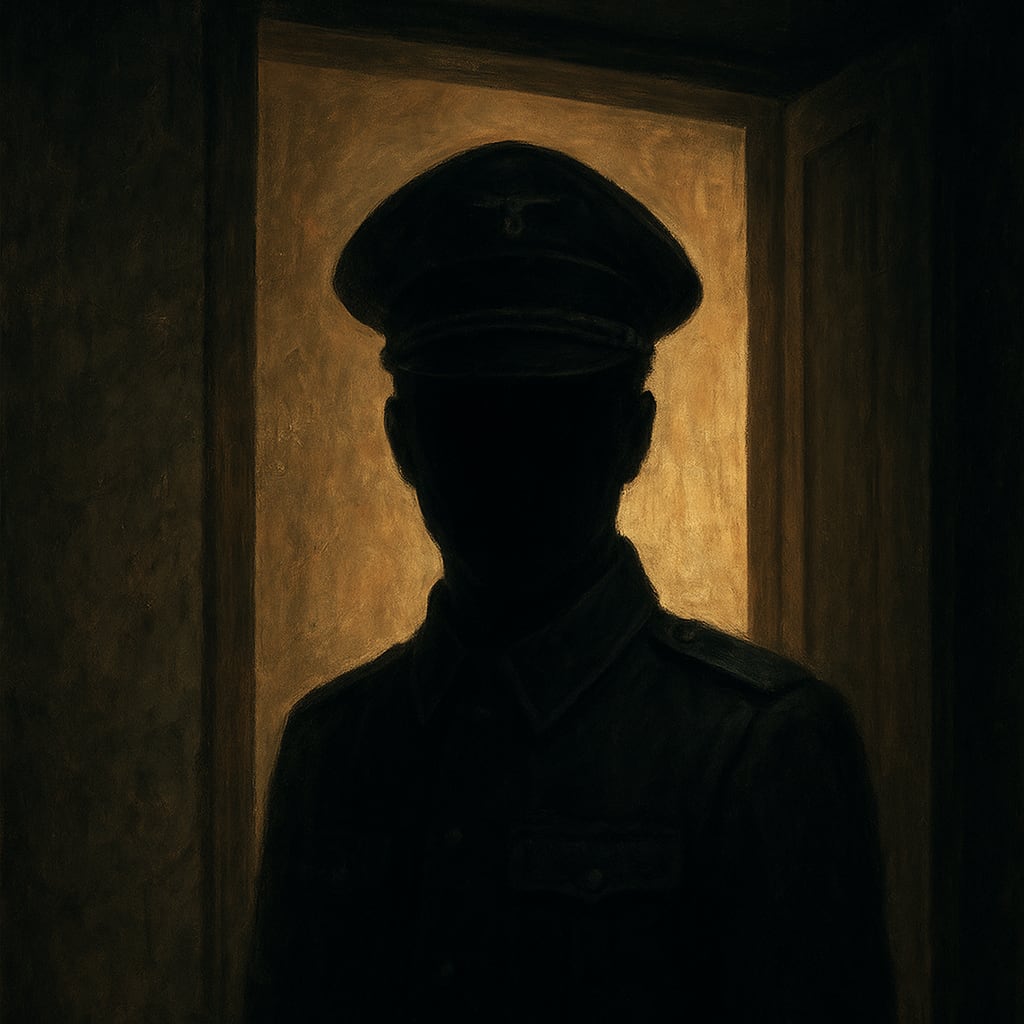
Then the Loom took hold and everything dissolved. He woke up in 1929 Germany. When Patrick woke up, he was in 1929 Germany. Twenty-five, tall and vibrant, his hair blonde, and his eyes a sharp blue. The very image of the idealized Aryan. It was a face that belonged here, unquestioned. He went to splash some water on his face to wake up more and took a moment to appreciate his new taught and toned physique.
He heard a knock at the door and everything about his real life was gone in a flash. He answered the door and was greeted by his friend, Fritz. “Come on, man. We need to get to the meeting.”
“Okay. Okay!” As they started to run, “When does it start?”
“Like 5 minutes.”
They arrived at the meeting hall, where the still-young Nazi Party had been quietly growing for nearly a decade. The turnout was impressive, and the speeches were crafted to captivate and persuade. Patrick watched everything with curiosity, absorbing each word, each gesture. Fritz and his friends were enthralled, hanging on every statement, shouting agreement at the right moments. Patrick mostly went along, swept up in the energy without fully understanding it.
He didn’t have much in his life to anchor him, and the group gave him a sense of belonging. Before he realized it, he was drawn into a world he could never easily leave. They fitted him for an SS uniform, and it suited him well—too well, perhaps. Every compliment and nod from his superiors reinforced the path he was taking.
“Good posture, Patrick. Keep your chin up. Discipline shows character,” one officer said as he inspected the new recruits.
Patrick nodded silently, trying to appear confident. Soon, they gave him assignments, each one changing every few months. He learned to keep his head down, to work diligently without attracting unnecessary attention. Only the right eyes of his superiors noticed him. Over the years, his dedication did not go unrewarded.
He rose steadily, recognized as loyal, competent, and unflinching. Many times, he found himself in the same room with Adolf Hitler and the inner circle of officers. He remained quiet, a shadow in the background, yet attentive to every word. The things he overheard were horrific, yet he never spoke. “You see what’s necessary, Patrick. It’s about strength… about survival,” a high-ranking officer once murmured as he passed by, eyes sharp and calculating.
Patrick simply nodded, letting the words sink in. Some words were chilling. “Those who resist… must be removed,” one officer said, almost casually, glancing at Hitler for approval.
Patrick’s stomach tightened. He forced himself to nod subtly, pretending understanding, pretending agreement. “Courage is not optional, Patrick,” another whispered, handing him a dossier. “You’ll see. Strength demands action. Never hesitate when duty calls.”
He was a soldier now, trained to obey, trained to listen, trained to keep his mouth shut. And he was learning, painfully, that silence could save you, or damn you. The uniform, the promotions, the quiet praise, they all chained him to this life, one step at a time. Patrick realized the terrifying truth: he was no longer on the outside. He was inside. And inside, there was no easy way out. And with each step, escape became more impossible.
Many nights, Patrick couldn’t sleep after overhearing the plans whispered in smoke-filled rooms. The camps. The invasions. Each word gnawed at him until he could no longer endure it. After weeks of torment, he decided he had to act. He learned when Hitler and his highest-ranking officers would be meeting. Himmler, Göring, Goebbels, the whole inner circle. It was the perfect opportunity to stop them.
The night came. Patrick was the only outsider in the room, quietly serving as an attendant. The men argued about logistics: deportations, mass killings, the destruction of nations. His stomach twisted. He couldn’t wait any longer. Patrick rose, calm as stone, and stepped beside Hitler. He drew his pistol and pressed it against Hitler’s temple. Chairs screeched. The eight men at the table leapt up. Three drew pistols and aimed at Patrick. His breath caught, but he steadied his hand. “You are monsters,” he said, voice cutting through the silence. “These plans will damn Germany for decades. You think yourselves superior? That gives you no right to torture and slaughter innocent people.”
Hitler sneered but said nothing. Patrick’s eyes swept across the table. “Taking him out delays your schemes. Taking all of you out might end them altogether. Guns on the table. Now.”
For a moment, no one moved. Then Himmler smirked faintly. “You were loyal, Patrick. Obedient. Why throw it away now?”
“I still have a conscience,” Patrick said. “That’s something none of you understand.”
Göring growled. “We could kill you where you stand. A soldier’s life means nothing.”
Patrick pressed the barrel harder into Hitler’s temple. “If you try, he dies first. One bullet could unravel all of this. Guns down or I start with your Führer.”
Reluctantly, the men obeyed. Steel clattered onto the polished wood. Patrick tilted his head at Hitler. “Some loyalty you inspired. They’d rather see you dead than sacrifice themselves.”
Hitler slammed his fist. “Cowards! Pull the trigger! Kill him!”
One officer protested. “If we fire, he’ll shoot you first!”
“Then die for me!” Hitler roared.
Shame and fear rippled through the room. Slowly, each man raised his own weapon to their temples and mouths. Silence pressed in. Then they pulled the triggers. The thunder of gunfire filled the chamber. When the smoke cleared, eight bodies slumped lifeless around the table and floor. Patrick never flinched. His pistol stayed on Hitler. “Ready to die?”
Hitler always put on a show when he was in front of a crowd or his subordinates. Now, Hitler trembled, pushing back his chair. He fell to his knees, voice breaking. “Please, don’t kill me. I’ll do anything.”
Patrick’s eyes hardened. “The moment I leave this room I’m a dead man. And so are you.”
The door burst open. A secretary shrieked at the sight of the carnage, then fled, screaming for guards. Patrick’s finger tightened. “No more time for you.”
He fired. The bullet struck Hitler square in the forehead. The dictator collapsed, lifeless. “Pathetic,” Patrick muttered.
The hall erupted with boots. Soldiers stormed in as Patrick dove through a window. Gunfire tore the air. Bullets ripped his uniform as he plummeted three stories, hit the ground, and staggered up. Pain should have crippled him, but adrenaline carried him. He ran through alleys, ducked into shadows, felt for wounds yet found none. His uniform was riddled with holes, his body bloodied, but his flesh was unbroken.
It hit him: the Loom. He layered the moment again, imagined the bullets missing, the fabric restored. And just like that, the damage was gone. Smiling faintly, he sprinted home, packed essentials, and prepared to vanish. Patrick opened the door and Fritz nearly punched him in the chest. His friend’s fist hung there awkwardly, his eyes widening as their gazes met. “Did you hear? The Führer is dead. Someone shot him! They’ll catch the man, they must.”
Patrick forced a flat expression. “That’s too bad. Excuse me, I need to go.”
Fritz blocked the way. “Where? Wait… oh my god! It was you.”
“No,” Patrick said evenly. “I wasn’t even in the building. My parents—”
“Don’t lie to me. I know you too well. Why did you do it?”
“He planned to kill millions. He would’ve ruined Germany for generations. Stopping him was the only way.”
Fritz’s hands shook. “I can’t let you leave. I’ll tell them.”
Patrick drew his pistol, low at his side. His voice dropped. “If that’s how you feel…”
Fritz paled. “Patrick, no. We’ve been friends since childhood. I don’t want to betray you but I can’t protect you either. I have a duty to fulfill. I’ll give you a head start.”
Patrick hesitated. That moment gave him clarity. A head start wasn’t enough. He fired a single shot into Fritz’s leg. Fritz screamed, collapsing. Patrick’s voice cracked with regret. “Good luck, Fritz. I’ll miss you.”
Then he ran. News of Hitler’s assassination tore through Germany. With the Führer and his circle gone, the regime collapsed into chaos. An interim military government seized control, de-escalated hostilities, and by August 1941 held elections. A decorated general rose as president, authoritarian but pragmatic, determined to stand down the war machine. Occupations ended. Negotiations opened. Slowly, Europe stepped back from the brink.
Patrick, now “Robert,” slipped away to New York. He married, raised children, lived quietly. Decades later, at eighty, his life in the Loom ended. He awoke in the sterile facility, monitors humming, a technician entering to check on him.
“You doing okay, Patrick?”
He chuckled. “That was… quite an experience.”
“Did you complete what you wanted?”
Patrick smirked. “Yeah. Right in the forehead.”
The technician sighed. “My people would thank you, if only it weren’t a simulation.”
Patrick left the Loom changed. On the way home, he signed up for a gym, bought new clothes, got a haircut. Like Germany in that spring of 1941, he was ready to begin again.
About the Creator
Michael Noon
I have a slew of thoughts and random ideas in my head. There's times I've had such vivid dreams I've had to write them down. I've published two books and you can find them on amazon:
Butterflies in the Garden
Storms of the Heart
Keep reading
More stories from Michael Noon and writers in Fiction and other communities.
Tales from the Loom
When technology finally caught up to the desire to live beyond a single lifetime, The Loom was born. It offered a person a chance to step into their own reality. Any life they imagined, complete and convincing in every detail. Inside, a year of experience was merely a minute in the real world. Their new reality around them was filled with people who could love, struggle, and die, yet the one who entered was spared from chance or tragedy. A wound, a fall, or a bullet became a miracle of survival, and only old age could bring their story to an end.
By Michael Noon4 months ago in Fiction
THE MOTH
Hapley was one of the most celebrated entomologists of his time, famous for his discoveries and infamous for his bitter feud with Professor Pawkins. Their rivalry had lasted for decades and had grown from an academic disagreement into a personal war. It began when Pawkins dismissed a species Hapley had named, and from that moment onward, the two men attacked each other relentlessly in papers, meetings, and public lectures. Their quarrel became legendary within scientific circles, stirring passions as fierce as any religious dispute.
By Faisal Khan4 days ago in Fiction


Comments
There are no comments for this story
Be the first to respond and start the conversation.