thriller
The Leonardo Paradox
Sarah found sanctuary in the shadows of the Duomo's crypt. As light filtered through narrow windows, she finally had a chance to study the manuscript properly. But something was wrong. Pages she had memorized in 1924 were different now – some text had vanished entirely, while new passages appeared in their place.
By Shane D. Spear12 months ago in Fiction
Busy Tone
Earnest’s home sat on 10 acres, and his closest neighbor was a half-mile beyond the junipers, piñons, and scrub brush surrounding him. He’d been there three years after deciding he was done with people—he’d spent his life surrounded by people, and all that was behind him. He had his trees, his acreage, a local golf course, and this house. He’d done his best to love the house, but it wasn't as simple as he’d hoped.
By Philip Canterbury12 months ago in Fiction
The Leonardo Paradox
Sarah had chosen to run. Neither the Guardians nor the Societá del Tempo could be trusted – Leonardo's warning echoed too strongly in her mind. Now she raced through Florence's narrow streets as the afternoon sun cast long shadows between the buildings. The compass in her hand ticked with increasing urgency, its dials spinning wildly whenever she changed direction.
By Shane D. Spear12 months ago in Fiction
The Wolf Witch - 2. Oliver's Life
It was three weeks since Oliver had moved out of Freda's life. He could shift into his werewolf self whenever he felt like it. It helped him to feel better. He was rolling around on the floor and just hanging out, letting his spirit feel free.
By Denise Larkin12 months ago in Fiction
The War of the Americas - Part VIII
The long bus ride to the camp where Sylvia Platt found herself imprisoned with close to 200 other American expats now declared enemy combatants after the United States had bombed and then declared war on Mexico was uneventful. She thought she knew approximately where she was. They were still on the Baja peninsula and not mainland Mexico given the shortness of the journey, approximately 10h, and the fact that they never crossed a body of water or left the bus. Also, they obviously had traveled south and/or east as directly to the west of where she had been arrested at her home near Tijuana, Mexico lay the Pacific Ocean, and only a short few miles north the border with the United States. They also could not go too far east as that way eventually led to the Texas border. Safest for prisoners would be an isolated location in the middle of the Peninsula as far south as possible. She could no longer see or smell the ocean and the roads had been relatively smooth for the first half of the journey and then terribly bumpy for the remainder so she guessed they had stayed on paved major roadways heading south of which were are only a few in that part of Mexico before turning off and heading east. The final 45 minutes or so of the journey had been a very bumpy steep uphill climb and that last part gave her all the information she needed to puzzle out their general location. Fortunately she had studied much of the geography of Mexico before moving there and those efforts had redoubled when she joined the ranks of the CIA. When she exited the bus and her blindfold was finally removed and she saw the terrain she knew immediately that they were somewhere within the boundaries of the Parque Nacional Sierra de San Pedro Mártir as she could see the Cerro Picacho del Diablo, or “Peak of the Devil” which, at >10,000 feet is the highest peak on the Baja peninsula of Mexico, not far from their position. She guessed they had stopped at an elevation of at least 8,000 feet somewhere near that peak. Hard to believe Mexico had a military outpost, let alone one set up for handling prisoners of war, in this remote location, but the Mexican military, much like that of the United States, had plenty of secrets that were known to only a very few. Sylvia guessed the CIA knew of the this location, but they had failed to inform her of its existence. Of course, there were many things the CIA knew about Mexico, and every other country in the world that they shared with almost no one. And she had no real reason to need to know. Her work at the time had nothing to do with Mexico, and that was not expected to change anytime soon despite the fact that she called the country her home. Neither Sylvia nor the CIA had predicted they would be at war with Mexico within the next few months or if they had her education and training would have been much different. The Mexican base she found herself at was well hidden, at elevation, and appeared to be buried deep in the rockface of the mountain meaning it was hardened from conventional attack and at least partially obscured from spy planes and satellites. The tracker the CIA had implanted in her when she was officially made an agent would allow them to divine her general location, but once inside the base, she had little doubt the thick walls and mountain rock would partially or completely obscure her signal. She would “go dark” as the CIA trackers would put it. She had no illusions that she was valuable enough of an asset to warrant any sort of second rescue attempt, especially after she had faked her own death to evade an initial attempt. That mission had been at her request and by now she was fairly certain that in addition to the CIA, the Navy at least knew she was still alive and that they had been deceived. If Dom had done as she had asked he would have explained her reasons for staying behind and that should end any discussion of another military intervention on her behalf, at least until she was ready to call for one. That might be a very long time from now and the military and CIA would be very busy dealing with the war and accomplishing her two main objectives; helping her fellow prisoners, and picking up intelligence from behind enemy lines, relied on her being with those prisoners in Mexico. That was the entire reason she had chosen to stay behind when her husband had left with the Seal team sent to extract her from her home in Baja shortly after the bombing of San Ysidro border crossing. Her thoughts turned to her husband Dom and their two dead dogs, along with her beloved cats, who she hoped had found a loving new home thanks to her own last minute maneuvering and negotiating with the Mexican soldiers who had arrested her. Two of those soldiers had suffered severe bite injuries at the hands of their dogs, and one had been killed by a SEAL sniper in the process. She felt a great sadness then, for the death of the dogs, the injuries and death of the Mexican soldiers and for her husband whom she missed terribly. She also felt some of the pain he must be feeling at the loss of his two best friends and longtime loyal companions.
By Everyday Junglist12 months ago in Fiction
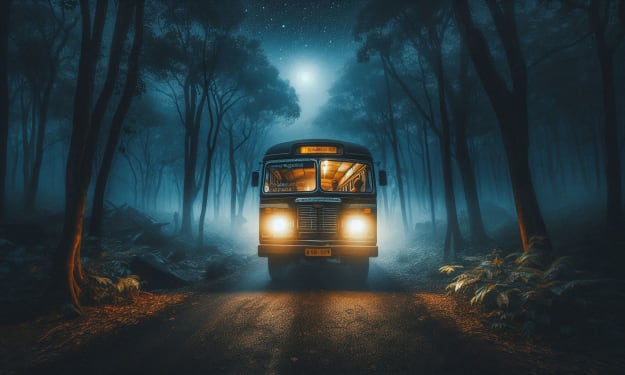
The Midnight Bus
It was a cold winter night, and a thick fog blanketed the deserted forest. A narrow road cut through the silence, stretching into the darkness. The only sound was the hum of an approaching bus, its headlights slicing through the mist as it made its way down the empty road.
By Manish Chauhan12 months ago in Fiction
From Haunted Houses to Castles: The Evolving Settings in Books with Mystery Suspense and Adventure
Regarding books with mystery suspense and adventure, the setting plays an important part in shaping the story. From eerie haunted houses to grand, mysterious castles, the backdrop of a tale can transport readers into a world of intrigue, danger, and excitement. For young readers, these settings are not just places—they are characters in their own right, adding depth and atmosphere to the story. In this blog, we’ll explore how settings evolve in mystery books for kids and books with mystery suspense and adventure, focusing on the transition from haunted houses to castles and why these locations effectively create unforgettable adventures.
By Parker Kelly Books12 months ago in Fiction
The Marionette's Father. Content Warning.
Late 1800s, France The candlelight flickered in the darkened workshop, casting shadows across the unfinished wooden puppets that hung lifelessly from their strings. The air was thick with the scent of sawdust and something fouler, something rotting beneath the fresh veneer of varnish. It had been two decades since the blue fairy granted Pinocchio his wish—to become a real boy—but time had not been kind to him.
By V-Ink Stories12 months ago in Fiction
The Leonardo Paradox
The next morning found Sarah in borrowed clothes, bent over Leonardo's workbench as dawn light filtered through the workshop's high windows. She had spent the night studying the manuscript, comparing its contents to Leonardo's current notes while he worked on what he would only call "the device."
By Shane D. Spear12 months ago in Fiction
The Leonardo Paradox
The man who stood before Sarah couldn't have been more than forty, with keen eyes and a neatly trimmed beard. He wore a simple linen shirt stained with paint and charcoal, and his fingers were spotted with ink. But it was his smile that caught her attention – knowing, yet kind as if he were welcoming back an old friend rather than meeting a stranger from the future.
By Shane D. Spear12 months ago in Fiction
The Leonardo Paradox
The world reassembled itself in fragments. First came the smell – not the familiar musty scent of the museum's archives, but something sharper: woodsmoke, unwashed bodies, and sun-baked stone. Then sound returned: the clatter of wooden wheels on cobblestones, distant shouting in rapid Italian, and the cry of gulls overhead.
By Shane D. Spear12 months ago in Fiction