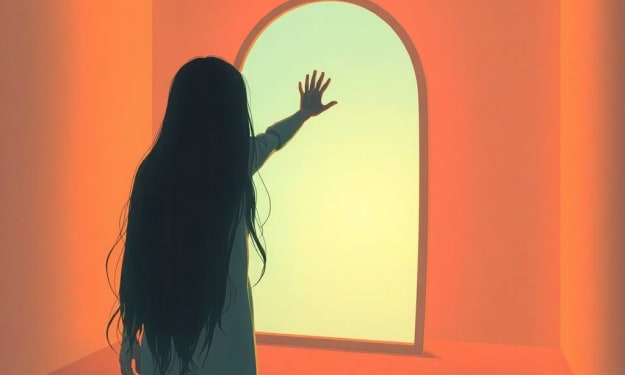
The Archivist of Borrowed Days
On the morning the city turned gold, Elia cataloged a stranger’s last summer.It came to her sealed in a glass ampoule, as all Borrowed Days did: a county courthouse seal at the neck, a silk ribbon twisting like a vein. She held it up to the light the way some archivists cradle relics, mindful of the contained weight. Inside the glass a moving vignette refracted against the skylight—sunlight trembling over water; someone’s toes sinking into late August sand; laughter, small and round, like a stone smoothed by a river.“Donor’s consent recorded,” the clerk said, flicking his stylus. “Imminent. They chose the whole day.”Imminent was the city’s polite word for what doctors called prognosis, what families wouldn’t say at all. Elia nodded, her breath fogging the ampoule. She set it in the Time Cabinet, drawer 13C, between “Autumn Afternoon, Pie-Baking, 1998” and “Early Train, First Job, Nerves + Coffee.” Her drawers were a cartographer’s map of people’s most guarded hours. She had stopped being surprised by how ordinary most of them were.At eleven, the light in the high windows shifted. The city’s towers burnished, turning to sheets of hammered gold as the sun caught the dust above the river. The first week they turned the time circulation system on, everyone had been prepared for glitches—people waking up in borrowed nights, a toddler accidentally gifted “Bachelor Party ‘15.” Instead: the color of the city changed. Around midday, time itself seemed visible as a floating particulate—memory-pollen, Elia called it—that made even errands feel ceremonial.“Archivist Elia?” A voice from the doorway, careful not to step into the nave of the archive without permission. “I’m here for today.”He wore a suit too formal for his years and a backpack with a cartoon astronaut on it. Nineteen or twenty, Elia guessed, the age of the newly brave. He handed her a request slip wrinkled at the corners. The city let you borrow up to eight hours per month, provided you had consent from the donors and a reason that satisfied the Clerk of Time. Exams, surgeries, goodbyes, last dances—people offered the marrow of their days to strangers to help them through.“Reason for borrowing?” she asked, though she could see it circled in shaky ink: Courage.“Presentation,” he said, not meeting her eyes. “Final critique. Everyone says it’s—it’s everything.”He had used all his words to get through the door, Elia thought. She checked his records. No disciplinary flags, two hours borrowed once for a driving test, returned in full. Good returns mattered. You couldn’t keep what you borrowed; you had to walk through it and then let it go. The system depended on ending.“What kind of courage?” Elia asked, softer. “Some days growl. Some days purr.”He blinked. “I need the kind that holds a room together.”She thought of drawer 7F. “We have a ‘Teach-In, 1972, Megaphone Failure’,” she murmured. “Or ‘Wedding Toast, Microphone Dies, Improvised Laughter’.”“Not that,” he said, and then, with a force she recognized, “The kind where you don’t leave yourself behind.”Ah. Elia turned to the cabinet labeled Plain Miracles. She had built it over years, one quiet act at a time. The categories she’d invented—Plain Miracles; Almost; After—were her minor rebellion, a way to draw constellations in other people’s skies.She found it in 3B: “Public Library, Card Renewal, Why Am I Crying?” Twelve-minute slice. It had been donated by a woman with a neat signature and an email address that bounced. Elia had filed it away because sometimes courage was a line at a counter, a patient clerk, a person allowing themselves to say, I need. The ampoule glowed like a match held in two palms.“Here,” Elia said. “Let it run during your walk to campus. Save the last three minutes for the moment your mouth opens. When you return it, add a caption. Tell me what color the carpet was.”He smiled, first at the ampoule and then at her. “Do archivists remember the days they lend?” he asked, same question they all asked in different words. He meant: Does it pass through you?“No,” Elia said, which was true in the way the posted rules were true. Borrowed Days went from donor to recipient, the archive a corridor of glass and reflected light, nothing touching her skin. She watched them like a lifeguard watches a summer crowd: strangers in water, their heads briefly bright.After he left, Elia opened her lunch at her desk. Tomato soup in a jar and a piece of bread that fell apart when she touched it. She was forty-three the year the city turned gold. She had been twenty-seven and newly divorced when the legislation passed and twenty-eight when she took the job. In a box beneath her desk were the things she did not catalog: a jagged stone from the riverbank where her brother had taught her how to skip pebbles; a paper wristband from a concert where she’d kissed a girl and felt every kind of lightning.Elia had never borrowed a day.By three, the gold had thinned to a watery brass. A woman in a red raincoat came to return “Third Date, Kitchen, Late Night Pasta.” She had borrowed it for a job interview and come back flushed, hair damp with the storm that had passed while she’d been inside. “They offered,” the woman said, cradling the ampoule like a sleeping bird. “I didn’t cry until the sidewalk. Who brought the basil the first time? Do you know?”“No,” Elia said gently. “But I know they didn’t have it and then they did.”At four, a courier brought an emergency: a set of linked ampoules signed by a mother in Labor & Delivery, the glass vibrating faintly against Elia’s palm as if it still contained the echo of voices. The label: “Night Before, The Quiet.” Twelve hours. Elia swallowed. Sometimes people donated their storms. Sometimes they donated silence.She shelved it with hands that had started to tremble last month when her doctor had said imminent like he was closing a curtain. It wasn’t a word anyone had said about her before. Elia had smiled with too many teeth and told him she knew the forms. She did not want to borrow a day to carry the news because she did not want to tie anyone else to the shape of this hour. She went home that night and boiled potatoes, roasted a chicken, stood in the door of her small balcony as the city drifted into its lamplight colors. The tremor in her fingers made her keys a rattle and then a song.The boy with the astronaut backpack returned the next morning.“How did it go?” she asked, not looking up yet, letting him choose the shape of his answer.“I saw the carpet,” he said. “It was green. I thought it was gray, but it was green, like the kind that makes you think of dentists. I told them ‘I’m afraid, and here’s the graph,’ and someone laughed, and then someone else said, ‘Me, too,’ and then—” He pressed the ampoule back into her hands, careful, grateful.“Caption?” she prompted, offering him the stylus.He wrote, Slowly is still forward, and his name, and he left, leaving behind the kind of silence that made Elia realize how much sound she carried home at the end of a day. She wrote the date in the ledger and then, without thinking about what it meant, she took the ampoule back out and held it against her wrist. It hummed, as all Borrowed Days hummed, one note, the exact tone of the moment’s truth. It made her bones ache a little.The following week the city published the updated guidelines. Borrowers could now request Sequence—linked arcs of hours that told a story. Donors could choose to let their sequences be reassembled and relived in a new order by people who needed to understand the shape of certain kinds of days: Days We Fell Out of Love; Days We Learned; Days We Tried Again. Elia could feel the whole archive shifting under her like a sleeper turning over.“You’ll need a new system,” the clerk said, apologetic, handing her a sheet that clattered like a gull. “We can send a student.”“I’ll write the map first,” Elia said. “Then they can follow it.”She stayed late, the gold in the windows fading to a coin at the bottom of a fountain. She pulled drawers gently, listening. She could hear the small sounds of people’s saved hours—footsteps on a hospital hall’s waxed floor; a kettle; a hand on a door. She found the sequences already present, the donors who had thought like she did, refusing to put a life in one compartment. She labeled them with the vocabulary of tides: Ebb; Flood; Slack Water.When she finished, she finally opened the envelope from her doctor. There were more words inside than imminent, and some of them were hopeful. The tremor might or might not get worse. There were experimental therapies. There were probabilities that were not promises. Elia folded the paper back into a plane and, for the first time, wondered what she might borrow.She thought: A day when someone was very brave far away from witnesses. She thought: A day when someone forgave themself for leaving. She thought: A day when someone cooked slowly because there was no rush.The next morning a girl of maybe ten came with her father. She held his hand the way a sailor holds a rope. He had the careful gentleness of a person trying to hide that he was walking on shards.“School assignment,” he said to Elia after the paperwork, voice hoarse. “Family history. Her grandmother died before she was born.”The girl put a folded photograph on the counter: a woman with a smile you trusted. “Can I borrow her birthday?” the girl asked. “Any of them. I just want to know if she liked candles.”Elia had seen the grandmother’s name before. People who had less money donated more days, not because they were better but because they were asked more. She ran her finger along the spines of drawers until she found “Birthdays, Undated.” Inside, the ampoules flickered like a string of low holiday lights. She found one labeled “Birthday, Alone, Cake for One, Laughs Anyway.” She thought of the girl’s photograph. She kept looking. There: “Birthday, Family, Off-Key Singing, Blue Frosting Teeth.”She put both on the counter. The father looked at her as if she had set down gentleness. “How do we—do we do both?”“Hold them at the same time,” Elia said. “Some days need another to be true.”After they left, she wrote “Some Days Need Another” on a small card and slid it under the glass where she kept the rules posted. People read rules; they took them seriously. Little rebellions hide best in plain sight.That evening, as she was locking up, a courier knocked, out of breath. “Priority,” he said, and held out a box. “Personal.”Inside: three ampoules, unsealed, with her own handwriting on the labels. Elia blinked, throat closing. “Where did you—who authorized—”“Donor did,” the courier said. “Says it’s from the Archivist of Last Times.”The name was a joke they used in the department for the person who had to process the final donations—people who gave up all their remaining Borrowables at once. Elia had held too many of those. She lifted one of the ampoules, heart knocking. “River, Late Summer, Pebbles, Six Skips,” she had written, years ago, when you could still donate to the public archive as if leaving out bowls of apples on your porch. The other two: “Concert, Wristband Ink Smudged, Rain,” and “Bakery, Second Loaf, The Owner’s Smile Like a Moon.”She had donated these. She had forgotten. Or she had believed she would never ask for them back.She took them home.The city at night went from gold to blue to graphite. Elia sat at her small table and set the three ampoules in a row. They thrummed like a chord, a weather map of the person she had been. She turned off the overhead light and, for the first time in her life, broke a seal.River first. The smell of algae and sunscreen and the hot metal of a bridge’s rail rose around her like a cup. She could feel the angle of her elbow, the itch of a mosquito bite she would scratch until it scarred. Her brother’s voice, laughing: Again. Again. She threw the stone and the water took it and then gave it back in jumps and the world was a series of little miracles, skip-skip-skip-skip-skip-skip, and she yelled, I did it! It had been ordinary. It was extraordinary.She let it go when the day ended. That was the rule. She let it go and when it left, it left like the tide leaves—reluctant, present even as it receded.The concert next. The press of bodies, the way the air tasted like rain and sugar. She kissed her and everything rearranged. Doors opened in her. She had time enough to walk through every single one.The bakery last. The story had been a small story. The second loaf because the first had been eaten at the counter with fingers, the owner laughing, and—moon smile—she had said, Take one more, on the house, it’s your day. The day had not had any other headline. But in the middle of an afternoon, a stranger had decided the world could tilt a little kinder.When it was over, Elia sat with her hands open, palms up, as if the world might put something in them.In the morning she went to work early and opened the ledger to a blank page. She wrote in clean block letters: Sequence Request: For self. Category: Kindness, Unremarkable. Reason: Imminent. She knew she could argue with the word. She chose not to. She wanted to build a raft.The clerk knocked, eyebrows climbing when he saw her form. “You don’t borrow,” he said, almost childlike.“I do today,” Elia said. “For a week. Ordinary kindnesses. I’ll return them in full.”He stamped the page so hard ink bled through. “Take all the time you need,” he said, flustered by his own bad joke, the way people were around her sometimes, like she was already slightly translucent.She built her week carefully. “Neighbor Holds Elevator.” “Bus Driver Waits.” “Someone Wears a Shirt That Makes You Smile in Spite of Yourself.” She borrowed “Teacher, Hands Back Essay, Says ‘I See You Trying’.” She borrowed “Barista Spells Your Name Right and Laughs.” She borrowed “You Make Soup and It’s Actually Good.” She wore the days like jewelry, invisible but present in the way she held herself. She found she walked slower, and the city arranged itself around her pace. She found that at the end of each day, when she returned the hour she’d borrowed, it didn’t feel like losing, but like having gotten to say thank you out loud.On the last day of the week, the girl with the family history came back, gleeful. “She liked candles,” she told Elia, triumphant. “She always cheated and lit one more than her age. The blue frosting made everyone’s tongues gross.” She tugged at her father’s sleeve. “Can we donate my birthday next year?”The father looked at Elia, something gentle and startled in his eyes. “If you want to,” he said. “If she wants to.”“I want my future kids to borrow it if they’re sad,” the girl said, as if this were the most obvious thing. “And if you need it,” she added, looking at Elia with a scientist’s seriousness, “you can borrow it first.”Elia laughed, and then, when they had gone, she put her head down on the counter and let herself be human for a minute. She had not known how much she had wanted to belong to the fabric she folded every day.That evening, as the city turned gold and then slowly away again, Elia wrote a letter to the Archivist of Last Times. She addressed it to herself and to whoever would take her place, because things would continue, and that was the point.Enclosed, she wrote, is my favorite day. She described it in the space where you’re supposed to put the legal language: She wrote about a Tuesday when nothing spectacular happened. She wrote: Morning errands, a new plant in the window, a child’s drawing pinned to a bus seat and left for the next person, the way the lady at the counter said “I’ll see you” instead of “Have a nice day,” which is an altogether different kind of hope. She wrote: I didn’t know I would need this day until I did. She wrote: Please give it to someone learning to say goodbye without shutting any doors.She sealed the ampoule. She tied the ribbon. She placed it in drawer 1A, an indulgence, but then again, what was the point of a map if you couldn’t point yourself home.When she turned off the lights, the afterglow of the archive was a constellation you could navigate by. She stood in the doorway with her keys in her hand and thought, when you spend your life making sure everyone else’s days are safe to touch, sometimes you forget you are allowed to hold your own.Outside, the city’s gold had softened to a good honey. People moved through it carrying their hours like lanterns, some borrowed, some earned, some given back with thanks. Elia stepped into the street. The day, like all days, was both a door and a room. She walked through.