Fable
The Monkey and the Fish
Animals in the wild simply live their life from their instincts that have been developed as adaptations to their environment. People are a product of their environment and experience society, culture, and all that. As tempting or easy as it may be to try to interpret everyone in our own image, we should recall that there is an important upshot to this monkey-and-fish fable: projecting our values and needs onto others without much real attempt to understand what they need, and in the context of which they need it can do damage, often well beyond our reckoning.
By Rohitha Lanka9 months ago in Fiction
NEO is Coming in Speed
My name is NEO,born ages ago from gold dust and pebbles of colliding meteors in outer space. I have been flying with no specific purpose for eons adrift ,specific effects happen wherever I shift,every galaxy I swam through knows my name.Speed is my offensive skill and damage is what happens to anything that comes in front of me. I, the black asteroid the one and only, know no friends and everyone and anyone is a collateral damage in my way with diameters as large and big as you have never seen and a speed you have never witnessed with your eyes. For ages, I have been swimming in the void for no purpose crossing miles of distances in a flash of light through the darkness emitting an immense sound like a roar of terror in the lost void. Hearing it means only a crucial impact afterwards causing explosions and ruins and more dust and pebbles.
By Youness Laktaoui9 months ago in Fiction
The Princess Who Chose Herself
Once upon a time, in a land where the stars whispered secrets to the moon and the rivers remembered the footsteps of queens, there lived a princess named Elara. She was born into velvet and silk, into expectations and traditions. From the moment she took her first breath, her future was already written by others—marry a noble prince, serve the crown, smile beautifully, speak softly. But Elara did not arrive in this world to follow a script. While the other girls in the palace learned how to dance in glass slippers and pour tea just right, Elara climbed trees and read books older than the kingdom itself. She studied the stars, asked uncomfortable questions, and often snuck out of the palace walls to sit by the lake alone. That lake became her mirror—the place where she saw herself not as others wanted her to be, but as she truly was. They told her she was "difficult," she knew. She knew the council worried she’d never marry. She knew her father, the king, secretly hoped that time would tame her. But Elara was not waiting to be tamed. She was growing up to be honest. Years passed. Suitors came and went. Princes with perfect smiles and practiced flattery. They brought roses, read poems they didn’t write, and promised kingdoms they hadn’t built. But none of them saw her—not the girl who loved poetry and storms, not the soul who longed for more than palaces and pearls. Then one winter evening, the king summoned her. “It is time,” he said. Stability is needed in the kingdom. You must choose a prince.” Elara didn’t argue. She simply nodded, as if she had finally surrendered. The grand engagement was set. The halls were decorated in gold, nobles from distant lands gathered, and the chosen prince—a charming, polished man named Dorian—stood beside her at the altar of tradition. The air in the hall was heavy. It smelled of power and pressure. Elara stood still, her crown gleaming under the chandeliers. She looked at her father, who smiled with tired hope. She looked at Prince Dorian, who smiled with ambition. And then, she looked at herself—reflected in the great crystal mirror behind the throne. She didn’t see a bride. She didn’t see a royal puppet. She saw her. She saw the girl who once cried beneath the stars, asking if there was more. She saw the woman who had learned her own worth, not because of anyone else’s approval, but because she had dared to face herself. She took a deep breath. And then, she stepped forward—not toward the prince, but toward the people. Her voice was as clear as the moonlight, and she said, "I know this is not what you expected." “You were told this would be the beginning of a royal love story. But I’m here to write a different story.” Gasps echoed across the hall. The king's face turned red. “I will not marry a prince today. Not because I reject love, but because I reject the version of love that asks me to shrink. I was born a princess, but I was not born to be silent. I was not born to belong to someone else. Today, I choose myself rather than a prince. The silence that followed was not empty—it was powerful. Then, slowly, a few claps. A woman in the back stood up. Then a man. Then others. And in that moment, Elara knew something had shifted—not just for her, but for every girl who had ever been told she was too loud, too bold, too much. Elara did not flee the palace that day. With her head held high and her crown in her hand—not on her head but under her control—she left gracefully. She traveled the kingdom—not as a runaway, but as a builder. She listened to her people, sat with the poor, spoke in the marketplaces, and learned what it truly meant to rule. Years later, she returned—not as someone begging to be accepted, but as the woman her kingdom had been waiting for. And so, the princess who was once feared for her fire became the queen who lit torches for others to find their way. They say her reign was the kindest and the strongest. They say girls were named after her, and not because she married well, but because she lived well. Elara’s tale was not one of rebellion, but of realization. Because sometimes, the most powerful fairy tale isn’t the one where the princess finds a prince… …but the one where she finds herself.
By SilentWings9 months ago in Fiction
Sam Gets a Shooting Lesson for Once
This is the next installment in The ShambElla Saga, wrapping up the companions' time with Damien Daimon, the Unwilling Antichrist, and the gifts and lessons he has for them before they tackle the final leg of their journey.
By C. Rommial Butler9 months ago in Fiction
"The Clock That Whispered Wishes"
The Story Begins... In a quiet village where nothing unusual ever happened, there stood an old clock shop at the end of Moon shadow Lane. No one remembered when it opened, or who owned it, but everyone knew one rule: Never ask the clock for a wish unless your heart truly means it.
By Ayesha Maryam9 months ago in Fiction
The Silver Feather and the Brave Princess
Once upon a time, in a quiet kingdom nestled between misty mountains, there lived a princess named Amira. Her heart was as gentle as the morning breeze, and her love for animals and the people of her land was well known. She was often called upon to settle disputes and bring peace between villages. Everyone admired her for the way she listened, cared, and worked towards harmony. But there was one mystery that had always intrigued the people of the kingdom: ''The Silver Feather''.
By Ayesha Maryam9 months ago in Fiction
Terms
Colin stepped back from his father’s gravestone, turning up his collar against the lingering winter chill. Father preached, ‘Take no risks. Stay the course’ for a trouble-free life. But Father never had to explain blight to a hungry child or when they might eat again. In his day, their valley was bountiful and taken for granted. What would Father think today?
By H.G. Silvia9 months ago in Fiction
Beneath the Velvet Sky. AI-Generated.
The air was thick with the scent of jasmine and anticipation, the kind that makes your skin hum before you even know why. In the quiet coastal town of Solara, where the ocean whispered secrets to the cliffs, Elena stood on her balcony, her silk robe slipping just enough to catch the moonlight. She wasn’t waiting for anyone—at least, that’s what she told herself. But when a stranger’s low, velvet voice called her name from the shadows below, her heart betrayed her with a reckless thump. Something dangerous and delicious was about to unravel, and she wasn’t sure she wanted to stop it.
By mobeen islam9 months ago in Fiction
Clash of the Kings: The Lion and the Tiger
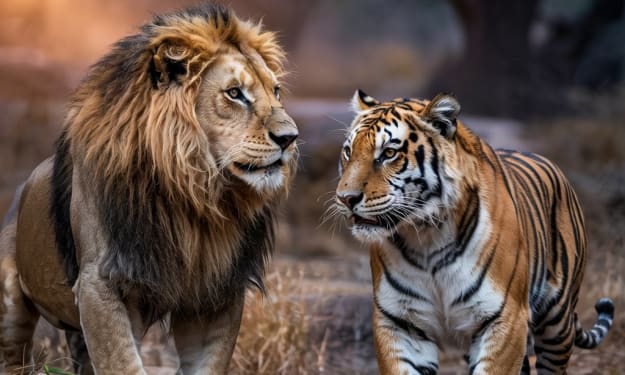
In the heart of a vast and untamed jungle, two mighty creatures ruled with unchallenged power. The lion, known as King Zafir, was the undisputed ruler of the savanna. His golden mane shimmered like the sun itself, and his roar echoed through the land, making the animals tremble. He was wise and strong, a symbol of leadership, and his reign had brought peace to the savanna for many years.
By saqiab khan10 months ago in Fiction
Icarus and Daedalus
The Price of Overweening Pride In the labyrinthine myths of ancient Greece, there is one story that still soars high in human imagination — only to fall, burning, into the deep abyss of human folly. It is the story of Icarus and his father Daedalus, a tale about pride unchecked and daring escapes. It reminds us that flying too close to the sun — literally or metaphorically — often leads not to glory but to destruction. Daedalus was a master craftsman, renowned across the ancient world for his brilliant mind and unmatched skill. His inventions were so ingenious that kings and gods alike sought his aid. However, genius frequently coexists with difficulty. Tasked with building the infamous labyrinth for King Minos of Crete, Daedalus designed a maze so complex that no one, not even its creator, could escape it without help. Icarus, Daedalus' young son, was the victims of fate, however. After assisting Theseus in slaying the Minotaur and escaping the labyrinth, Daedalus and Icarus themselves were imprisoned atop a high tower by King Minos, who feared that they might reveal the secret of the maze. In that moment of despair, Daedalus realized that walls and chains could not bind the spirit of invention. If the earth and sea were guarded, the sky remained free. From feathers and wax, Daedalus fashioned two pairs of wings — one for himself, and one for his beloved son. Before they took flight, he gave Icarus a stern warning: “Do not fly too low, or the sea’s dampness will clog your wings. Avoid flying too high because the wax will be melted by the sun's heat. Keep your course in the middle. At first, Icarus obeyed. They soared above the endless blue, tasting freedom like never before. The boy's heart filled with wonder as he felt the winds lift him ever higher. But wonder soon turned to exhilaration, and exhilaration to arrogance. Icarus began to believe he was not merely escaping; he was mastering the very forces of nature. The sun, brilliant and golden, seemed to call out to him — not as a warning, but as an invitation. Blinded by pride, Icarus forgot his father's words. He flapped harder, climbing higher and higher into the sky, chasing the sun as if he were a god himself. The wax binding his wings softened under the scorching heat. One feather, then another, loosened and drifted away. In moments, his marvelous wings disintegrated. Icarus plummeted from the heavens, his cries lost in the wind, and was swallowed by the dark waves of the Aegean Sea. Daedalus, heartbroken and helpless, mourned his son’s fall — a fall not merely from the sky, but from the human limits that pride had made him forget. The Eternal Lesson: The Middle Path The story of Icarus is more than an ancient tragedy; it is a timeless lesson about the danger of excess pride — what the Greeks called “hubris.” Icarus was not punished for desiring freedom. He was punished because he overestimated his own power and underestimated the natural laws that governed him. In his pride, he thought himself immune to consequences. Daedalus’s warning to follow the middle path is wisdom that resonates even today. Extremes frequently result in failure, whether in ambition, relationships, career, or personal goals. Flying too low, filled with fear, prevents growth. Flying too high, blinded by arrogance, invites disaster. The true art of living lies in balance — in soaring high enough to achieve greatness, but humble enough to know one’s limits. Modern Echoes of an Ancient Fall In today’s world, the myth of Icarus finds new relevance. We live in an age that glorifies reaching for the stars, breaking limits, and chasing personal glory at all costs. Social media rewards risk-takers and iconoclasts, often turning a blind eye to caution. But every year, we see countless modern Icaruses — celebrities, entrepreneurs, influencers — who, intoxicated by fame or success, forget their roots and fall spectacularly. Excessive pride can manifest subtly: ignoring advice, dismissing mentors, believing oneself invincible. We may believe that we are on our way to the sun, just like Icarus did. Yet pride weakens the wings we so painstakingly build. And when those wings fail, the fall is sudden, merciless, and irreversible. Humility: The True Strength True greatness is knowing when to respect the sun's heat rather than defying it. Humility is not weakness; it is the wisdom to recognize that no matter how high we soar, we remain human. We have limits. We are bound by nature, by society, by the consequences of our actions. Icarus’s dream was beautiful — but untempered by humility, it became his doom. His story might have ended in a different way if he had balanced his exuberant spirit with grounded wisdom. In the End The myth of Icarus and Daedalus teaches us that ambition is necessary, but arrogance is fatal. It teaches us that life is a careful dance between ambition and restraint, not a straight line to glory. We will always be tempted higher by the sun's rays. But ultimately, our journey is sustained by the wisdom of the middle path rather than the careless flight toward glory. Let us soar, but let us soar wisely.
By SilentWings10 months ago in Fiction