
Summer, '69
Imagine a world run by Amazon, in which climate change continued unabated and the pandemic never ended. Not nice, is it?
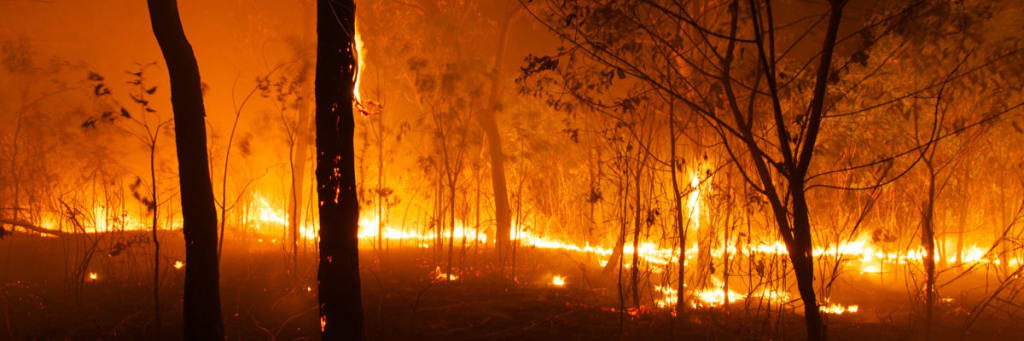
It was December, so the hills were on fire.
Colomatta they were called once, those mountains that rose up from the plain. Myle had been told of eucalypt cathedrals, piled high into air so blue it seemed suffused with the very spirit of the gods. But fallen now, and swept away as ash they were remembered only as the hollows and ridges of some great buried monster, grown over with thin, greedy shrubs that spread out from half-yearly burnings, constant as a tide. While a scorched concrete wall kept the flames at bay the smoke spread up, and out, until all the air was a haze and the tendrils that were sucked inside the coach crept under the corners of Myle’s mask, burning his lungs with each breath. As he rattled through the Belt – crushed between the glittering towers standing sentry on the bay and the long, low barns of corrugated iron that stretched out into the firebreak, humming with machines – the night sky was a tie-dyed mass. Garish purples, greens and blues spilled out of floodlights at the tops of the towers that reared over, rising like chemical candles above the squat, blank tenements that lined the street. Though it was midnight the air baked, and most windows hung open, shrill voices tumbling out from television sets and radios. And the coughing, the spluttering, the heaving and the hacking. That was there too, and it never went away.
*
“Never take the break. Don’t you know that?”
Willson had given half a tired smile, then slouched and clasped his hands tighter around the side of his mug. He was a large man, twenty years Myle’s senior, and his fingers swaddled it entirely in great scabs with fine red lines of tenderness running through them like veins. He had been to tech., it was said, back when such a thing existed, and was duly recognised with sole managerial post in the facility. Slumped in a halogen box with streaked concrete on either side, he tracked the packers’ progress on an ancient computer. When the green slope representing completions fell below the red, dashed path of projected net efficiency, it was his job to find the face behind the number, call them in, and replace them as soon as possible.
It was Myle this time who had been shirking.
His bi-yearly break had come around, and over the seventy-two allotted hours the skin on his fingertips had partially healed and softened, meaning that when he returned to the line that morning the tape they used to seal the boxes had torn them anew. He had worked as blindly as he could until finally, in his eleventh hour, he had stopped and let the boxes whip by unfinished while he scrabbled on the floor for some cloth, paper, or plastic wrap; anything to stop the bleeding. There were pale flashes as packers further down the line had glanced his way, faces shining briefly in the harsh strip that tracked the conveyor belt snaking through kilometres of massed, shadowed shelving on either side. He had bounded back up, fingers roughly wrapped in packing tape, and bent back to work. But it had made him clumsy. It had made him slow. Two hours later, with three to go before his release, the light at his station flashed red and an electronic voice blared at him to report to the office.
Willson spared him few words, grimacing as he motioned Myle through the dark rectangle in the wall, where streamed a dull, low throb from the bowels of the warehouse.
“But only four more years to go! For me, that is…”
He had shook his head and cut off the sound of the conveyors with a snap, this boulder of a man who spoke with cautious optimism of the day that he, too, would start coughing and die. He pulled a tissue out of the box on his desk and rubbed half-heartedly at the crimson smear where the younger man’s hands had been resting. But there was no use. It had dried. It would stay there with the others.
*
It was a twenty-minute walk from the terminus to his room, and by the time the door clicked shut Myle’s sweat had dislodged the tape on his fingers and blood was streaming out once more. He swore, switched on the lamp and rummaged under the stained mattress humped up against the wall, drawing out the wad of plasters that had cost a third of last month’s pay. His life – four mouldy walls, a door with a broken, scarred lock, the cushion on the floor and stool sill set from breakfast, eighteen hours earlier – was lit wholly by the glow of a single bulb he could now scarcely afford to keep running. The few crumbs of credit he had would buy food for four days, perhaps six. A week, maybe, of water, and double that of board. Scarch – the hulking cleaner who moonlighted as security – would have to be paid all the way through. His meagre possessions still had a value here, though an empty room was better than a bed on the street.
In the dark he thought of this mother, and the stories she had told him as they picked in his earliest memories through the foothills now swept with flame. Her locket hung, still, on a nail in the wall; a silly, heart-shaped thing, meant for little girls. It was no good for living, so no good for selling. He kept it only because it had always been there.
A packer too, she was born in the second decade of the new millennium, and spoke of a childhood framed by the very first strains of the world she left as his bequest. She was seven when the fires first reached the city, roaring over the mountains. The first smoke, the first masks, the first blood-red dawn, and then the virus that pushed into every corner of the globe. She lost her grandparents in that first frenzied year, bound up in ventilators and piles of plastic tubing. She told of the race for ‘normality’, how, as the waves rose and fell through all the years of her schooling, swallowing up the old, the sick, and those who could not pay, the world of her birth was won, decisively, by those technicolour towers standing guard on the water.
A vaccine, at first, was given to all, but when the virus morphed and swung back with new fury production could not be sustained, and a bargain was struck. Those that could surrendered a foothold amongst the workers, and received in return a view outward to the sea, their perch reinforced by annual shots now required just for a handful. After her own parents succumbed she had been amongst the riots, the seething mass of fear and anger that burned a shipment of twelfth generation vaccine, crying that a cure for the few was no cure at all. But the terminal age continued to fall, to fifty, and lost productivity was clawed back with a doubled working day. ‘Rounds’, they called them. Beaten down, eventually, by hunger, she stooped to play her part until monthly food packets and the eight hour break between rounds drove out all her memories of what had come before. She died on cue, seven years after she first awoke to the taste of ash, lungs heaving in this room at the ankles of the city. Lacks had taken care of the arrangements, as was routine, and provided the forty-eight hours’ due dispensation before summoning him back to the line.
Now, Myle stilled his angry stomach with practiced ease. He switched off the lamp and fell, springs squealing, to the mattress, feeling the dampness and grit against his back. He breathed. Smoke trickled down the back of his nose, and settled on his lungs. The groans and the splutters wore on in the night.
*
A girl ran up a mountain. Her strong brown legs churned the dust at her feet, and a locket, shaped like a heart and painted ruby red, bounced against her throat. Blackened stumps of trees stood on either side of the path like blasted pillars, with tender, young leaves sprouting from gaps in their bark. The sun was falling down the sky, and its last rays stained everything a hazy, glowing gold.
She called back to her parents, labouring behind: “You said you wanted to get to the top before it got dark!”
She could never understand why her father would say one thing, and then do the other.
They talked as they walked, her words bubbling like a stream. The greenhouse effect, something she had learned about at school, that was making the ice caps melt and meant that polar bears had nowhere to live. Her father nodded, motioning to the stumps and ground burned to a dead, grey hue. “Remember when all this was on fire?” Grandma and grandpa had had to come and stay, driven by the flames that lapped at their fence. She remembered their thin, grey bodies huddled together on the couch, with sirens outside shooting past like demons. The crunch of dead grass underfoot, and the hot dry wind that came bursting down the street and pulsed against her, stinging her eyes until she pulled them closed against the smoke. The roar.
They had watched the funeral on a video link, stuck at home for the better half of the first year she was meant to spend at school. Just the priest in his smooth white dress, the coffins and a camera were allowed, in the chapel with the big window at the back where green leaves trembled. Her father looked distant whenever he said their names.
The three long shadows stretched into the path ahead, and the bush was awash with cicadas’ reedy call. She was going to be a doctor, she had decided. She was good at maths and her parents said she was smart enough. They seemed nice, like they did something good and important. They had been all over the TV for the last couple of years; talking heads with glasses, grey hair and kind eyes, speaking in calm, soft tones about when she would finally be allowed to go back to school. Next year, they said, after Christmas, they hoped. They always hoped.
*
A klaxon shriek crashed through his dreams and Myle awoke, panting, in a puddle of sweat. Weak brown sunlight lay in a puddle on the floor, and the boards outside clattered with workers rushing for coaches to the periphery. Though the smoke would lift overnight, as cooler air came in from the sea and forced its way under, thick pockets remained. Stagnant, they sat suspended like grey columns on the air.
His communicator was barking; Lacks, standard issue. A battered red cube that sat on the floor, promulgating changes in the timing of rounds and the narrow breaks between. Willson’s weary voice, nasally flattened by a bad signal, crackled out:
“2368. Myle, was it? You are reinstated with immediate effect following unanticipated workforce depletion. Station 3B, Baxter facility. Round commencing at 0900.”
A blue light winked next to the speaker, illuminating expectantly the button that, so pressed, signalled receipt and acquiescence. Myle had thirty seconds, but he needed only three.
He rolled, crashing onto the floor, and slammed it down. A wave of relief flooded through him, staying momentarily his body’s scream for rest. His fingers stung and pain ripped through his back as he scrambled for his boots. He would not stop this time, no matter the blood. The light blinked once more, and then fell dark. An LED flashed on the front of the communicator: 0614. He still had time.
Myle pulled on his mask and joined the throng of unwashed bodies elbowing their way out onto the street. The air burned and the low summer sky was the colour of rust. Only twenty four years to go.
About the Creator
Keep reading
More stories from writers in Fiction and other communities.
Miss Persephone's Manual to a Seemingly Ordinary Life
Miss Persephone was found at the dining table, her blue eyes swollen, her tears arriving and retreating like the tides of the ocean. Earlier that day, her family had visited her in the retirement home where she had lived for eight years. It was her eightieth birthday.
By Imola Tóth2 days ago in Fiction
How I Met My Soulmate 🌸🌸
How I Met My Soulmate Harsh Chaudhari © Harsh Chaudhari Copyright © 2025 by Harsh Chaudhari. All rights reserved. No part of this publication may be reproduced, stored in a retrieval system, or transmitted in any form or by any means — electronic, mechanical, photocopying, recording, or otherwise — without prior written permission from the author, except for brief quotations used in reviews or critical articles.
By Harsh Chaudhari 🌸4 days ago in Fiction
Silver Screen Magic with Mae West
American actress and singer Mae West became a popular film actress during the Great Depression. She started entertaining in vaudeville, then performed on Broadway, and finally went to Hollywood. She signed up with Paramount Pictures and made her debut in the 1932 film “Night After Night.” She also starred in musicals, comedies, and crime dramas. The American Film Institute named her one of the best classic Hollywood actresses.
By Rasma Raisters4 days ago in Geeks


Comments
There are no comments for this story
Be the first to respond and start the conversation.