
Saturn
Saturn, the sixth planet from the Sun, stands as one of the most captivating objects in our solar system. Known for its extensive and stunning ring system, Saturn has fascinated astronomers for centuries.

Saturn
The Giant’s Composition and Structure
Saturn is a gas giant, composed primarily of hydrogen and helium, much like Jupiter, its larger neighbor. However, Saturn is less dense, with an average density lower than water, meaning it would float if placed in a sufficiently large body of water. The planet's diameter is about 120,500 kilometers (74,900 miles), nearly 9.5 times that of Earth, and it has a mass 95 times greater than Earth.
The planet’s atmosphere is divided into bands of clouds, similar to Jupiter’s, though less colorful. These bands consist of ammonia ice, water ice, and other elements, creating the yellowish-brown appearance often associated with Saturn. Beneath these clouds, the planet likely has a core composed of rock and metal, surrounded by layers of metallic hydrogen, a unique state of hydrogen that behaves like a liquid metal due to the intense pressure.
The Rings:

Saturn’s rings are undoubtedly its most distinctive feature. While other gas giants like Jupiter, Uranus, and Neptune also have ring systems, none are as prominent or complex as Saturn's. The rings extend up to 282,000 kilometers (175,000 miles) from the planet but are incredibly thin, with a thickness of about 10 meters (30 feet) in most places.
The rings are composed mainly of ice particles, ranging in size from tiny grains to massive boulders. These particles are thought to be remnants of comets, asteroids, or even moons that were shattered by Saturn’s powerful gravity. The rings are divided into seven main sections, labeled A through G, with the A, B, and C rings being the most prominent. The Cassini Division, a dark gap within the rings, separates the A and B rings and is one of the most recognizable features within the ring system.
Cassini Mission:

One of the most significant missions to study Saturn was NASA’s Cassini spacecraft, which orbited the planet from 2004 until its mission ended in 2017. Cassini provided a wealth of information, transforming our understanding of Saturn, its rings, and its moons.
Among the mission’s most notable discoveries was the detailed study of the rings. Cassini revealed that the rings are much younger than Saturn itself, possibly only 100 million years old, which is relatively recent in the solar system’s history. The spacecraft also detected complex interactions between the rings and Saturn’s moons, including the creation of propeller-shaped gaps by small moonlets within the rings.
Cassini also provided insights into Saturn’s atmosphere, including the discovery of massive storms, such as the Great White Spot, a periodic storm that appears roughly every 30 years. The spacecraft’s observations revealed the intricate details of Saturn’s magnetic field and how it interacts with the solar wind.
Saturn
Saturn’s Moons:
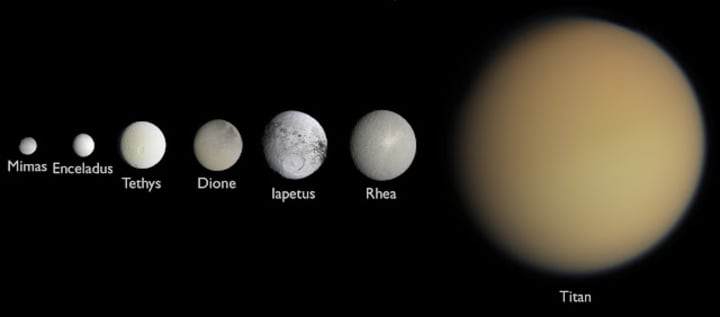
Saturn is home to 146 known moons, ranging from tiny moonlets embedded in the rings to large moons with their own complex geology. The most significant of these moons include Titan, Enceladus, Rhea, Iapetus, and Dione.
Titan
is Saturn’s largest moon and the second-largest in the solar system, even bigger than the planet Mercury. Titan is unique due to its thick atmosphere, primarily composed of nitrogen, with traces of methane and hydrogen. The Huygens probe, carried by the Cassini spacecraft, landed on Titan in 2005, revealing a landscape eerily similar to Earth’s, with rivers, lakes, and seas of liquid methane and ethane. Titan’s surface temperature is a frigid -179 degrees Celsius (-290 degrees Fahrenheit), yet its complex chemistry and the presence of liquid hydrocarbons make it a subject of great interest in the search for extraterrestrial life.
Enceladus
is another of Saturn’s moons that has captivated scientists. Despite its small size, Enceladus has a global ocean beneath its icy crust, as evidenced by the plumes of water vapor and ice particles that erupt from its south polar region. These plumes, first observed by Cassini, contain organic compounds, making Enceladus one of the prime candidates in the search for life beyond Earth.
Other moons like Rhea, Iapetus, and Dione also have unique characteristics. Rhea is known for its heavily cratered surface, Iapetus for its striking two-tone coloration, and Dione for its wispy terrain formed by ice cliffs. Read more :
About the Creator
Galaxiesbuzz
Welcome to Galaxiesbuzz your one-stop destination for exploring the wonders of space, staying healthy, discovering new travel destinations, and staying informed with the latest knowledge. Our blog offers everything for everyone
Keep reading
More stories from Galaxiesbuzz and writers in Fiction and other communities.
Dragonfly Mission to Titan
NASA's Dragonfly mission to Titan represents an ambitious leap in planetary exploration, promising groundbreaking discoveries about one of the most intriguing moons in our solar system. Set to launch in 2027, Dragonfly will journey to Titan, Saturn’s largest moon, and is expected to arrive by 2034. This innovative mission aims to explore Titan’s surface and atmosphere using a rotorcraft, marking the first time such technology has been deployed on another planetary body.
By Galaxiesbuzz2 years ago in Fiction
Lightning Never Strikes Twice
The distant rumble, the sudden deluge, the crescendo of sound, the flash of light, the explosive energy — it never gets old. I became an amateur storm chaser about two years ago. My wife, Cindy suggested it. Sort of. She said, "Alex, you know this cancer is killing me. I've come to terms with that, but you're smothering me. Go join a band, write a book, or become a storm chaser, for all I care. I love you, but you need a hobby."
By Julie Lacksonen4 days ago in Fiction
The 30 Percent Armor
My bathroom is a minefield I know by heart. Every tile under my bare feet has its own temperature, every bottle on the shelf its own weight and texture. This is my sanctuary, my little staging ground for practicing “normal” before I step out and put on the mask I’ve spent years carving. This morning is particularly rough. The fog in my left eye—the one that checked out years ago, a late-coming bill from a war injury that finally came due—has started bleeding into the right. A recent ablation did its job, but it left the world looking like a water-damaged oil painting. I see about thirty percent of reality. The other seventy? I fill that in with memory, gut instinct, and pure, raw spite.
By Feliks Karić3 days ago in Fiction
Review of 'Man on the Run'
My wife and I saw Man on the Run, a nearly 2-hour documentary on Amazon Prime, about Wings, Paul McCartney's group that flew around the world from shortly after The Beatles broke up in early 1970 to shortly after John Lennon was murdered at the end of 1980, making a Beatles reunion forever impossible.
By Paul Levinson4 days ago in Beat




Comments
There are no comments for this story
Be the first to respond and start the conversation.