
The 30 Percent Armor
In a world that only respects strength, a man fights his hardest battle behind a designer mask and therapist's smile.

My bathroom is a minefield I know by heart. Every tile under my bare feet has its own temperature, every bottle on the shelf its own weight and texture. This is my sanctuary, my little staging ground for practicing “normal” before I step out and put on the mask I’ve spent years carving. This morning is particularly rough. The fog in my left eye—the one that checked out years ago, a late-coming bill from a war injury that finally came due—has started bleeding into the right. A recent ablation did its job, but it left the world looking like a water-damaged oil painting. I see about thirty percent of reality. The other seventy? I fill that in with memory, gut instinct, and pure, raw spite.
But before I step out, there’s the hardest part. A ritual that would look like a nervous breakdown to an outsider, but to me, it’s a survivalist’s drill. I’ve crossed the line into my fifties, and my body has started betraying my aesthetics in the most insulting ways: hair. It grows where it has no business being—in my ears, my nostrils, in that furrow between my eyebrows that makes me look like I’m perpetually pissed off. I reach for the tweezers. They’re my primary weapon, and my fingertips are my only honest allies.
Since I can’t see that thin, silver wire sticking out of my ear in the mirror, I have to find it by touch. I run the pad of my left index finger along the rim of my ear until I feel that tiny, prickly needle. Once I lock onto it, I fish for it blindly with the tweezers. Sometimes I pinch the skin. It hurts like hell, a sharp jolt that brings a tear to the little bit of good eye I have left, but I don’t quit. Then comes the trimmer. It buzzes against my skull as I clear out the nose and level the brows. That sound tells me I’m still in the game. You see, a neglected man my age is invisible. But a man who’s losing his sight and lets himself go? He’s a charity case. I won’t have it.
My clothes are my declaration of independence. I don’t do the “dad” uniform—khakis and regret. I go for the avant-garde, the trendy stuff, asymmetric cuts and textures I can feel under my palms. If I’m going to walk through a fog, I’m going to do it looking like someone you can’t help but notice. I want people to see an impeccably groomed man, someone with perfectly trimmed brows and a style that screams confidence. I want them to wonder, “How does he pull that off?” That’s my tiny victory over the seventy percent of darkness.
They knew, of course. In the small circles I move in, the news of my surgeries and the old war wounds circulated like stale air. But knowing a fact and seeing the truth are two different things. My appearance—the sharp shirt, the clean beard, the firm handshake—was so at odds with the “disabled” label that people subconsciously chose to believe my facade over my medical charts. Marko was the ringleader of that crowd. To him, my condition was just a bad acting project, a way to grift for benefits I didn't “look” like I needed. After all, how could someone who looks this put-together be that close to the void?
I grab the bottle of Terre d’Hermès. That scent of earth and orange is my signature, my armor. When I get dressed, when I feel the weight of my watch on my wrist, I stop being a patient. I become the therapist who used to piece together broken minds in a psych ward, the soldier who defended his home, the man with scars nobody is allowed to see. Finally, I slide on the tinted shades. They aren’t a fashion statement, though they look like one. They’re a screen for my left eye—which looks like a collapsed, hollowed-out socket—and the right one, which is perpetually bloodshot from the aggressive treatments.
“Dad, are you ready?” my daughter shouts. She’s fourteen. I try to stay her hero, even though every time she hands me a cup of coffee, I’m silently praying to God that my fingers don't miss her hand.
“Ready, honey. Let’s go," I say in my stable, “therapist” voice. The one that commands the room.
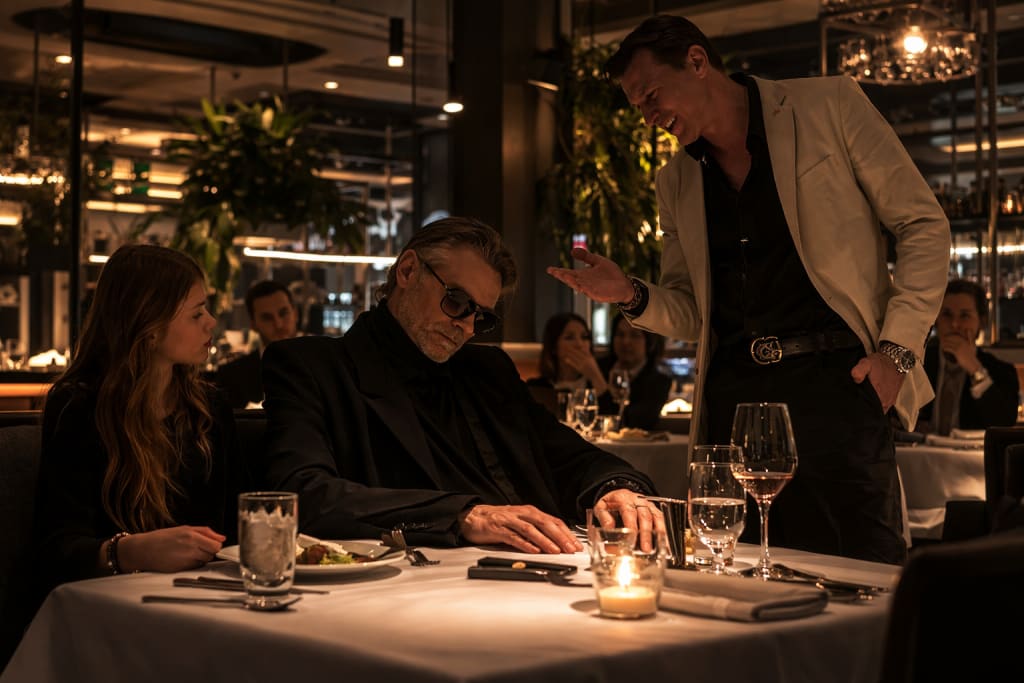
Saturday is our day. We head to this upscale spot downtown—all white tablecloths and dim lighting. As we walk, I hold her arm. To people passing by, it looks like a tender father-daughter moment. To me, it’s the only way I don't trip over a curb or walk into a mailbox. She’s my silent navigator through a city I’m slowly losing. We walk in, and the waiter recognizes us. He bows the way he bows to regulars who bring the scent of money and decisiveness.
I sit up straight, dominating the table in my avant-garde shirt. We talk about her school, while underneath the table, I’m white-knuckling a napkin because I can’t quite judge how far the water glass is from my elbow. Then, I feel it. That old knot in my stomach. My empathy, sharpened to a razor’s edge by my other lost senses, picks up a voice three tables over. It’s Marko.
“Look at him,” his half-whisper carries, intentionally loud. "Perfect hair, fancy clothes, and he’s out here whining for a pension. Look at him use that fork—guy’s a damn sniper. It’s a total act. He’s the ultimate con artist."
The restaurant goes quiet. Everyone hears it, but everyone pretends they don't. It’s that collective, unwritten agreement to keep things “normal.” Marko stands up. I hear the scrape of his chair. He approaches our table, smelling like envy and cheap tobacco.
“Oh, hey, it’s our resident therapist," he says, leaning on the edge of our table. “How are the eyes, legend? Picking out the best cuts of steak, I see. Not bad for a guy who can barely move, huh?"
My daughter freezes. I feel her breath hitch. I put my silverware down, slow and deliberate. Likewise, I stand up, squaring my shoulders, pulling myself to my full height. Without a word, I reach up and take off my sunglasses.
I look him dead in the face with what’s left of my sight. My left eye—that war souvenir, that sunken, empty dupe—and my right, red and clouded, meet his gaze. Marko flinches. I see it, in my thirty percent of vision, his face contorts. He sees what nobody was supposed to see: the wounded soldier behind the trendy facade.
And then, the bizarre defense of “normalcy” kicks in. Marko doesn’t run, and he doesn’t apologize. Instead, he adjusts his shirt, swallows hard, and says:
“Yeah, well… the sun’s really bright today. Hits you right in the head. That’s probably why your eyes are so red. AC and fatigue, I guess.”
I smile. It’s my therapist smile—empty and perfect.
“You’re right, Marko. The AC in these places is merciless on sensitive people. Have you been sleeping more, or is that chronic restlessness still eating at you? You look tired.”
“Yeah, yeah… I’ll work on that," he mumbles, retreating back into the safety of his own lie.
I slide my glasses back on and sit down. My daughter looks at me. She saw my handshake, saw the horror I just bared to the room, but she just calmly said:
“Dad, I think you got a little something on your shirt. You should be careful, that’s your favorite one.”
There was no stain. I knew there wasn't because I’d checked it by touch three times. But that was our deal. She didn't ask me if I was going blind, and I didn't tell her that her face is becoming nothing more than a shadowy outline to me. Instead, I took the cloth and theatrically wiped the invisible spot.
“Thanks, baby. I really need to pay more attention to the details.”
We went back to eating. Around us, the chatter of the restaurant drifted back up. People laughed, wine was poured, and nobody mentioned the man with the ruined eyes. Normalcy had won again. We sat there, avant-garde and perfectly groomed, while outside the sun kept shining for everyone who could still see it. I’m still the therapist, the father, the veteran, and the dandy. But under this flawless shirt, I’m a man screaming in the dark, terrified of the silence that’s coming. My vanity is my shield, and lying is our shared language. And as long as that shield holds, I’ve won—at least until tomorrow morning’s shave in the dark.
Author’s Note: This story is deeply rooted in my personal journey as a war veteran living with significant vision loss. While some elements have been dramatized for the purpose of the challenge, the emotions, the struggle for dignity, and the mask I wear are very much my reality.
About the Creator
Feliks Karić
50+, still refusing to grow up. I write daily, record music no one listens to, and loiter on film sets. I cook & train like a pro, yet my belly remains a loyal fan. Seen a lot, learned little, just a kid with older knees and no plan.
Keep reading
More stories from Feliks Karić and writers in Fiction and other communities.
The Friday Ritual
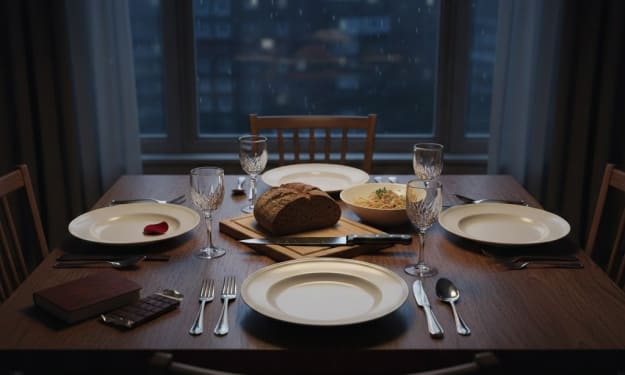
The routine was a loop, the same silent ceremony every Friday at 7:00 PM sharp. It had been going on for three long years. Marko would stand at the heavy oak table, his shoulders tight, and begin to slice the sourdough. Skritch. Skritch. The sound of the blade biting through the hard crust was the only clock that ticked in that house. He cut each slice with the focus of a surgeon, terrified that if a single crumb fell outside some imaginary line on the dark wood, the fragile peace he’d spent years building would just snap.
By Feliks Karić17 days ago in Fiction
Veil of Subconscious Awakening
Images slide behind my eyelids like film cadres, bursting with meanings. In one moment, I’m speeding down the highway, making the speedometer swing wildly like a frantic pendulum. The next moment, I’m plunging from a falling plane, slowly crashing earthward. At home, I meet black cat’s green, googly eyes staring at me from the cavernous hollowness of the kitchen. When I turn for a moment, it disappears, and all I can see is a pair of blue suede shoes set up against the wall. I pick them up and put them on. When I glimpse at them again, they’ve become black as night, making me blink and flinch.
By Moon Desert7 days ago in Fiction
THE ENDING OF AN ERA AND THE BEGINNING OF A NEW ONE
The gentle beacon that had begun to shine for myself could now illuminate a path shared with others, a constellation of women embarking on their own unique journeys, hand-in-hand, or perhaps, side-by-side, ready to explore the vast, uncharted territories of their own lives. The quiet was still there, but it was no longer an emptiness; it was the soft hum of possibility, a prelude to a grand, unfolding symphony.
By Vera Myles5 days ago in Fiction



Comments
There are no comments for this story
Be the first to respond and start the conversation.