
Dragonfly Mission to Titan
Dragonfly mission to Titan represents an ambitious leap in planetary exploration, promising groundbreaking discoveries.


NASA's Dragonfly mission to Titan represents an ambitious leap in planetary exploration, promising groundbreaking discoveries about one of the most intriguing moons in our solar system. Set to launch in 2027, Dragonfly will journey to Titan, Saturn’s largest moon, and is expected to arrive by 2034. This innovative mission aims to explore Titan’s surface and atmosphere using a rotorcraft, marking the first time such technology has been deployed on another planetary body.
Dragonfly Mission to Titan
Mission Overview and Objectives
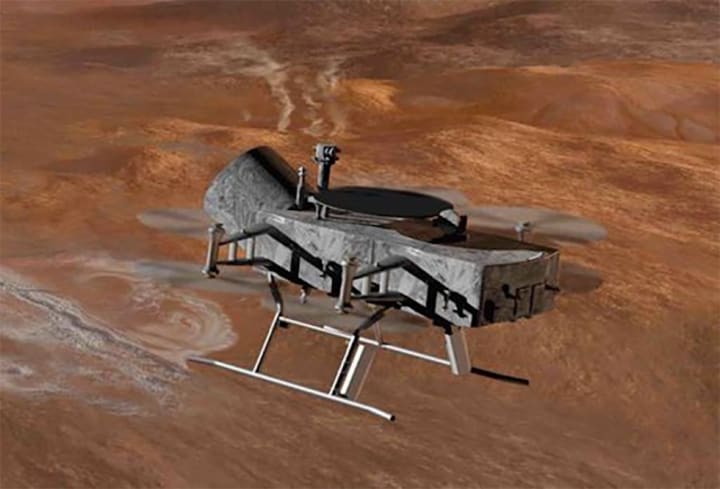
Dragonfly will land on Titan and conduct a series of flights to various locations, utilizing its unique rotorcraft capabilities. The primary goals of the mission include studying Titan’s prebiotic chemistry, assessing its habitability, and searching for signs of past or present life. Titan is of particular interest due to its dense atmosphere and the presence of liquid methane and ethane on its surface, which create conditions analogous to those on early Earth. The mission will investigate the moon’s organic compounds and chemical processes that could provide insights into the origins of life on Earth.
Innovative Technology and Design

The Dragonfly rotorcraft is designed to operate in Titan’s thick atmosphere, which is four times denser than Earth’s, making flight easier despite the lower gravity. This drone-like spacecraft will be powered by a Multi-Mission Radioisotope Thermoelectric Generator (MMRTG), similar to the power sources used by the Mars rovers. This power source will enable Dragonfly to perform long-duration flights and extensive scientific observations.
Dragonfly will carry a suite of scientific instruments, including mass spectrometers, gamma-ray spectrometers, and meteorology sensors, to analyze the chemical composition of Titan’s surface and atmosphere. Additionally, a seismometer will be used to detect Titan quakes, which can provide valuable data on the moon’s internal structure. The rotorcraft’s mobility will allow it to cover over 175 kilometers during its mission, far surpassing the distance traveled by all Mars rovers combined.
About the Creator
Galaxiesbuzz
Welcome to Galaxiesbuzz your one-stop destination for exploring the wonders of space, staying healthy, discovering new travel destinations, and staying informed with the latest knowledge. Our blog offers everything for everyone
Keep reading
More stories from Galaxiesbuzz and writers in Fiction and other communities.
The Artemis Moon Mission Humanity Return to the Lunar Surface
In the annals of space exploration, the Apollo missions hold a storied place, marking humanity's first steps on the Moon. Over half a century later, NASA's Artemis program aims to reignite that spirit of exploration and push the boundaries even further. Named after the twin sister of Apollo in Greek mythology, Artemis symbolizes a new era of lunar exploration with ambitious goals that extend beyond simply returning to the Moon.
By Galaxiesbuzz2 years ago in Fiction
The Last Message You Never Sent
At 11:47 p.m., my phone buzzed. I remember the time because I was staring at the clock when it happened, lying on my bed with the lights off, listening to the quiet hum of the ceiling fan. The room smelled faintly of rain drifting in through the open window.
By Ihsanullah3 days ago in Fiction



Comments
There are no comments for this story
Be the first to respond and start the conversation.