
Sapne Bade Hain Par Kahan Milega Itna Bada
Jahan Iraade Mazboot Hain, Wahan Raaste Khud Ban Jaate Hain

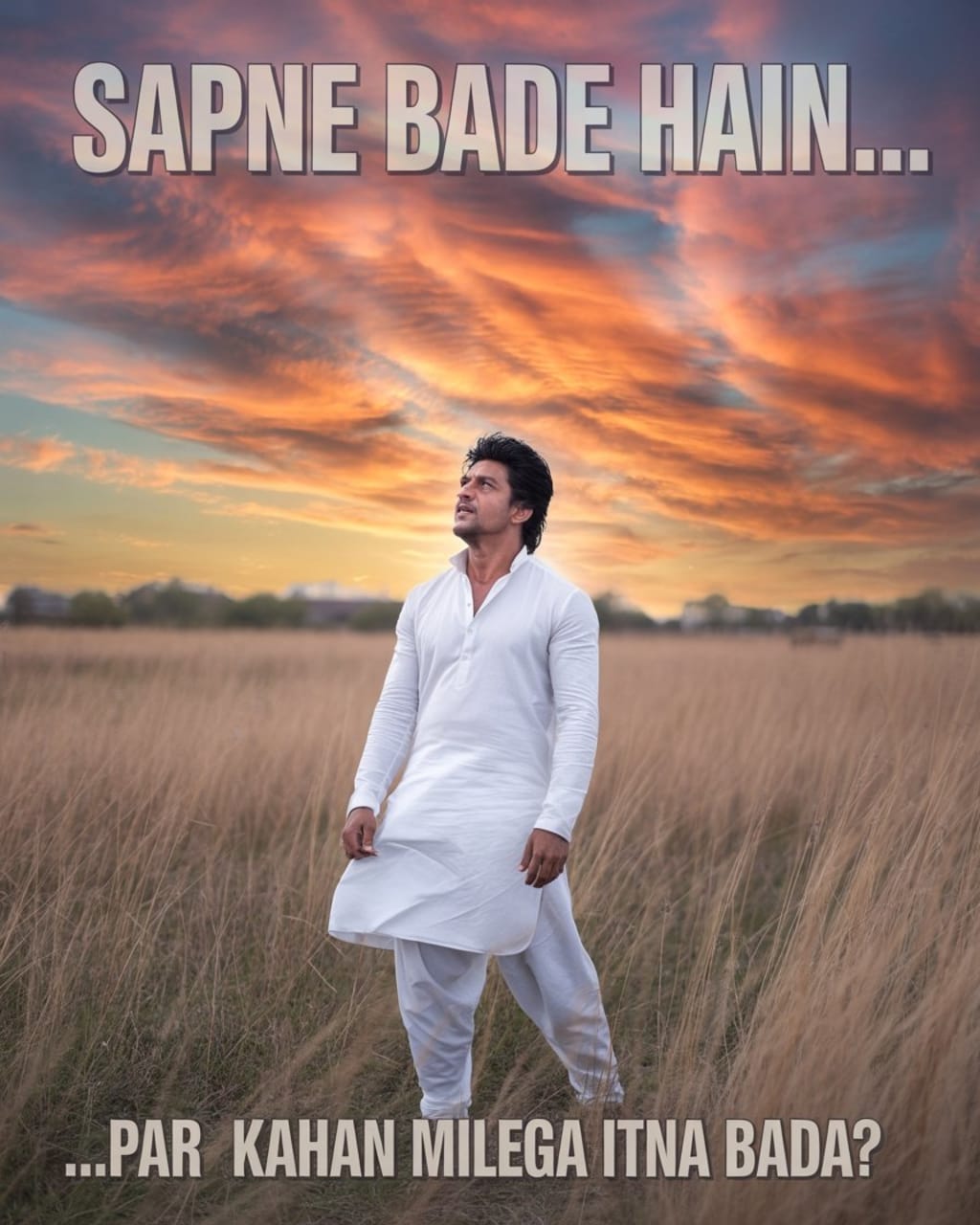
In the small, dusty town of Bhairoganj, nestled between barren hills and forgotten railway tracks, lived a boy named Aman. He wasn’t born into privilege or fortune. His father ran a tiny tea stall near the bus stand, and his mother stitched clothes from home. Their world was modest, sometimes hard, but full of quiet love and unspoken sacrifices.
What set Aman apart, however, were his dreams—big, bold, and seemingly impossible.
At twelve, he told his father, “Main astronaut banunga.”
His father chuckled, “Beta, sapne bade hain... par khaan milega itna bada?”
Aman didn’t mind the laugh. He looked up at the sky, wide and infinite, and whispered, “Milega. Raasta khud banega.”
School was tough. The government school had more broken benches than books, and the science lab was a locked room no one dared enter. Still, Aman devoured whatever he could find—borrowed textbooks, old newspapers, even broken encyclopedias that the local librarian was about to throw away.
While other boys played cricket in the lanes, Aman scribbled equations in chalk on his courtyard floor, drawing diagrams of rockets and planets. He built a telescope using discarded lenses and pipes from the kabadiwala. At night, he'd climb the terrace and gaze at the stars for hours, dreaming of distant galaxies.
But dreaming wasn’t enough.
By the time he reached class 10, Aman's marks were top of the district. A local newspaper featured him with the headline: “Chaiwala Ka Beta Jo NASA Jaana Chahta Hai.”
For most, it was a heartwarming story. For Aman, it was only the beginning.
He earned a scholarship to a prestigious school in the city. The first day, he arrived in torn shoes and a shirt faded from too many washes. The city kids laughed. They called him "Gaon ka Scientist." But Aman didn't flinch. He remembered his mother’s words: “Beta, log kya kehte hain, usse sapne nahi rukte.”
He studied harder than ever, often skipping meals to afford the bus fare. On weekends, he cleaned tables at a café to buy secondhand books. At night, he studied under streetlights when power cuts hit the hostel.
Rejections came too—he failed his first IIT entrance attempt. Friends dropped out. Relatives whispered, “Itna bada sapna le kar kya karega yeh?” But Aman had fire in his belly and steel in his heart.
He tried again. And cracked it.
The day his name appeared in the IIT merit list, his father served free tea to every customer. Tears rolled down his mother’s cheeks as she folded his admission letter and placed it beside the family’s temple idol.
Four years later, Aman graduated as an aerospace engineer with distinction. He received an internship offer from the Indian Space Research Organisation (ISRO). At the farewell ceremony, his professors asked, “What kept you going when everything seemed against you?”
Aman smiled, “Because mere sapne bade the... aur iraade usse bhi bade.”
At ISRO, Aman worked tirelessly. He joined a team developing low-cost satellite propulsion systems for rural communication. His work caught international attention. Within two years, he was selected for a joint Indo-American research program on advanced space exploration.
When he finally visited NASA headquarters, standing before the massive structure he had only seen in library photos as a child, he closed his eyes and remembered the dusty lanes of Bhairoganj, the tea stall, the cracked telescope, and his father's laugh: “Khaan milega itna bada?”
He whispered to himself, “Yeh raha. Sapna bhi... aur raasta bhi.”
Years later, Aman returned to his hometown, not with pride, but with purpose. He started a foundation that provided scientific education in rural schools, opened digital libraries, and launched a mobile planetarium for underprivileged children.
Standing before a crowd of bright-eyed students, he told them:
“Bachpan mein log haste the jab maine kaha main NASA jaunga. Unhone kaha, ‘Sapne bade hain, par khaan milega itna bada?’ Main kehna chahta hoon—Jahan iraade mazboot hote hain, wahan raaste khud ban jaate hain. Toh sapne dekhna chhodo mat. Unhe itna bada banao ki duniya ko jhuk kar kehna pade—Haan, yeh mumkin hai.”
The crowd erupted in applause, but Aman’s eyes were fixed on one little boy in the front row, staring up at the sky with a spark of possibility in his eyes—the same way Aman once had.
Because dreams don’t ask where you’re from. They only ask how far you’re willing to go.
About the Creator
Miss Persephone's Manual to a Seemingly Ordinary Life
Miss Persephone was found at the dining table, her blue eyes swollen, her tears arriving and retreating like the tides of the ocean. Earlier that day, her family had visited her in the retirement home where she had lived for eight years. It was her eightieth birthday.
By Imola Tóth5 days ago in Fiction
Identity and the Exhaustion of Grand Ideas
Over the past few decades, intellectual life has been shaped by a growing distrust of ambitious theories that once claimed to explain history and society as a whole. The fading influence of the radical projects associated with the 1968 generation produced a more careful and restrained scholarly atmosphere. Many historians and social theorists became skeptical of large narratives and universal categories, preferring limited scope and methodological caution. In Germany, this shift took a distinctive form through the rise of microhistory, an approach that emphasizes close attention to sources, local contexts, and everyday life. Microhistorians sought to revive the craft of traditional historiography while distancing themselves from older positivist assumptions. Their work often challenges broad concepts such as capitalism, industrialization, and the state, treating them as abstractions that obscure rather than clarify lived experience.
By Gopal Balakrishnan8 days ago in Fiction
Smart phones, Humans and Aliens.
WARNING. I will be tapping into one of your favorite creative tensions: The absurdity of humans worshipping their glowing rectangles as if they were tiny oracles. There’s something deliciously poetic about that contradiction, and it lends itself beautifully to an instructive proviso.
By Novel Allen4 days ago in Poets


Comments
There are no comments for this story
Be the first to respond and start the conversation.