


When Clara inherited her grandmother’s house, it felt less like a gift and more like a responsibility. The estate was old, sprawling, and sagging under the weight of time. Its walls leaned inward like listening shoulders, its corridors were narrow veins through which only silence traveled. Every step she took echoed in a way that made her imagine the house remembering who had once walked there.
Clara had always known the house as a place of shadows and strictness. As a child, her visits were rare and short, marked by her grandmother’s clipped voice and cold tea served in bone china. Still, the place held a kind of mystery that fascinated her. She would slip away from the parlor, wander the upstairs hallway, and pause before the one door she was never allowed to open.
“That room is not for you, Clara,” her grandmother would warn. “It isn’t for anyone anymore.”
Her grandmother never explained further. And Clara, though curious, was young enough to obey—or at least pretend to. She’d stand with her small hands against the cold brass knob, her ear pressed to the wood, waiting for a sound from the other side. There was never anything: no shuffle of movement, no creak of boards, only the thick silence that made her imagination work harder.
Now, years later, her grandmother was gone. Clara had returned as the house’s sole occupant, its reluctant heir.
The Key
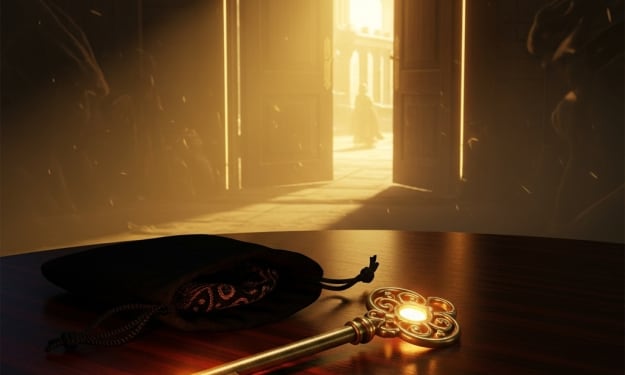
The discovery came on her third day of sorting through the old place. She was in the sewing room, where spools of faded thread sat like tiny suns in their boxes, when she opened a tin to find, beneath scraps of lace and a half-finished hem, a small key wrapped in yellowed tissue paper.
She knew immediately what it must open.
Clara carried the key down the hall, her heart tight with a mix of dread and childish anticipation. The door stood just as it always had—plain, painted white long ago, the paint cracked now like dry earth. The knob was tarnished, a dull brass that caught no light.
Her fingers trembled as she slid the key in. It resisted at first, reluctant after so many silent years. Then, with a groan that seemed almost pained, the lock gave way.
The door opened.
A rush of air met her, stale and heavy, as though the room had been holding its breath. Clara hesitated before stepping inside, and when she did, the floorboards protested with a deep, weary creak.
The Room That Time Kept
The room was small, almost modest, but everything in it had been preserved as if frozen mid-moment. A narrow bed stood against the wall, neatly made, its quilt faded but intact. Toys lined the shelves, their paint dulled and their faces expressionless with dust. A wooden train was halfway along its track. In the corner, a dollhouse with missing shingles hunched as though waiting for play that never came.
Clara’s eyes fell on a desk beneath the window. An open notebook lay there, its pages browned at the edges, the last line of handwriting interrupted, the ink blot like a breath cut short. She didn’t touch it—not yet.
What caught her most was the photograph hanging above the bed. It was of a boy, smiling with bright, mischievous eyes. She recognized him from the few family albums her mother had reluctantly shown her: Samuel, her mother’s younger brother.
He had died at nine years old.
Clara had never known the details. The subject was avoided, as though his memory was a fragile vase that might shatter if mentioned. Her grandmother had locked the door to his room and, in time, locked away the story too.
Ghosts of Silence
Clara sat carefully on the bed, the quilt soft and brittle beneath her hands. She let her gaze wander the room, absorbing the details: the neat stack of books, the pair of shoes tucked beneath the chair, the coat hanging on its peg. Everything spoke of a life interrupted, paused rather than ended.
She thought of her grandmother, how stern she had always seemed, how joyless. Perhaps it wasn’t strictness at all but grief hardened into discipline. The silence of the house had never been emptiness—it had been mourning, carefully contained.
As she sat, Clara almost expected the boy to appear, to fling himself onto the bed with the carefree laugh frozen in his photograph. But of course, no one came. The house breathed only dust.
Yet something stirred in Clara: a weight she hadn’t known she carried. It was as though the room itself was asking her to remember what others had chosen to forget.
The Notebook
Eventually, her curiosity drew her to the desk. She touched the notebook gingerly, afraid the paper might crumble. The handwriting was a child’s—awkward loops and uneven lines.
He had written about small things: a game he played, a bird he saw outside the window, a dream about flying. On the last page, the unfinished sentence read:
“Tomorrow I will—”
And then nothing.
Clara’s throat tightened. The abruptness felt louder than any words could have been. She closed the notebook gently, as though she were tucking him back to sleep.
The House at Night
That night, Clara found herself unable to leave the room entirely behind. The rest of the house seemed more silent than usual, its creaks sharper, its shadows longer. She tried to sleep in her own room but woke repeatedly, restless. At last, she wrapped herself in a shawl and walked back to the locked hallway.
The door to Samuel’s room was ajar.
She was certain she had closed it earlier.
Inside, the air was no longer stale but seemed fresher, lighter, as if the room had sighed. She stepped inside, drawn not by fear but by something gentler—a need to keep the space company, to honor it with presence.
She sat again on the bed. The moonlight poured in through the window, spilling silver across the quilt, the desk, the photograph. And for a moment, Clara felt less alone than she had since arriving.
Inheritance
The days that followed were quieter in a different way. Clara still worked through the house, sorting linens, boxing dishes, deciding what could be kept and what must be let go. But every evening, she returned to Samuel’s room.
She did not disturb it—did not clean or rearrange—but simply sat. Sometimes she read the books from the shelves, sometimes she whispered aloud the words from his notebook. Other times she sat in silence, letting the room breathe.
Gradually, the weight of her grandmother’s silence made sense to her. Perhaps she had locked the room not only to preserve it but to protect herself. For to step inside was to step into grief, raw and unhealed.
But grief, Clara realized, does not disappear when locked away. It lingers, waiting, pressing against the door from the other side.
Opening Windows
On the seventh day, Clara did something different. She walked to the window, stiff with rust, and forced it open. The hinges screamed, but the night air rushed in, cool and sharp. The curtains stirred, and for the first time in decades, the room exhaled into the world.
She imagined Samuel’s laughter in the sound of the wind.
The photograph above the bed caught the moonlight, and his eyes seemed brighter.
Letting the House Breathe
Clara knew she could not lock the door again. She left it open, not wide but just enough, so that light and air could slip in and out. She continued with her work, but the house no longer felt like a mausoleum. It felt like a place where memory was allowed to live.
She wrote her mother a letter, telling her gently about the room. She didn’t know whether her mother would want to see it, but she extended the invitation. The silence needed to end with her; grief, like inheritance, had to be handled, not hidden.
The Past Waits in Silence
Weeks later, Clara sat once more in Samuel’s room. She had not altered it, except for the open window. The quilt was still faded, the toys still waiting. The notebook remained on the desk, the last sentence still unfinished.
And yet, the room no longer felt forgotten. It felt remembered.
She spoke aloud, softly: “Tomorrow I will remember you.”
And for the first time in her life, Clara felt the house ease its shoulders, as though releasing a burden it had carried for too long.
The past had waited, in silence, and now it had been heard.
About the Creator
Muhammad Ilyas
Writer of words, seeker of stories. Here to share moments that matter and spark a little light along the way.
Keep reading
More stories from Muhammad Ilyas and writers in Fiction and other communities.
The Midnight Key.
An unexpected knock at the door jolted Clara from her evening reverie. She wasn’t expecting anyone—her apartment was usually quiet, save for the hum of the refrigerator and the occasional honk of a car outside. She frowned, lifting herself from the couch. That knock had been deliberate, firm, and oddly precise, as if the knocker had known exactly how to reach her.
By Muhammad Ilyas5 months ago in Fiction


Comments
There are no comments for this story
Be the first to respond and start the conversation.