
Researchers use fungi to create futuristic eco-building designs.
Mycocrete, a fungi-based paste, can be used in conjunction with a knitted textile framework to produce constructs that are sustainable.

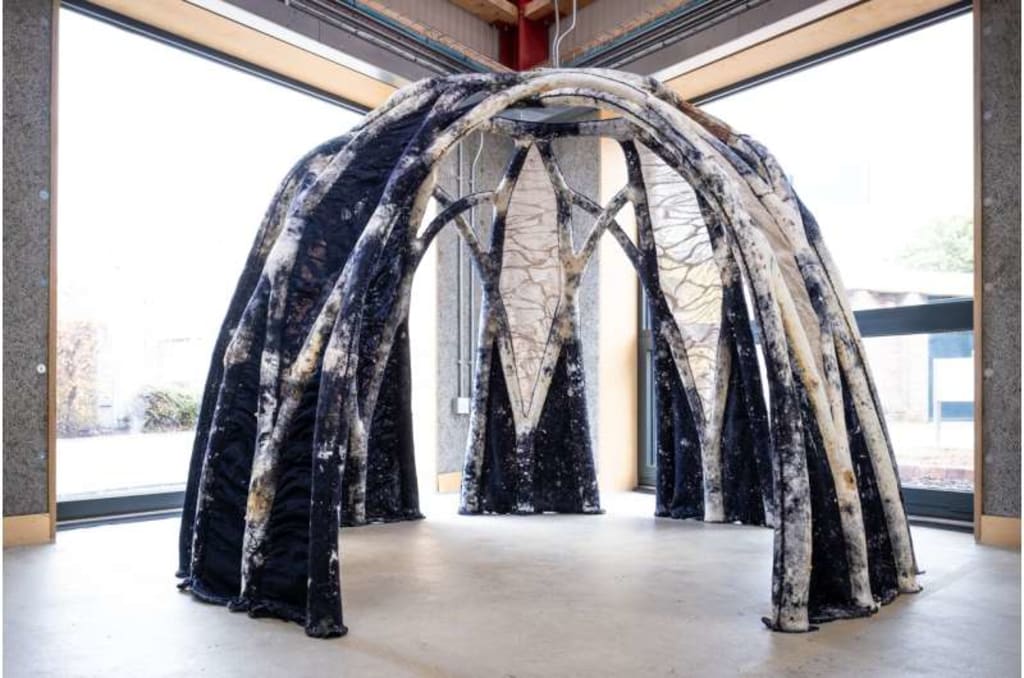
Researchers use fungi to create futuristic eco-building designs.
Scientists have discovered a way to create building materials using knitted moulds and the root system of fungi in an effort to lessen the environmental impact of the construction sector. Although similar composites have been the subject of previous research, the organic material's structure and growth restrictions have made it challenging to create a variety of uses that fully exploit its potential.
The scientists developed a composite material dubbed "mycocrete" that is stronger and more shape- and form-flexible using the knitted moulds as a flexible framework or "formwork," enabling the scientists to grow lightweight and more eco-friendly building materials.
Dr Jane Scott of Newcastle University is the corresponding author of the paper published in Frontiers in Bioengineering and Biotechnology. "Our ambition is to transform the look, feel, and well-being of architectural spaces using mycelium in combination with biobased materials such as wool, sawdust, and cellulose," she said.
A group of scientists, engineers, and designers from Newcastle University's Living Textiles Research Group, which is a component of the Hub for Biotechnology in the Built Environment and is supported by Research England, carried out the study.
Scientists combine mycelium spores with grains they can feed on and materials they can grow on to create composites using mycelium, a component of the root network of fungi. To allow the mycelium to grow and firmly bond the substrate together, this mixture is put into a mould and left in a warm, dark place.
It is dried out once it reaches the proper density, but before it begins to form the fruiting bodies that we refer to as mushrooms. This method might offer an affordable, environmentally friendly alternative to foam, wood, and plastic. However, as mycelium requires oxygen to develop, standard hard moulds are limited in size and shape, which also has an impact on the existing range of uses.
A potential solution is provided by knitted materials, which can be used to create moulds that can shift from flexible to stiff as the mycelium expands. However, fabrics sometimes have too much give, making it challenging to stuff the moulds consistently.
In order to fully utilise the potential of knitted forms, Scott and her colleagues set out to create a mycelium combination and a production method.
Scott declared that knitting is a remarkably adaptable 3D manufacturing technology. It is pliable, lightweight, and moldable. The capacity to knit 3D structures and forms without seams or waste is knitting technology's main advantage over other textile techniques.
The researchers created samples of traditional mycelium composite as controls and grew them alongside samples of mycocrete, which also included water, glycerin, xanthan gum, paper powder, and paper fibre clumps.
To increase packing consistency, this paste was made to be injected into the knitted formwork using an injection cannon; it had to be liquid enough to work with the delivery system but not too liquid to lose its shape.
To ensure that changes in fabric tension would not affect the performance of the mycocrete, the tubes for its intended test construction were knitted from merino yarn, sterilised, and fastened to a sturdy structure while they were filled with the paste.
constructing the future
Samples were put through tension, compression, and flexion strength testing after drying. The mycocrete samples outperformed mycelium composites grown without knitted formwork and were stronger than standard mycelium composite samples. Additionally, the samples grown in the formwork's porous knitted fabric had greater oxygen accessibility, and when they were dried, the samples shrank less than most mycelium composite materials do, indicating that more consistent and predictable manufacturing outcomes might be possible.
The flexible knitted form allowed the researchers to develop a larger proof-of-concept prototype structure called BioKnit, a complicated freestanding dome built in a single piece without seams that might end up being weak places.
A notable outcome and a step towards the usage of mycelium and textile biohybrids in construction, according to Scott, is the mechanical performance of the mycocrete utilised in conjunction with permanent knitted formwork. The specific yarns, substrates, and mycelium required to accomplish a particular task are listed in this document.
However, there is a lot of room to customise this composition for other uses. To integrate textiles into the structure, new machine technology may be needed for bio-fabricated architecture.
About the Creator
Keep reading
More stories from Francis Dami and writers in Fiction and other communities.
The Conspiracy Brains Here's How Theorists Differ From One Another
You don't have to search far in our hyperconnected society to find someone promoting conspiracy theories, from the classic Flat Earth movement to QAnon "truthers" and anti-vaccine fanatics. Friends and relatives are frequently shocked when someone slips into the dark world of conspiracies. After all, how can a once sensible person become convinced that dinosaurs don't exist? Psychology, though, may have a solution.
By Francis Dami2 years ago in Fiction




Comments
There are no comments for this story
Be the first to respond and start the conversation.